
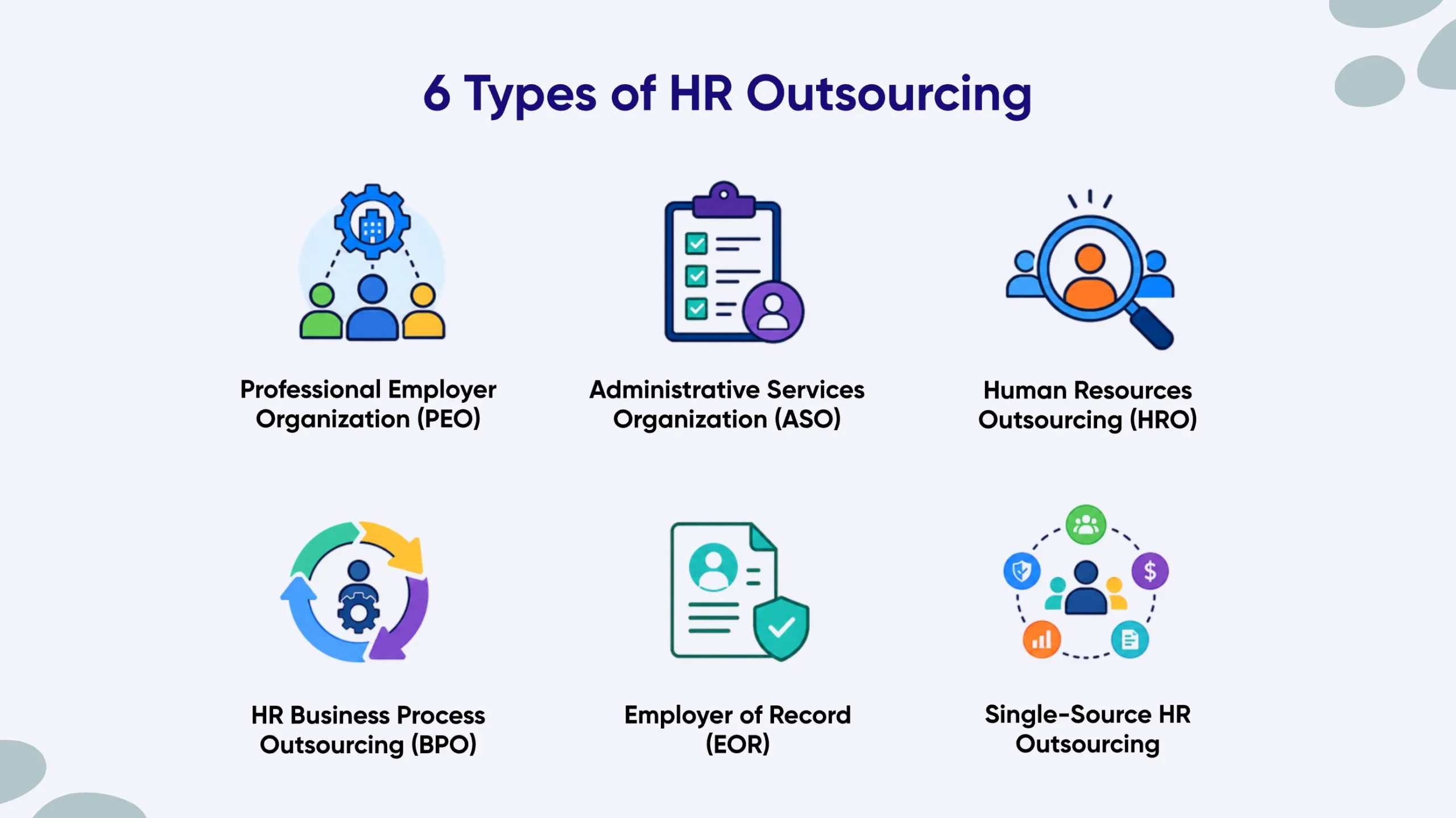
Types of HR outsourcing businesses can outsource include Professional Employer Organizations (PEOs), Administrative Services Organizations (ASOs), Selective Human Resources Outsourcing (HRO), HR Business Process Outsourcing (BPO), Employer of Record (EOR), and Single-Source HR Outsourcing. Each HRO model offers a different combination of employer control, service scope, and legal responsibility, making it important to select the option that aligns with the organization’s HR and operational requirements.
Beyond selecting an HR outsourcing model, businesses should also consider the scope of HR services they need and the factors that affect outsourcing decisions. Commonly outsourced functions include payroll, benefits administration, recruitment and hiring support, onboarding, HR compliance, employee relations, training, performance management, and HR reporting. Specific services vary by provider. Key considerations include HR support, employer control, workforce needs, budget, HR technology, and provider structure. A structured evaluation helps businesses choose the HR outsourcing model that best fits their operational and compliance needs.
6 types of HR outsourcing are:
| HR Outsourcing Model | Employer Control | Best For |
| Professional Employer Organization (PEO) | Shared responsibilities | Small and midsize businesses seeking comprehensive HR support |
| Administrative Services Organization (ASO) | Client retains employer responsibility | Businesses needing HR administration without PEO arrangement |
| Human Resources Outsourcing (HRO) | Client chooses outsourced HR functions | Organizations outsourcing selected or end-to-end HR activities |
| HR Business Process Outsourcing (BPO) | Provider manages defined HR processes | Businesses outsourcing standardized, high-volume HR operations |
| Employer of Record (EOR) | Acts as the legal employer for designated workers | Companies hiring employees where they do not have a legal entity |
| Single-Source HR Outsourcing | Depends on the services selected | Businesses wanting multiple HR services managed through one provider |
1. Professional Employer Organization (PEO)
A Professional Employer Organization (PEO) is an HR outsourcing model based on shared responsibilities. Under this joint arrangement, the PEO administers agreed employer-related functions such as payroll processing, payroll tax filings, employee benefits, workers’ compensation coverage and claims support, HR guidance, and HR technology. The client continues to direct employees and remains responsible for workplace operations and employment decisions. Depending on the PEO arrangement and applicable tax rules, payroll taxes may be reported using the PEO’s or client’s employer identification information.
According to the NAPEO, more than 230,000 U.S. businesses currently partner with a PEO, representing about 15% of all employers with 10 to 499 employees. PEO clients are in every state, with the highest concentrations in Florida (18%), California (16%), New York (9%), and Texas (8%). By pooling the employee bases of hundreds of client companies, a PEO leverages economies of scale to grant small and mid-sized businesses access to high-tier, enterprise-level health insurance, 401(k) plans, and supplemental benefits that would otherwise be cost-prohibitive.
2. Administrative Services Organization (ASO)
An Administrative Services Organization (ASO) is an HR outsourcing model in which a third-party provider manages selected administrative functions while the client company remains the sole legal employer of record. Unlike a Professional Employer Organization (PEO), an ASO does not operate under a co-employment model. Instead, businesses can choose à la carte services, allowing them to outsource only the HR functions they need while retaining full responsibility for employment taxes, compliance, and workforce management.
As a result, an ASO commonly provides payroll processing, benefits administration, HR compliance support, risk management, and employee administration, such as maintaining personnel records and onboarding documentation. This flexible model is well suited for businesses that want administrative support without changing their employer status. For instance, a manufacturing company with 75 employees may keep its existing health insurance plan and remain the legal employer while outsourcing payroll processing, HR administration, and compliance support to an ASO.
3. Human Resources Outsourcing (HRO)
Human Resources Outsourcing (HRO) is a type of HR outsourcing that allows businesses to outsource specific HR functions or their entire HR department to external specialists. Depending on the provider, services may include recruitment or hiring-process support, employee relations, training and development, performance management, and HR compliance support, while the company retains responsibility for functions outside the service agreement. This flexible approach helps businesses address specific HR needs without fully outsourcing their HR operations.
This model is ideal for businesses that need specialized HR expertise without expanding their internal HR team. Consider a software company experiencing rapid growth. As its workforce increases, the company outsources employee relations and HR compliance to a human resources outsourcing service while continuing to manage recruitment and talent development in-house. This targeted approach fills skill gaps, improves HR efficiency, and supports compliance with employment regulations.
4. HR Business Process Outsourcing (BPO)
Businesses use HR Business Process Outsourcing (BPO), a type of HR outsourcing, to delegate specific, repeatable HR processes to a third-party provider. Depending on the provider, outsourced processes may include payroll processing, recruitment or hiring-process support, onboarding, benefits administration, and employee record management. Service delivery is based on predefined workflows and agreed service level agreements (SLAs), ensuring consistent execution, standardized processes, and measurable performance across HR operations.
By delegating complete business processes to dedicated experts, enterprises achieve significant cost predictability, standardized global practices, and continuous process improvements. The model allows corporate leadership to redirect valuable internal capital and bandwidth away from transactional back-office mechanics and toward core revenue-driving activities. It is best suited for enterprise-level organizations or multi-location companies seeking to streamline large-scale HR operations through a single accountable partner.
5. Employer of Record (EOR)
An Employer of Record (EOR) is a third-party provider that legally employs workers on behalf of another company. Under this arrangement, the EOR assumes responsibility for payroll, tax withholdings, employee benefits, employment contracts, and compliance with local labor laws, while the client company retains responsibility for managing the employee’s daily work, performance, and business objectives. This division of responsibilities makes the model well suited for businesses hiring across international markets.
For companies expanding globally, an EOR eliminates the need to establish a local legal entity before hiring employees. For example, a US-based software company can hire a developer in Germany through an EOR. The EOR manages payroll, taxes, benefits, employment contracts, and local compliance, while the company’s managers continue to oversee the employee’s projects and day-to-day responsibilities.
6. Single-Source HR Outsourcing
Single-Source HR Outsourcing is an HR outsourcing model in which a single provider manages multiple HR functions through an integrated service offering. Services may include Human Resources Outsourcing (HRO), HR Business Process Outsourcing (BPO), Administrative Services Organization (ASO), payroll processing, benefits administration, HR compliance, and HR technology solutions. The level of employment responsibility depends on the underlying service model selected, such as ASO or PEO.
Side Note: Software as a Service (SaaS) is not technically a form of HR outsourcing because the responsibility for performing HR functions remains with the employer. However, HR technology can significantly reduce the administrative burden on an internal HR team by automating processes, centralizing employee information, and improving efficiency. Unlike a PEO or other HR outsourcing provider, SaaS is primarily a technology solution—the employer continues to perform and oversee the HR work rather than relying on a dedicated service partner. The benefit to a PEO is that it provides both the technology and the dedicated service.
By blending modern cloud software with dedicated human expert support across the entire employment lifecycle, single-source outsourcing helps foster seamless data flow between payroll, benefits, and HR administration. This helps reduce double-entry errors and streamlines compliance management across all employee touchpoints. It is ideal for mid-sized organizations seeking to simplify their technology stack and human resource partnerships into a single, fully aligned relationship.
What HR functions are outsourced?
HR functions that can be outsourced or supported by an external provider include payroll, benefits administration, recruitment and hiring support, and onboarding. Outsourcing these HR functions helps organizations improve operational efficiency, access specialized expertise, and reduce administrative workloads.
9 major HR functions that can be outsourced are:
1. Payroll
Outsourcing payroll transfers complex operations, including managing wage calculations, tax withholdings, direct deposits, and year-end W-2/1099 forms, to specialized external processing teams. Third-party providers use specialized payroll technology and standardized processes to help minimize processing errors and reduce the risk of penalties associated with missed deadlines or changing tax requirements. Outsourcing payroll also reduces the administrative burden on internal teams while supporting accurate wage-garnishment administration, timely filings, and regulatory compliance.
2. Benefits administration
Benefits administration is a commonly outsourced HR function that covers employee benefits enrollment, carrier coordination, eligibility tracking, and regulatory compliance. It includes managing health insurance, retirement plans (401(k)), open enrollment, and compliance with regulations such as COBRA and the Affordable Care Act (ACA). Outsourcing this function to an HRO provider helps organizations maintain accurate benefits administration, streamline employee benefit processes, and support compliance with applicable regulations.
3. Recruitment
Recruitment and hiring support varies by HR provider. Some recruitment and staffing providers handle candidate sourcing, screening, interviewing, and shortlisting. Other HR providers support the hiring process through technology, administrative services, and best-practice guidance while leaving hiring decisions with the employer. Optimum HR does not recruit, source, interview, or select candidates. Instead, it provides applicant tracking technology, background-check administration, job-description support, templates, and hiring best-practice guidance, while clients remain responsible for recruiting, interviewing, and selecting candidates.
4. Onboarding
Many businesses outsource onboarding to streamline the process of integrating new employees into the organization. An external HR provider manages employment paperwork, new hire orientation, training, and compliance documentation, creating a consistent onboarding experience while reducing administrative work. Providers may supply electronic onboarding technology, employment forms, payroll setup, and administrative support. The employer remains responsible for orientation, workplace access, role-specific training, supervision, and cultural integration.
5. HR compliance
HR compliance is one of the key HR functions organizations outsource to help meet legal and regulatory requirements related to employment. Outsourced compliance services cover payroll tax filings, wage and hour compliance, benefits administration, and employment documentation, helping businesses meet regulatory requirements. For example, a manufacturing company may have an HR provider manage payroll tax filings and benefits administration while the employer retains ultimate legal responsibility for complying with employment laws and workplace regulations.
6. Employee relations
Organizations often outsource employee relations to improve workplace communication and address employee concerns objectively. Services may include grievance handling, policy development, workplace investigations, conflict resolution, and employee engagement support, helping employers manage workplace issues with specialized expertise. Depending on the service agreement, an outsourced HR team may be able to investigate an employee grievance and recommend corrective actions while the employer retains decision-making authority.
7. Training
Many organizations rely on external providers to deliver employee training and development programs. These programs commonly include new hire onboarding, compliance training, and leadership development, giving businesses access to specialized expertise and scalable learning solutions. One practical example is a financial services company that relies on an external provider to deliver compliance training and leadership workshops, allowing its HR team to focus on employee development strategies.
8. Performance management
Among the HR functions that organizations outsource, performance management helps improve the way employee performance is measured, documented, and developed. To support this process, outsourced HR providers may manage performance reviews, goal tracking, feedback, and improvement plans through standardized processes and digital platforms. They may also help establish performance frameworks, define key performance indicators (KPIs), support manager evaluations, identify training and development needs, and maintain consistent performance documentation to support employee development and organizational objectives.
9. HR reporting
HR reporting is another HR function that organizations outsource to gain accurate workforce data and support informed decision-making. Outsourced HR providers generate reports such as payroll summaries, benefits usage, and compliance audits, helping businesses improve reporting accuracy, meet regulatory requirements, and monitor HR performance. A multi-location retail company uses outsourced HR reports to review payroll costs, monitor employee benefits, and prepare for compliance audits across all locations. These reports also help organizations identify workforce trends, measure key HR metrics, and support strategic planning through reliable, data-driven insights.
Which Factors Determine the Right HR Outsourcing Model?
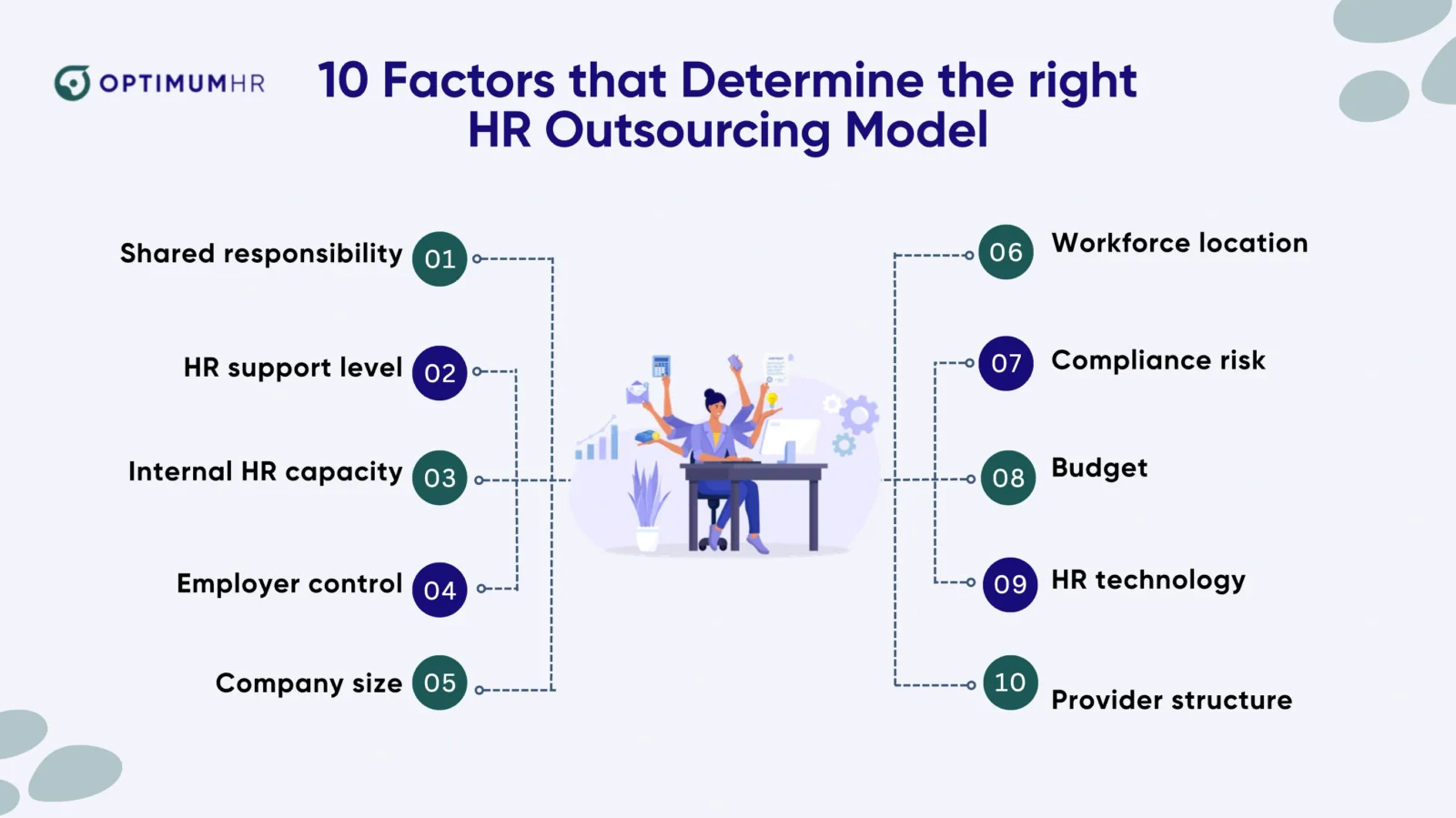
The factors that determine the right HR outsourcing model include the level of HR support required, internal HR capacity, employer control, company size, workforce location, compliance risk, budget, HR technology requirements, and provider structure. Evaluating these components helps organizations select an HR outsourcing model that aligns with their operational needs, workforce goals, and compliance responsibilities.
10 factors that determine the right HR outsourcing model are:
1. Shared responsibility
Shared responsibility is a key factor in choosing the right HR outsourcing model because it determines whether an organization is willing to share certain employer responsibilities with an HR provider. PEOs operate under an arrangement with shared responsibilities for payroll, employee benefits, and HR compliance, while ASOs and HR BPOs allow employers to retain full legal responsibility. Understanding this distinction helps organizations select a model that aligns with their preferred level of employer control, compliance responsibilities, and HR support needs.
2. HR support level
HR support level is an important factor in selecting the right HR outsourcing model because it determines the extent of assistance an organization needs from an external provider. ASOs primarily provide administrative support, such as payroll and benefits administration, PEOs offer comprehensive HR support through a shared responsibility arrangement, and HRO providers can manage selected or end-to-end HR functions, including strategic HR services. Choosing the appropriate support level helps organizations align HR services with their operational requirements and business goals.
3. Internal HR capacity
When choosing the right HR outsourcing model, organizations should evaluate the size, experience, and expertise of their internal HR team. Businesses with sufficient in-house HR resources require support for only specific functions, while those with limited HR capacity often need broader assistance to manage day-to-day HR operations, compliance, and workforce administration. As a result, organizations can select an outsourcing model that complements their existing HR capabilities and operational needs.
4. Employer control
One factor in choosing the right HR outsourcing model is the level of employer control an organization wants to retain over HR functions and employment decisions, since each outsourcing model offers a different balance of employer responsibility and provider involvement. Organizations that prefer greater control often choose ASOs or HRO providers, while those seeking broader HR support may opt for a PEO, which shares certain employer responsibilities.
5. Company size
To choose the right HR outsourcing model, organizations should consider company size, as it influences the level and complexity of HR support required. Smaller businesses often benefit from comprehensive solutions such as PEOs, while mid-sized and large organizations use ASOs or HRO providers to supplement existing HR resources with specialized or scalable services. Matching the outsourcing model to company size helps HR support align with business needs and growth plans.
6. Workforce location
When choosing an HR outsourcing model, organizations should consider where their employees are located, as workforce location can affect payroll administration, tax requirements, employment laws, benefits, and HR compliance obligations. For example, a U.S.-based company with employees across multiple states may benefit from an HR provider with experience supporting multi-state payroll and navigating state-specific employment requirements. Businesses with employees outside the United States may need a different solution, such as an Employer of Record (EOR), depending on the countries involved and their legal entity structure.
7. Compliance risk
When selecting the right HR outsourcing model, organizations should assess compliance risk because employer liability can remain with the business even when HR tasks are outsourced. Key risks include payroll tax errors, wage and hour violations, worker misclassification, benefits non-compliance, and data privacy breaches. Clear service agreements, regular audits, and provider oversight help reduce compliance risks.
8. Budget
Available budget is an important factor in determining the right HR outsourcing model, as it influences the level and scope of HR services an organization can outsource. The scope of outsourced services often depends on the financial resources available. For example, a company with a limited budget may choose an ASO for payroll administration, while a business with greater resources may adopt a PEO or comprehensive HRO for broader HR support.
9. HR technology
HR technology capabilities are an important consideration when selecting an HR outsourcing provider, since they determine how efficiently HR tasks are automated and managed. Cloud-based HRIS platforms, payroll software, benefits administration tools, and employee self-service portals automate routine tasks such as onboarding, time-off requests, and pay stub access while enabling businesses to retain daily HR decision-making. Organizations should prioritize secure, user-friendly solutions that integrate with existing systems.
10. Provider structure
When choosing an HR outsourcing partner, provider structure is an important consideration because it defines how HR services, legal responsibilities, and administrative support are shared. HR outsourcing providers operate as PEOs, ASOs, or HRO/BPO providers, with each model differing in compliance responsibilities, liability, and service delivery. Understanding the provider structure helps businesses select a solution that meets their operational and compliance needs.
How Should Businesses Choose an HR Outsourcing Model?
Businesses should choose an HR outsourcing model by identifying HR gaps, defining the required service scope, evaluating employer control needs, matching the model to workforce requirements, comparing available options, and selecting the solution that best aligns with their business goals. Following a structured evaluation process helps organizations select an outsourcing model that supports their operational, compliance, and workforce requirements.
7 steps businesses should follow to choose an HR outsourcing model are:
Step 1: Identify HR gaps
Begin by identifying HR gaps within your organization to understand where additional support is needed. Assess current HR processes, staffing capacity, and compliance requirements to identify capability, process, or resource gaps before evaluating outsourcing options.
Step 2: Define the service scope
Once HR gaps have been identified, define the scope of HR services to outsource, such as payroll, benefits administration, compliance, or recruitment, based on business priorities and internal capabilities. This step helps outsourced services align with organizational needs and strategic objectives.
Step 3: Decide what level of shared responsibilities is needed
After defining the required services, determine whether your business needs the shared responsibilities arrangement of a PEO. This decision influences whether a PEO or another HR outsourcing model is the most appropriate option based on legal responsibilities and HR support requirements.
Step 4: Set employer control requirements
After deciding how employer responsibilities should be shared, establish the level of control your business wants to retain over HR functions. Determine whether strategic and day-to-day HR decisions should remain in-house or whether selected administrative responsibilities can be delegated to the provider.
Step 5: Match the model to workforce needs
With your service and control requirements established, evaluate which HR outsourcing model best supports your workforce. Consider workforce size, business growth, compliance complexity, and employee support needs to identify the model that aligns with both current operations and future business plans.
Step 6: Compare model tradeoffs
Compare differences in cost, compliance support, employer control, service scope, and administrative responsibilities to identify the option that provides the best overall fit. Before making a final decision, weigh the strengths and limitations of each HR outsourcing model against your business priorities.
Step 7: Select the matching HR outsourcing model
After completing your evaluation, choose the HR outsourcing model that best aligns with your operational requirements and long-term business goals. Base your decision on identified HR gaps, service needs, workforce requirements, control preferences, and model tradeoffs, and consult an HR expert if additional guidance is needed.
For businesses evaluating HR outsourcing options, Optimum HR provides Professional Employer Organization (PEO) services designed for small and midsize employers across the United States. Through its PEO model, Optimum HR helps organizations manage payroll administration, employee benefits, HR compliance support, workers’ compensation administration, risk management, and HR technology while businesses continue directing their employees, managing daily operations, and making business decisions. Optimum HR provides compliance guidance and administrative support while clients remain responsible for their workplace operations and employment decisions.