
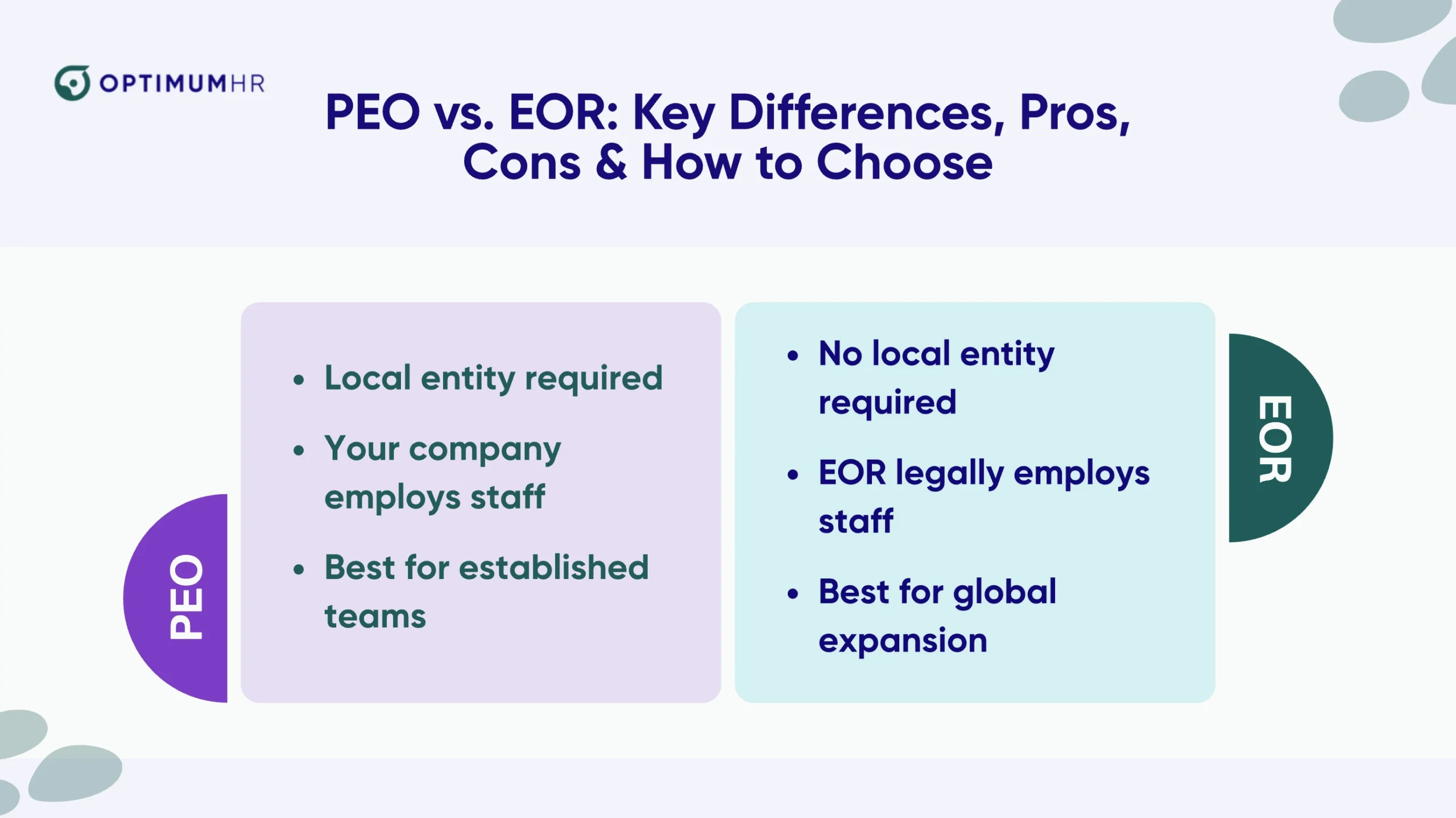
A Professional Employer Organization (PEO) supports businesses registered in the United States by handling HR functions like payroll, benefits, and compliance, whereas an Employer of Record (EOR) becomes the legal employer of your workers, allowing you to hire in countries where your business has no legal entity. While both models handle HR work, they serve distinct needs.
A PEO provides administrative support across all 50 states, allowing you to hire anywhere in the U.S. without additional setup while enabling you to retain full control over hiring, employee management, and day-to-day operations. In contrast, an EOR enables international expansion by acting as the legal employer in foreign markets. However, this global reach comes with trade-offs, including less direct control over the employment relationship and significantly higher service costs.
Ultimately, if your workforce remains entirely within the United States, a PEO is almost always the simpler, more cost-effective choice. If you need to hire internationally, an EOR fills a critical gap that a PEO cannot.
What Is a PEO?
A PEO is a specialized human resources firm that helps businesses, including small and medium-sized businesses (SMBs), outsource key administrative functions while retaining full control over their workforce and daily operations. Depending on the service agreement, a PEO may manage payroll and tax administration, employee benefits, workers’ compensation support, HR guidance, and compliance assistance.
In addition to these HR services, a PEO is registered and licensed to operate in all 50 states, giving your business the ability to hire and manage employees anywhere in the U.S. without having to register separately in each new state. This makes a PEO a practical choice whether you are hiring in a single state or expanding your workforce nationwide, as long as your employees are based within the United States.
What Is an EOR?
An EOR is a third-party company that acts as the sole legal employer of your workers. This setup allows you to hire employees in foreign markets where your company lacks a registered legal entity, thus eliminating the additional cost and complexity of establishing foreign local subsidiaries.
However, that international reach comes with trade-offs. Because the EOR holds the official employment agreement and is responsible for the associated legal and compliance liabilities, you give up some direct control over the underlying employment relationship, even though you continue to direct daily work. Ultimately, an EOR is a targeted tool for global expansion, so for hiring anywhere within the U.S., a PEO remains the simpler, more cost-effective choice.
PEO vs. EOR at a Glance
A PEO helps businesses hire and manage workers across all 50 U.S. states while allowing you to remain the legal employer and retain full control over hiring, HR policies, and daily management, whereas an EOR becomes the legal employer to enable hiring in countries where your business has no legal entity. Because an EOR absorbs international compliance risks and manages legal employment relationships abroad, it costs $300-$600+ per employee per month, making it best for global expansion, while a PEO provides a simpler, more cost-effective U.S.-focused solution at roughly $100-$150 per employee per month.
Here is a table highlighting the major differences between PEO and EOR:
| Factors | PEO | EOR |
| Where you can hire | Any of the 50 U.S. states | Countries where your business has no legal entity |
| Legal employer | Your business | The EOR |
| Who’s in control | You keep control of hiring, HR policy, and daily management | You keep day-to-day direction, but the EOR controls the legal employment relationship |
| Typical cost | About $100-$150 per employee per month | About $300-$600+ per employee per month |
| Best for | Businesses hiring only within the U.S. | Businesses that need to hire where they have no legal entity |
Where You Can Hire: States vs. Countries
A PEO lets you hire anywhere across the United States, whereas an EOR enables you to hire in foreign countries where it maintains its own legal entities. To utilize a PEO, your business must already be registered as a U.S. company. From there, partnering with an established PEO like Optimum HR, which is registered and licensed in all 50 states, allows you to seamlessly add employees nationwide without any extra setup or state-by-state paperwork.
An EOR operates on a completely different model. It does not require your business to hold a legal registration where the employee lives. Instead, the EOR hires the worker on your behalf through its own local entity in that country. While this structure is ideal for international expansion, it is unnecessary for domestic hiring, as a PEO already provides full coverage across all 50 U.S. states.
Who’s in Control: PEO vs. EOR
With a PEO, your business remains a legal employer, while with an EOR, you transfer that legal status to a third party. With a PEO, you retain control over hiring, terminations, workplace policies, and day-to-day employee management. The PEO acts as an HR partner by handling payroll, benefits, compliance, and HR guidance while your business continues to make all workforce and operational decisions.
In contrast, an EOR changes the employment relationship because the EOR becomes the legal employer. While you continue to direct employees’ day-to-day work, the EOR holds the employment contract and assumes responsibility for many legal, compliance, and HR-related obligations. As a result, a PEO is the better choice if you are hiring within the U.S. and want to retain full control, whereas an EOR is the right solution when you need to hire in countries where your business does not have a legal entity.
What Each Option Costs
A PEO costs $100 to $150 per employee per month, with pricing varying based on factors such as employee count, benefits selected, workers’ compensation exposure, and the scope of services provided. Because a PEO supports your business rather than serving as the legal employer, it is generally the more cost-effective option for U.S.-based hiring.
An EOR costs $300 to $600 or more per employee per month because it assumes the legal responsibilities associated with employing your workforce in countries where your business has no legal entity. Actual pricing varies by provider and country, so these figures should be treated as general estimates rather than fixed rates.
Compliance and Liability
Under a PEO, compliance responsibility is shared, while with an EOR, the service provider assumes primary responsibility for the formal, statutory side of employment. In a PEO model, the provider manages payroll tax filings, benefits administration, and much of the regulatory paperwork under its own tax ID, while your business remains actively responsible for workplace decisions and day-to-day compliance.
Under an EOR model, the provider handles tax filings, employment agreements, and labor-law compliance in the country where the worker is based. That said, your business can still retain some legal exposure depending on its own decisions, workplace practices, and the terms of the service agreement. An EOR reduces this exposure, but it does not erase it entirely.
How Do PEO and EOR Compare Across Key HR Functions?
The differences between a PEO and an EOR across key HR functions lie in who serves as the legal employer, where you can hire, payroll, employee benefits, compliance, and employment agreements. The table below provides a side-by-side comparison of these key HR functions to help you determine which solution best aligns with your hiring and workforce management needs.
| HR Function | PEO | EOR |
| Legal employer | Your business | The EOR |
| Where you can hire | All 50 U.S. states | Countries where you have no legal entity |
| Payroll | Manages payroll and taxes | Manages payroll and taxes |
| Employee benefits | Access to PEO-sponsored benefit plans | Provided under the EOR’s own plans |
| Compliance | Shared with your business | Primarily handled by the EOR |
| Employment agreements | Issued through your company | Issued by the EOR |
| Best for | U.S. businesses, including multi-state teams | International hiring without a foreign entity |
What Are the Pros and Cons of a PEO?
Pros of a PEO include access to enterprise-level employee benefits, outsourced payroll, tax, and HR administration, workers’ compensation and risk management support, dedicated HR guidance, and the ability to hire across all 50 U.S. states through one provider. Drawbacks are limited but include domestic-only hiring, shared HR and compliance responsibilities, and potential additional fees for benefits, workers’ compensation, or compliance support. Overall, a PEO is a cost-effective solution for U.S. hiring if you accept its shared-responsibility model and do not require international hiring capabilities.
PEO Pros
- Access to enterprise-level benefits: Competitive health insurance and retirement plans that would otherwise be hard for a smaller business to get on its own.
- Payroll, tax, and HR administration handled for you: Payroll processing, tax filings, and day-to-day HR administration, without adding headcount internally.
- Workers’ compensation and risk support: Help managing workplace injury claims, safety programs, and coverage.
- Dedicated HR guidance: Access to HR professionals for employment practices, compliance questions, and workforce management.
- Full coverage across all 50 states: One relationship gives you HR support wherever you hire in the U.S.
PEO Cons
- Limited to domestic hiring: A PEO supports hiring anywhere in the U.S., but not internationally, so businesses expanding abroad need a foreign entity or an EOR.
- Some responsibilities are shared: Certain HR and compliance decisions are split between your business and the PEO, based on your service agreement.
- Additional service costs: Some providers charge separately for things like health insurance, workers’ compensation, or compliance consulting, which can add to the base fee.
What Are the Pros and Cons of an EOR?
Pros of an EOR include the ability to hire internationally without setting up a foreign legal entity, faster onboarding, and handling of employment contracts, payroll, taxes, and compliance with local labor laws and benefits. However, EORs can be more expensive per employee, offer less control over HR policies and benefits, and may reduce employee integration with company culture. They can also become less cost-effective as international operations grow. Overall, EORs are best for companies needing quick global expansion without the complexity of establishing local entities.
EOR Pros
- No foreign entity required: Hire in a country where your business has no legal presence, without setting one up first.
- Fast onboarding: International employees can typically be onboarded in a matter of days rather than weeks.
- The EOR takes on legal-employer responsibilities: Includes employment agreements, payroll, and tax filings in that country, subject to the service agreement.
- Simplified international compliance: The EOR manages local labor law, payroll, and statutory benefits across the countries where it operates.
EOR Cons
- Higher cost per employee: Commonly $300 to $600 or more per employee per month.
- Less control over HR policy and benefits: The EOR’s structure limits how much you can customize employment terms.
- Less integration with company culture: Employees are legally employed by the EOR, which can make full integration into your team more difficult.
- Less cost-effective long-term: An EOR is well suited to entering a market quickly, but a business planning a large, permanent presence in a country may find its own legal entity more cost-effective over time.
What Are the Best Use Cases for PEO vs. EOR?
A PEO is ideal for businesses that are already established in the United States and want to streamline payroll, benefits, and compliance while retaining full control over their workforce, whereas EOR is designed for businesses that need to hire internationally without establishing a legal entity, making it the better option for entering new markets quickly and compliantly. The best choice between a PEO and an EOR depends on where you plan to hire and the level of HR support you need.
PEO Use Cases
A PEO is the right fit for a business that is already registered in the U.S. and wants help with payroll, benefits, and HR compliance, whether that business hires in one state or many. For example, a software development company based in California can use a PEO to manage payroll taxes, health insurance, workers’ compensation, and employment law compliance for employees working in California and several other states, all through one relationship.
EOR Use Cases
An EOR is the right fit when a business needs to hire in a country where it has no legal entity. For example, a manufacturing company expanding into Europe can use an EOR to legally employ staff in Germany or France without setting up a foreign subsidiary, useful for testing a new market or making a small number of international hires quickly.
How to Choose Between a PEO and an EOR?
To choose between a PEO and an EOR, consider why you are hiring, how much control you want to keep, what you need for employee benefits, your budget, and whether you need a long-term or short-term hiring solution. Each of these factors can significantly influence which model is the better fit for your business, helping you align cost, compliance, operational control, and your overall growth strategy.
5 Factors to Consider When Choosing Between a PEO and an EOR:
1. Where are you hiring?
Your physical hiring location is the primary decision driver. If you are hiring anywhere within the United States, a PEO provides full coverage, for instance, partnering with Optimum HR enables you to hire employees in all 50 states without the administrative burden of separate state-by-state registration. Conversely, if you need to hire talent in a foreign country where your company lacks a registered corporate entity, an EOR provides the global legal infrastructure required to employ workers locally.
2. How much control do you want to keep?
Consider how much authority you want to retain over the employer-employee relationship. With a PEO, your business remains the legal employer, ensuring you keep direct control over hiring, terminations, company policies, and daily management. An EOR, by contrast, becomes the legal employer on record, which means you delegate underlying compliance decisions and employment contract ownership to the provider while maintaining direction over daily duties.
3. What do you need for employee benefits?
Access to competitive perks often determines your ability to win top talent. A PEO leverages aggregated purchasing power across all its client companies to unlock high-grade, enterprise-level health insurance, 401(k) plans, and wellness perks at accessible rates. An EOR also manages benefits, but those offerings are typically standardized to match local statutory requirements within each specific country.
4. What’s your budget?
Pricing models reflect the scope of risk each provider assumes. A PEO costs between $100 and $150 per employee per month, providing an economical outsourcing partnership for domestic teams. An EOR costs $300 to $600+ per employee per month, with higher pricing accounting for the substantial legal liability, foreign tax obligations, and statutory oversight the provider assumes on your behalf.
5. Is this a long-term presence or a quick entry?
Align your strategy with your long-term goals in a given location. An EOR is an exceptional vehicle for agile market entry, allowing you to test new foreign regions or quickly onboard small international teams without heavy upfront investment. However, if you plan to build a large, permanent workforce in a foreign country over time, establishing your own foreign subsidiary may eventually prove more cost-effective than paying ongoing EOR administrative fees.
How Optimum HR Fits In
If your hiring strategy is focused on hiring within the United States, whether in a single state or across all 50, Optimum HR’s PEO services are designed to support your growth. Because we are fully registered and licensed across all 50 states, your business can seamlessly expand into new regions without the burden of additional state registrations or navigating complex state-by-state paperwork.
Our dedicated team handles payroll and tax administration, employee benefits, workers’ compensation, HR guidance, compliance support, and HR technology, while you retain full control over your business and day-to-day workforce management.
To explore whether a PEO is the right fit for your growth strategy, call Optimum HR at (888) 466-5521 or visit optimumhr.net to speak directly with our team.