
What is a PEO?
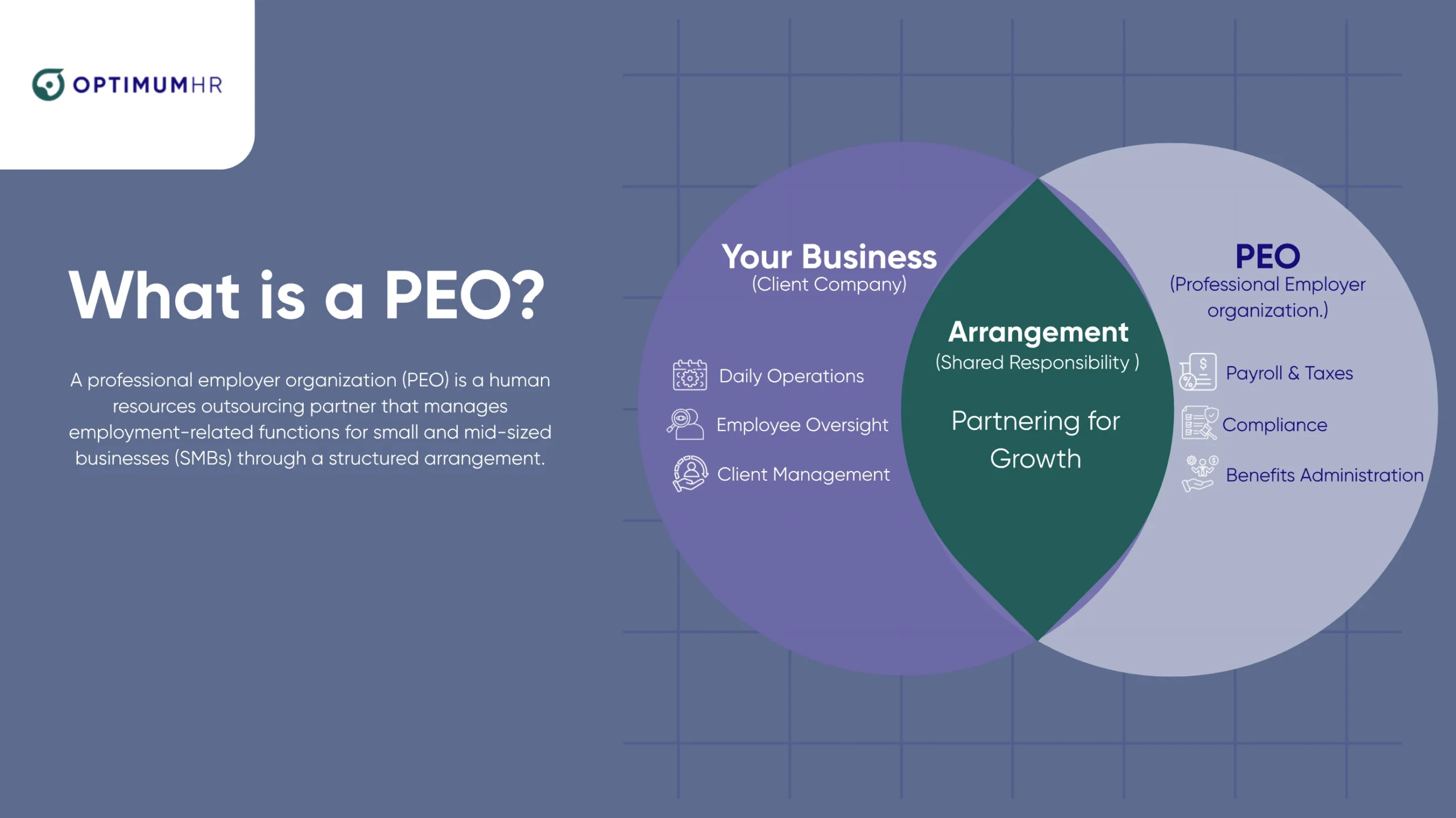
A professional employer organization (PEO) is a human resources outsourcing partner that manages employment-related functions for small and mid-sized businesses (SMBs) through a structured arrangement. In this arrangement, the business retains control over daily operations, while the PEO handles critical HR administration, including payroll processing, employee benefits, compliance management, and employment taxes.
Categories of PEOs include full-service PEOs, Administrative Services Organizations (ASOs), and Certified PEOs (CPEOs), each offering varying levels of HR support, compliance oversight, and employee benefits. Core services include payroll processing, benefits administration, risk mitigation, and access to pooled resources for enterprise-level health, retirement, and insurance plans.
By managing onboarding, tax filings, and benefits, PEOs reduce administrative workload, enhance HR expertise, lower costs, and improve employee satisfaction. Industries such as technology, healthcare, construction, and manufacturing can leverage these services without building large internal HR teams. PEOs address challenges like talent acquisition, compliance, administrative inefficiencies, and turnover, allowing businesses to focus on strategic growth, optimize workforce performance, and maintain operational control, providing a scalable and efficient HR solution.
What Are the Different Types of PEO?
Different types of PEOs include full-service PEOs, administrative services organizations (ASOs), and certified PEOs (CPEOs). Each PEO model offers a different level of human resource outsourcing, compliance support, and administrative control. These differences determine how the PEO handles payroll processing, employee benefits, and employment-related compliance for a business.
3 types of PEO are:
What Services Does a PEO Provide?
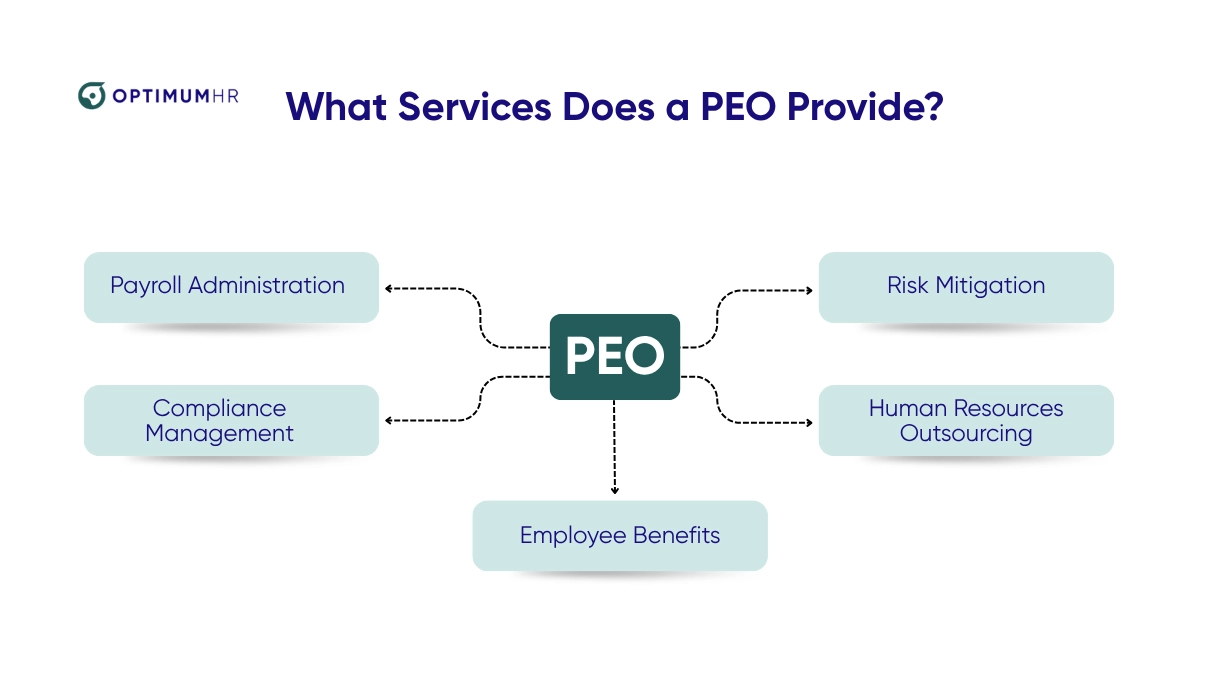
PEO provides payroll administration, compliance management, risk mitigation, human resources outsourcing, and employee benefits, allowing businesses to focus on growth while delegating complex HR tasks to a specialized partner. These services help mitigate employer liability while providing SMBs with the sophisticated HR infrastructure reserved for enterprise-level corporations.
5 core PEO services are:
How Does a PEO Work?
A PEO works by partnering with a business to take over HR administrative tasks such as payroll, tax compliance, benefits administration, and workers’ compensation. The client company retains operational control over daily activities, while the PEO manages employee-related liabilities, provides access to better benefits rates, and streamlines HR processes to reduce administrative burdens.
The working mechanism of a PEO includes:
- Employment Administration & Operational Oversight: The PEO assumes certain employer responsibilities, including payroll and employment tax administration under its own FEIN, while the client retains day-to-day operational control and authority over hiring, termination, compensation, work assignments, and employee management.
- Payroll and Tax Management & Tax Integration: The PEO processes payroll, issues paychecks, and files federal, state, and local taxes under its own FEIN, reducing errors and administrative workload.
- Benefits Administration & Pooled Purchasing: By combining employees across clients, the PEO secures Fortune 500-level health and retirement benefits at lower rates while managing enrollment and reporting.
- Risk and Compliance & Liability Sharing: PEOs manage workers’ compensation, assist with employment law compliance (e.g., FMLA, EEO-1), and contractually assume certain risks, providing legal protection for the business.
- Costs: Services are typically charged as a percentage of payroll or as a flat fee per employee per month, enabling predictable budgeting.
What Are the Key Benefits of Using a PEO?
Key benefits of using a PEO include enhanced HR expertise, improved employee benefits, expert HR support, workers’ compensation coverage, retirement options, regulatory compliance, and cost savings. These PEO benefits streamline HR operations, reduce administrative burdens, and provide access to enterprise-level services unavailable to SMBs, enabling focus on growth while maintaining compliance and efficiency.
7 key benefits of using a PEO are:
PEOs vs. In-House Models
PEOs provide outsourced HR services for payroll, benefits, and compliance, whereas in-house models maintain direct control over HR functions and rely on internal staff management. Each approach offers unique advantages in cost, compliance, scalability, and administrative workload based on the company’s size and HR needs. Businesses can choose between leveraging a PEO’s expertise and shared resources or retaining full internal control to tailor HR operations to their specific culture and strategic goals.
The following is the table highlighting major differences between PEOs vs. In-house models:
| Features | PEO Model | In-House HR Model |
| HR Expertise | Access to certified HR professionals with experience across industries | Limited to in-house staff knowledge |
| Employee Benefits | Enterprise-level benefits at lower costs due to pooled purchasing power | Offer limited benefits due to higher costs |
| Scalability | Easily scales with business growth and multi-state operations | Scaling requires hiring more HR staff and additional systems |
| Administrative Burden | PEO handles routine HR, payroll, and benefits administration | Business owners/managers handle all administrative tasks |
| Cost Structure | A percentage of payroll or a per-employee monthly fee | Fixed salaries for HR staff plus software and administrative costs |
| Risk Exposure | Shared liability for payroll and compliance | Business bears full responsibility for errors and compliance issues |
What Kinds of Businesses Benefit from PEOs?
Businesses benefiting from PEOs include growing startups, small-sized businesses, and mid-sized businesses. By partnering with PEOs, these businesses gain access to professional HR services, streamlined payroll and compliance management, and cost-effective employee benefits through a single provider without relying on a large in-house HR team.
Growing Startups
Growing startups benefit from PEOs by gaining an immediate, plug-and-play HR infrastructure that scales alongside their hiring velocity. For a startup, the main benefits include the ability to offer elite benefits packages that attract top-tier talent away from established tech giants and the peace of mind that employment contracts and equity-related payroll tasks are legally compliant. This allows founders to focus on product development and fundraising rather than getting bogged down in the minutiae of state-level labor laws and payroll setup.
Small-sized Businesses
PEOs benefit small businesses with fewer than 50 employees by offering a cost-effective alternative to hiring full-time HR staff, while lowering health insurance premiums through pooled purchasing power. Small business owners save significant administrative time as the PEO manages workers’ compensation claims, payroll processing, and annual tax filings, reducing the risk of compliance errors and administrative burden. Additionally, PEOs provide access to professional HR guidance, help implement standardized policies, and offer employee training support, strengthening workforce management.
Mid-sized Businesses
Mid-sized businesses use PEOs to streamline their operations and manage the complexities of a multi-state workforce. As a company grows, it faces stricter regulations, such as the Affordable Care Act (ACA) and various state-specific leave mandates, and a PEO ensures full compliance across all jurisdictions. The main benefits for mid-sized firms include enhanced data analytics for workforce planning, professionalized training and development programs, and reduced per-employee benefits costs, which can save the company tens of thousands of dollars annually.
Which Industries Benefit Most from Using a PEO?
Industries that benefit the most from using a PEO include engineering, architecture, life sciences, logistics, manufacturing, real estate, healthcare, and software development. By leveraging a PEO, these industries gain access to expert HR support, streamlined payroll and compliance management, and enhanced employee benefits. Here is how PEO benefits different industries:
- Architecture: Handles licensing compliance, aligns payroll with projects, and supports retention of design professionals.
- Electricians: Oversees licensing, enhances job-site safety, and streamlines mobile technician payroll.
- Engineering: Tracks certifications, manages project-based staffing, and ensures safety and labor compliance.
- Healthcare: Tracks credentials, administers benefits, and ensures labor law compliance for clinical staff retention.
- HVAC: Tracks certifications, manages field payroll, and reduces safety and liability risks.
- Life Sciences: Ensures regulatory adherence, recruits specialized talent, and scales research teams efficiently.
- Light Manufacturing: Provides cost-effective workers’ compensation, HR compliance support, and payroll efficiency for smaller teams.
- Logistics: Simplifies high-volume hiring, manages labor law compliance, and handles payroll across multiple sites.
- Manufacturing: Improves workplace safety, lowers insurance costs, and standardizes HR and payroll processes.
- Marketing: Streamlines project-based hiring, simplifies onboarding, and offers benefits that retain creative talent.
- Pharmaceuticals: Manages payroll for research, manufacturing, and field teams, ensures regulatory compliance, and provides benefits that help attract and retain skilled talent.
- Real Estate: Real estate firms benefit from PEOs by streamlining payroll, administering employee benefits, and ensuring compliance for staff across multiple locations.
- Retail: Manages seasonal and hourly payroll, automates HR processes, and ensures wage and hour compliance.
- Software Development: Offers competitive benefits, manages global payroll, and ensures compliance with contractor and IP rules.
- Wholesale: Simplifies payroll, supports workforce scaling, and ensures compliance across warehouses.
How Does a PEO Help Overcome Common Business Challenges?
PEO helps businesses overcome common challenges by competing for talent, managing compliance and risk, handling time-consuming administrative tasks, and reducing high employee turnover. By partnering with a PEO, businesses gain access to expert HR support, streamlined payroll and benefits management, and regulatory guidance, allowing them to focus on growth and strategic priorities.
Competing for Talent
PEOs overcome the challenge of talent acquisition by providing small businesses with “Fortune 500” benefits packages that are typically out of reach for smaller budgets. By pooling employees into a large group, a PEO allows a small firm to offer premium health, dental, and vision coverage, as well as a robust 401(k) plan. This levels the playing field, enabling smaller companies to attract and retain high-level professionals who might otherwise choose the security and perks of a larger corporation.
Compliance and Risk
A PEO mitigates compliance and risk challenges by acting as a dedicated regulatory watchdog for the business. They provide expert oversight of shifting federal and state labor laws, including the Affordable Care Act (ACA), FMLA, and COBRA, helping ensure policies and handbooks remain compliant. Furthermore, because PEOs often provide workers’ compensation coverage, they may take the lead on safety audits and claims management, helping businesses reduce exposure to legal penalties and the financial impact of workplace injuries.
Time Management/Administrative Overload
By automating and managing the time-consuming back-office tasks of employment, PEOs eliminate administrative overload. Instead of business owners or office managers spending hours each week on payroll processing, tax filings, and benefits enrollment, the PEO handles these functions through a centralized, digital platform. This redistribution of labor frees up leadership to focus on revenue-generating activities, such as product development, client acquisition, and long-term business strategy.
High Employee Turnover
To address high employee turnover, PEOs professionalize the entire employee experience through better benefits and structured HR support. They provide access to Employee Assistance Programs (EAPs), professional development training, and clear performance management systems that make staff feel valued and supported. Businesses that partner with a PEO see significantly lower turnover rates because PEOs provide a more stable and rewarding workplace environment than companies managing HR in-house.
What a PEO Cannot Do for Your Business?
A PEO can take on many time-consuming HR, payroll, benefits, compliance, and administrative responsibilities, but it does not replace the business owner or leadership team. Your business continues to control its strategy, culture, workforce decisions, and day-to-day operations, while the PEO provides expertise, technology, and support in the areas covered by your agreement.
5 things that PEO cannot or will not do for your business include:
- Make Strategic Business Decisions: A PEO does not set your company’s vision, business strategy, or financial priorities. These decisions remain with your leadership team, allowing you to maintain control over your business’s direction and growth.
- Define Your Company Culture: A PEO can provide HR guidance, policies, performance-management tools, and employee-relations support, but your leadership team ultimately shapes your company’s values, workplace culture, management style, and approach to employee engagement.
- Customize Every Service: PEOs typically offer established payroll, benefits, HR, and technology solutions that can often be configured to meet your business’s needs. However, certain benefit options, integrations, features, or workflows may have limitations, making it important to choose a provider whose services align with your requirements.
- Replace Leadership’s Role in Managing Employees: A PEO can provide HR expertise, systems, documentation, and recommendations, but your managers remain responsible for supervising employees, setting expectations, evaluating performance, assigning work, and making day-to-day workforce decisions.
- Assume Responsibility for Every Legal Matter: A PEO can support employment-related responsibilities, including payroll, benefits, workers’ compensation, HR administration, and compliance. However, the PEO does not assume responsibility for every aspect of your business. Matters such as business contracts, corporate finances, strategic decisions, and broader operational or legal obligations generally remain with the company, subject to the responsibilities outlined in the PEO agreement.
How Much Does a PEO Cost?
PEO costs are typically charged either as a flat per-employee-per-month (PEPM) fee or as a percentage of gross payroll. Pricing often ranges from $40 to $200 per employee per month, or 3% to 15% of payroll, depending on company size, industry, workforce risk, geographic footprint, and selected services. Smaller businesses generally pay higher rates, while larger organizations may benefit from economies of scale. Additional fees may apply for benefits administration, multi-state compliance, specialized HR support, or higher-risk workers’ compensation coverage.
In the case of Optimum HR, PEO pricing is based on a PEPM model, which offers greater cost predictability and helps prevent expenses from increasing solely due to payroll growth. While standard administrative PEO costs with Optimum HR range from $100 to $150 per employee per month, this reflects a broader, more comprehensive service offering than lower-cost PEO providers. Optimum HR includes services such as full-service HR management, compliance support, risk management, payroll administration, and workers’ compensation coverage, areas that are often limited or unavailable in more basic PEO packages.
How Much Does a PEO Cost in California?
PEO pricing in California is often higher than in other states due to the state’s more complex wage-and-hour laws, leave requirements, compliance obligations, and workers’ compensation regulations. Like elsewhere, California PEOs typically charge either a per-employee-per-month (PEPM) fee or based on gross payroll. As a general planning benchmark, costs often range from $40 to $300+ per employee per month or 3% to 15% of total gross payroll, with pricing influenced by factors such as employee count, industry risk, workers’ compensation class codes, claims history, benefits requirements, and the level of HR support needed.
Factors That Affect PEO Cost
Factors affecting PEO costs include the number of employees, industry risk classification, selected benefits package, and contract length. Each of these elements impacts administrative complexity, compliance requirements, and the level of HR support needed, which in turn affects overall pricing.
Number of Employees on Payroll
The number of employees directly affects PEO pricing as workforce size drives the economies of scale in administrative costs. Smaller teams generally face higher per-employee fees since fixed costs such as software licenses, dedicated account management, and onboarding setup are distributed across fewer employees. Larger organizations benefit from volume discounts, where per-employee rates decrease as headcount grows. In addition, PEOs often provide tiered services based on workforce size, offering more sophisticated reporting and analytics for larger teams.
Industry and Risk Classification
Industry type heavily influences PEO pricing, primarily due to variations in workers’ compensation insurance, regulatory oversight, and compliance requirements. White-collar sectors, such as software development or legal services, carry lower risk and therefore have lower premiums. Blue-collar industries, such as construction, manufacturing, and HVAC, are classified as higher-risk, resulting in increased costs for mandatory safety training, ongoing compliance monitoring, and insurance coverage. High-risk industries may also require additional HR support to manage workplace incidents and maintain regulatory compliance.
Benefits Package Selected
The scope and quality of employee benefits offered directly impact monthly PEO costs. Premium medical plans with low deductibles, retirement contributions, and additional voluntary benefits, such as life insurance, disability, or wellness programs, increase the employer’s contribution. However, because PEOs pool employees across multiple clients, businesses often secure these high-tier benefits at 10%–15% lower rates than in the small-group market. The level of customization, like offering multiple plan tiers or adding dependent coverage, can also influence the overall cost.
Contract Length and Commitment Terms
The length and terms of a PEO contract affect overall pricing. Multi-year agreements often provide discounted rates because they offer predictable revenue to the PEO and enable long-term planning for benefits and HR support. In contrast, month-to-month or short-term contracts provide flexibility but typically carry higher administrative fees. Early termination clauses or fees may also apply, so businesses should carefully evaluate contract terms in light of anticipated growth, workforce changes, and service needs.
How to Choose the Right PEO for Your Business?
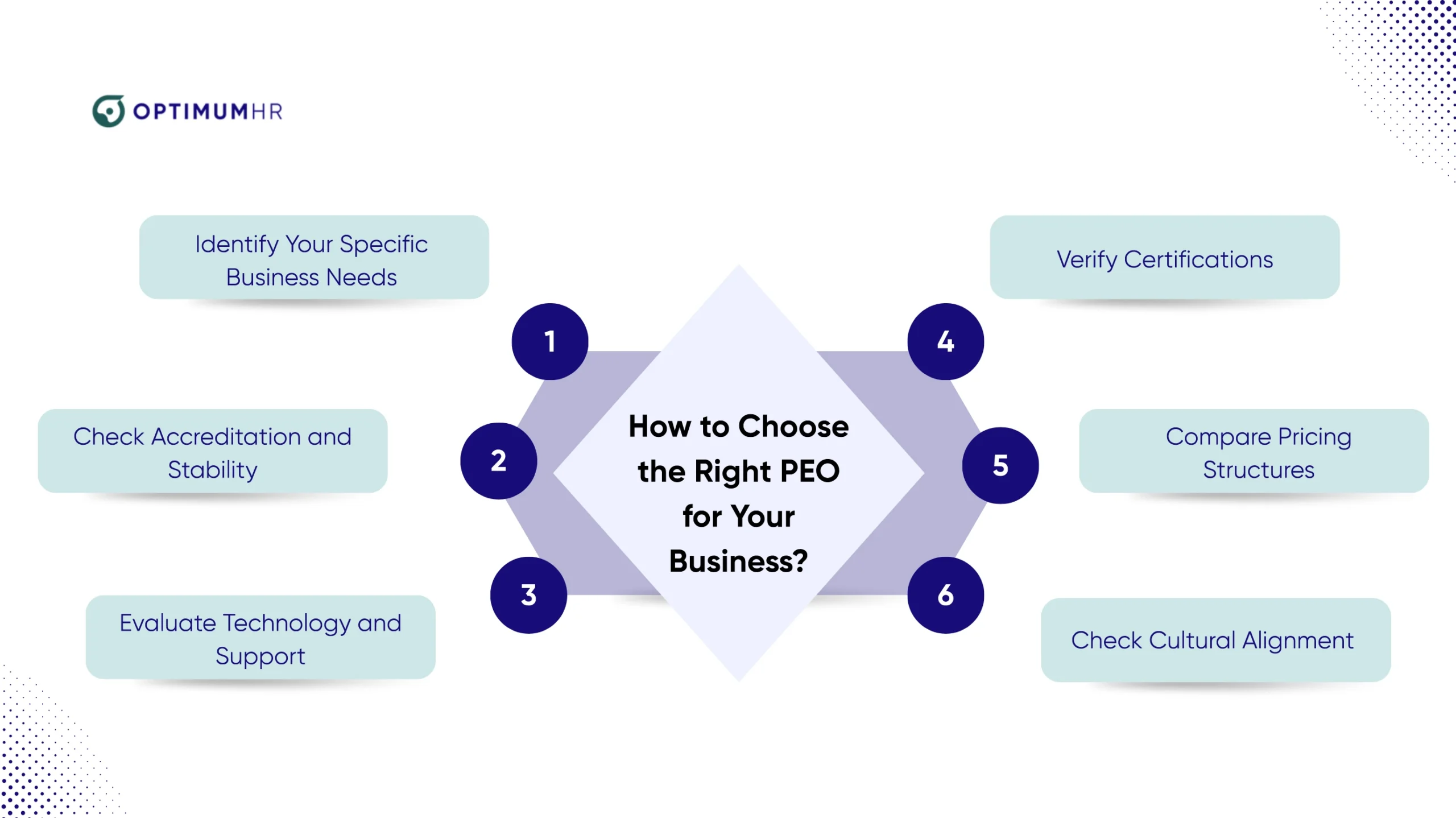
To choose the right PEO for your business, start by identifying your business needs, checking accreditation, evaluating technology, verifying certifications, comparing pricing, and assessing overall cultural alignment. Taking this structured approach ensures that the PEO you select can effectively support your HR, payroll, and compliance requirements while aligning with your company’s growth goals, workforce size, and organizational culture.
Follow the following steps to choose the right PEO:
Identify Your Specific Business Needs
Start by determining whether your primary need is to secure lower health insurance premiums, offload the risk of labor law compliance, or implement a more sophisticated recruitment and onboarding system. By defining these requirements upfront, you can filter for PEOs that specialize in your particular industry, such as blue-collar trades with high safety risks or white-collar tech firms requiring elite 401(k) options.
Check Accreditation and Stability
You should investigate the PEO’s financial track record and industry standing to ensure they can meet their long-term obligations to your staff. Look for PEO providers that are members of the National Association of Professional Employer Organizations (NAPEO) and have a history of consistent service without frequent ownership changes. Financial stability is non-negotiable, as the PEO will be responsible for processing your entire payroll and managing sensitive tax withholdings.
Evaluate Technology and Support
Next, assess the PEO’s platform for ease of use by both managers and employees, ensuring it provides robust mobile access for pay stubs, benefits enrollment, and time tracking. Verify whether you will have a dedicated HR account manager or if support is routed through a generic call center for complex personnel issues. The true value of a PEO often depends on the quality of its Human Resource Information System (HRIS) and the responsiveness and accessibility of its support team.
Verify Certifications
Confirming that a provider is a Certified PEO (CPEO) by the IRS is one of the most effective ways to mitigate financial risk. CPEO status provides federal assurance that the PEO is solely responsible for paying federal employment taxes, shielding your business from liability if the provider fails to make a payment. Additionally, ensure the provider has a strong track record of financial stability and regulatory compliance, demonstrating reliability and trustworthiness in managing payroll and HR services.
Compare Pricing Structures
Analyze the PEO’s pricing model to ensure it remains sustainable as your company grows. Determine if they charge a flat fee “per employee, per month” (PEPM) or a percentage of your total gross payroll. Be wary of hidden costs, such as separate fees for implementation, annual reporting, or recruitment modules. A transparent pricing structure should clearly separate administrative costs from insurance premiums, allowing you to see the true ROI of the partnership.
Check Cultural Alignment
Finally, ensure the PEO’s service philosophy matches your internal company culture and communication style. A PEO is an extension of your brand to your employees, meaning if their benefits portal is confusing or their support staff is unresponsive, it reflects poorly on your leadership. Ask for client references within your specific industry to gauge how the PEO handles sensitive employee relations and whether their vibe aligns with how you want your workforce to be treated.
How Long Does It Take to Onboard with a PEO?
Onboarding with a PEO takes 4-8 weeks on average, depending on the size of the business, the complexity of employee data, and the range of services selected. The process involves several structured steps, including kickoff and planning, data collection and setup, system integration and training, employee enrollment, and the first payroll launch to ensure a smooth transition of HR, payroll, and benefits administration. Delays can occur if employee information is incomplete, operations span multiple states, or benefits packages require customization.
What Happens During Onboarding?
During onboarding with a PEO, the company completes kickoff & planning, data collection & setup, system integration & training, employee enrollment, and the first payroll launch while preparing managers and staff to use the new systems. The process ensures a smooth transition in payroll, benefits, and HR compliance.
Kickoff & Planning
The kickoff and planning phase begins immediately after the contract is signed, during which you meet with your implementation team to establish a timeline, define key points of contact, and set the Go-Live date. The PEO reviews your current HR processes to identify any immediate compliance gaps to address before the official transition.
Data Collection & Setup
During data collection, you provide the PEO with comprehensive employee information, including historical payroll data, tax identification numbers, and current benefit plan details. The PEO uses this data to build your company profile in their system, ensuring that year-to-date earnings and tax withholdings are accurately reflected for year-end reporting.
System Integration & Training
Once the data is uploaded, the PEO integrates your company into their HRIS platform. You and your managers receive training on using the software to track time, approve payroll, and manage employee requests. This phase ensures that your leadership feels confident using the new tools before the system is opened to the wider staff.
Employee Enrollment
In the employee enrollment phase, your staff is introduced to the PEO, where they also receive login credentials for the portal to review their personal information, sign new employment documents required for agreement, and select their health and retirement benefits. PEOs often hold “Open Enrollment” webinars to explain the new coverage options to your team.
First Payroll Launch
The first live payroll run processes wages, deductions, and taxes under the PEO’s FEIN. The implementation team closely monitors this initial run to resolve any discrepancies and officially complete the transition from your previous HR system to the PEO model.
What Affects the Onboarding Timeline?
Factors affecting the onboarding timeline are company size, number of employees, multi-state operations, benefits complexity, completeness of employee data, and required system integrations. Larger organizations or those with highly customized HR needs typically experience longer onboarding periods, as more extensive data collection, system configuration, and employee training are required to ensure a smooth and accurate transition.
What Skills and Expertise Should a PEO Have?
A PEO should have comprehensive human resources knowledge, compliance and risk management capabilities, payroll administration proficiency, benefits administration expertise, technology proficiency, and strong communication skills. These core competencies enable a PEO to effectively manage HR operations, ensure regulatory compliance, streamline payroll and benefits administration, and provide reliable support to both employees and business leadership.
Human Resources Knowledge
Expertise across the full employee lifecycle is critical for a PEO, as it enables businesses to effectively manage recruitment, onboarding, employee relations, performance management, and training. By integrating new hires quickly and legally, mediating workplace issues, and implementing structured performance systems, a PEO helps align employee goals with business objectives. Strong HR knowledge supports retention, develops talent, and strengthens overall organizational performance.
Compliance and Risk Management
Managing employment laws and regulatory compliance is essential for PEOs to protect businesses from legal and financial risks. Understanding federal and state regulations, including FLSA, FMLA, and local mandates, enables PEOs to conduct safety audits, oversee workers’ compensation claims, and implement proactive risk mitigation strategies. This reduces liability, lowers insurance MOD scores, and ensures stable, compliant operations.
Payroll Administration
Payroll administration is a core area of expertise for a PEO, requiring the knowledge and systems needed to ensure employees are paid accurately and on time while maintaining compliance with complex tax and labor regulations. A skilled PEO manages automated payroll processing, multi-state wage withholdings, paid time off (PTO) tracking, and benefit and retirement deductions. This expertise helps reduce payroll errors, streamline administrative processes, and support ongoing regulatory compliance.
Benefits Administration
Providing competitive benefits is important for a PEO because it helps SMBs attract and retain talent. By leveraging pooled purchasing power, a PEO can offer comprehensive health, dental, vision, life insurance, and retirement plans at lower costs while remaining fully compliant with ACA and ERISA. Well-administered benefits boost employee satisfaction and reduce turnover.
Technology Proficiency
Proficiency with HR technology is vital for PEOs to maintain operational efficiency and data accuracy. Using enterprise-grade HRIS platforms enables secure access to employee data, automates repetitive HR tasks such as PTO tracking and expense reporting, and improves reporting. Strong cybersecurity protects sensitive information, ensuring that HR operations are efficient, accurate, and secure.
Communication
Effective communication skills are crucial for PEOs to maintain trust and clarity with both leadership and employees. By providing updates on HR trends, explaining complex benefits, and resolving workplace conflicts professionally, PEOs ensure smooth operations, minimize misunderstandings, and foster a supportive, compliant work environment.
Is a PEO Right for Your Business?
Yes, a PEO is the right choice for businesses that need to streamline HR operations, reduce administrative burdens, and access enterprise-level benefits without hiring a full internal HR team. Partnering with a PEO service provider is particularly beneficial for SMBs, growing startups, or businesses expanding into multiple states, where compliance, payroll, and benefits management can become complex and time-consuming.
However, a PEO may not be suitable for businesses that prefer full internal control over HR processes, highly customized employee benefits, or unique corporate cultures that cannot be standardized.
Key factors to consider while choosing a PEO for your business include business size, growth stage, HR needs, available budget, and the level of flexibility required in managing staff and operations. Also, balance your business’s operational efficiency with the desire for internal control and company-specific customization.


Deanna Wietor
Vice President of Client Experience
Deanna is the Vice President of Client Experience at Optimum HR, where she has spent nearly two decades advancing from Client Service Manager to VP of Operations and now into her current role leading client experience. With over 25 years in HR and client service, she holds both the PHR certification from HRCI and the SHRM-CP credential, as well as a Certificate in Human Resources from California State University, Long Beach. Deanna's focus on operational strategy and client-centered service delivery makes her a trusted leader in the human resources industry.