

Choose the right PEO by following a structured process that starts with identifying business needs, evaluating providers, assessing technology and compliance capabilities, comparing pricing, and reviewing contract terms to ensure operational efficiency and reduced risk. Begin by defining your payroll, benefits, compliance, and HR support requirements, then evaluate providers based on certifications, financial stability, service scope, and technology integration. This approach ensures the provider can manage regulatory responsibilities and support your workforce without operational gaps.
As you move closer to making a selection, focus on key features such as payroll accuracy, risk management, HR compliance, and employee benefits, and ask targeted questions about customization, support, pricing, and financial reliability. Finally, review the service agreement in detail, including fee structure, liability coverage, and contract terms, to avoid hidden costs and long-term constraints. This end-to-end evaluation ensures you select a PEO that fits your business model, minimizes risk, and supports long-term scalability.
Steps to Choose a PEO
To choose a PEO, align with your business needs and operational priorities, define your payroll, employee benefits, compliance, and HR support requirements, then evaluate providers based on service offerings, technology, pricing, certifications, and support quality. As you approach a decision, review the agreement carefully to confirm scope, cost clarity, and compliance coverage.
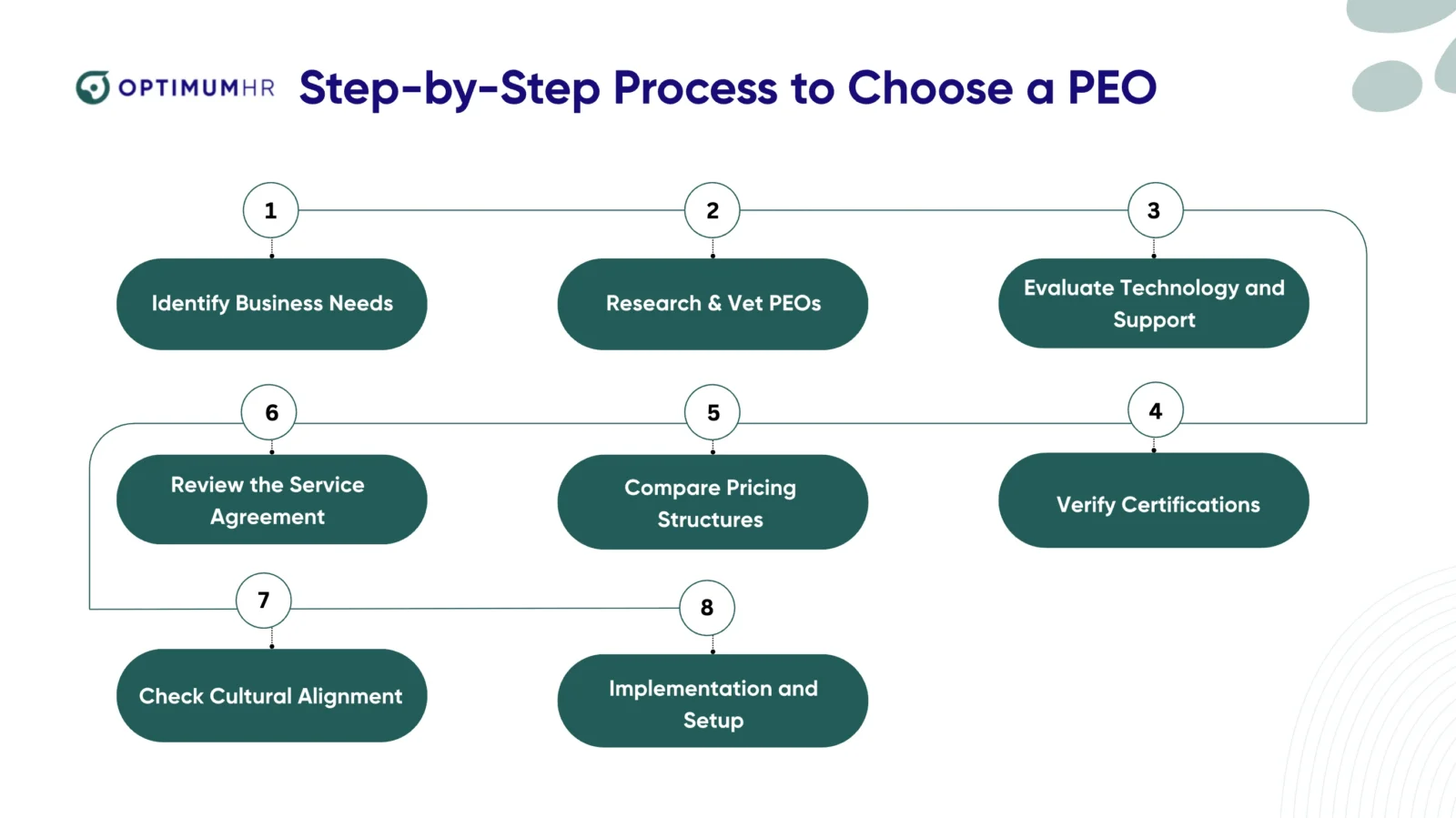
8 Steps to Choose a PEO:
- Identify Business Needs
- Research & Vet PEOs
- Evaluate Technology and Support
- Verify Certifications
- Compare Pricing Structures
- Review the Service Agreement
- Check Cultural Alignment
- Implementation and Setup
1. Identify Business Needs
Start by defining your primary goal, whether it is reducing health insurance costs, managing labor law compliance, or improving recruitment and onboarding, so you can choose a PEO that aligns with your business priorities. Review HR functions such as payroll, employee benefits, compliance, and hiring workflows to determine what the PEO should manage. Also assess workforce size, growth plans, and challenges like workers’ compensation or tax filings, since these directly affect operational costs, compliance needs, and provider suitability.
2. Research & Vet PEOs
Shortlist PEOs with proven industry experience, strong client retention, and expertise in payroll, compliance, employment taxes, and employee benefits to ensure reliable HR management. Verify ESAC accreditation, IRS-certified CPEO status, NAPEO membership, financial stability, and response time, since these reflect compliance standards and service reliability. Also assess industry specialization, as manufacturing-focused PEOs may better manage safety programs and workers’ compensation, while startup-focused providers often offer scalable HR systems and flexible onboarding support.
3. Evaluate Technology and Support
Assess how the PEO’s HRIS handles payroll, benefits, reporting, and time tracking to reduce manual work and compliance errors. Review how easily employees and managers can access data, enroll in benefits, and generate reports across devices, since limited functionality slows daily HR operations. Evaluate data accuracy, system performance, and integration with accounting or time-tracking tools for long-term reliability. Finally, examine support quality, response times, and access to dedicated HR contacts, as delays in payroll or compliance assistance directly disrupt operations.
4. Verify Certifications
Confirm whether the PEO holds IRS-certified CPEO status, which establishes clear responsibility for federal employment taxes and reduces liability risk. Verify accurate management of payroll processing, tax filings, and compliance reporting, since errors can trigger IRS penalties, audits, or delayed filings. Review financial stability, audit history, and regulatory standing, and check for ESAC accreditation to confirm operational reliability. Strong certification and compliance records signal a provider that can protect sensitive payroll data and support long-term business stability.
5. Compare Pricing Structures
Analyze whether the PEO uses a per-employee per-month (PEPM) model or a percentage-of-payroll structure to assess cost predictability and long-term affordability. Review what the base fee covers, including payroll processing, employee benefits, tax filings, compliance support, and HR administration, since unclear inclusions can increase actual costs. Also, separate administrative fees from insurance premiums to understand the true cost of service. To avoid budget issues, identify hidden charges for implementation, reporting, benefits administration, recruiting, or multi-state support, and evaluate how pricing scales with your workforce and operational needs.
6. Review the Service Agreement
Review the PEO service agreement to define service scope, responsibility split, legal liability, and contract limitations before signing. Confirm which HR functions the PEO manages — payroll, employment taxes, benefits, and compliance, and which responsibilities your business retains to avoid gaps or overlap. Examine liability clauses, data ownership, termination conditions, auto-renewal terms, and pricing changes, since vague terms create financial exposure and disputes. A thorough review ensures clearer accountability, greater flexibility, and better control over operational and compliance risk.
7. Check Cultural Alignment
Evaluate whether the PEO’s communication style, service approach, and employee management practices align with your company culture to maintain a consistent employee experience. Review how the provider interacts with employees through HR support, benefits administration, and communication channels, since these touchpoints directly reflect your brand and influence employee trust. Assess responsiveness, issue handling, and industry experience by requesting client references. Strong cultural alignment supports clear communication and long-term engagement, while poor alignment creates friction and dissatisfaction across your workforce.
8. Implementation and Setup
Execute implementation by planning the transition of payroll, employee data, and benefits administration into the PEO’s system without disrupting daily operations. Confirm onboarding timelines, data migration, HRIS setup, compliance configuration, and payroll accuracy, since errors during implementation affect employee trust and operational continuity. Evaluate how the PEO manages training, onboarding support, and issue resolution to ensure employees and managers adapt quickly. A structured rollout with clear communication, defined responsibilities, and responsive support keeps HR operations stable throughout the transition.
How Do You Choose a PEO That Matches Your Business Needs?
Choose a PEO by aligning its service scope, HR capabilities, compliance expertise, technology, and pricing with your business needs to ensure efficient operations and reduced risk. This alignment should reflect your industry requirements, growth stage, and business size, since small businesses often rely on full HR outsourcing to manage administrative tasks, while fast-growing startups require scalable systems and flexible support to sustain expansion.
How Do Small Businesses Choose the Right PEO?
Small businesses choose the right PEO by selecting a provider that manages HR tasks, reduces compliance risk, and delivers cost-effective employee benefits without in-house support. Focus on PEOs that handle payroll processing, employment taxes, regulatory compliance, and workers’ compensation, as these directly impact operations. Verify IRS-certified CPEO (Certified Professional Employer Organization) status or ESAC (Employer Services Assurance Corporation) accreditation to ensure reliability, and assess pricing, HRIS usability, and support access to maintain efficient HR operations.
How Do Fast-Growing Startups Choose a PEO?
Fast-growing startups choose the right PEO by prioritizing scalability, strong HR technology integrations, competitive employee benefits, and multi-state compliance to support rapid hiring. To sustain this growth, select a provider with an advanced HRIS, automated payroll processing, and the ability to efficiently manage employment taxes and distributed teams. Ensure the provider meets recognized compliance standards such as CPEO or ESAC, and evaluate onboarding speed and support agility to keep operations aligned with growth.
What Are the Questions to Ask a PEO Before You Commit?
Ask questions about customization, technology integrations, financial stability, support structure, and pricing before committing to a PEO to ensure the provider fits your business needs. These questions clarify how the PEO operates, what responsibilities it handles, and where potential risks or limitations exist. By evaluating these areas upfront, you avoid hidden costs, service gaps, and compliance issues, and ensure the provider can support your operations, growth, and long-term requirements.
6 Key Questions to Ask Before Choosing a PEO are:
How Fast Do You Respond?
HR issues often require immediate attention to avoid payroll delays, compliance problems, or employee disruptions, making response time a direct indicator of how quickly the PEO can resolve urgent operational concerns.
Do I Get a Dedicated Support Team?
A dedicated support team ensures faster communication, clearer accountability, and more reliable handling of payroll issues, compliance concerns, and employee requests during time-sensitive situations.
How Does the PEO Treat Its Own Employees?
A reputable PEO operates through a co-employment model, managing payroll, taxes, benefits administration, and HR compliance while your business oversees daily operations. Employees gain access to large-group health, dental, and 401(k) plans, while the PEO handles payroll processing, workers’ compensation, compliance documentation, and W-2 reporting under its EIN, reducing employment-related risk and improving HR consistency.
What Customization and Flexibility Does the PEO Offer?
This helps ensure the PEO can adapt its services and workflows to your specific business needs rather than applying a fixed structure, allowing it to scale with changes in workforce size or industry requirements.
What Does Ongoing Support and Communication Look Like?
Evaluating communication channels, response time, and access to dedicated support helps you avoid service gaps and ensures consistent HR management during time-sensitive situations.
How Does the PEO Structure Its Pricing and Contracts?
Asking about pricing structure and contracts helps you identify hidden costs, restrictive terms, and long-term financial commitments before signing. This ensures cost control and protects your business from unexpected expenses or limited provider flexibility.
How Much Does a PEO Cost?
PEO costs are structured in one of two ways: a flat per-employee-per-month fee or a percentage of total gross payroll. Many PEO arrangements fall in the range of roughly $40 to $200 per employee per month, or about 2% to 15% of gross payroll, depending on the size of the business, number of employees, industry, workers’ compensation exposure, state footprint, and services selected. Smaller businesses may pay more per employee or as a percentage, while larger businesses may benefit from economies of scale. Additional fees may apply for benefits administration, multi-state compliance, specialized HR support, or higher-risk workers’ compensation classifications.
At Optimum HR, PEO pricing is based on a PEPM model, which offers greater cost predictability and helps prevent expenses from increasing solely due to payroll growth. Final PEO pricing still depends on variables such as employee count, benefits requirements, workers’ compensation exposure, and overall service scope, although the standard administrative cost generally ranges from $100 to $150 per employee per month.
Is a PEO the Right Fit for Your Business?
A PEO helps businesses streamline HR operations, reduce administrative workload, and access competitive employee benefits without building an in-house HR team. This value becomes more evident for small to mid-sized businesses, growing startups, and companies expanding across multiple states, where managing payroll, compliance, and benefits becomes increasingly complex.
As these demands increase, working with the right provider helps ensure payroll runs accurately, taxes are filed on time, and employees receive consistent support. Choosing a reliable PEO service provider also gives access to better benefits plans, compliance guidance, and scalable HR systems, helping your business operate smoothly while supporting growth.