
The benefits of HR outsourcing include reducing operational costs, accessing specialized HR expertise, improving compliance, streamlining workforce management, and allowing businesses to focus on strategic growth. By partnering with a human resource service provider, organizations can outsource time-intensive functions such as payroll, recruitment, employee benefits administration, compliance, and performance management while gaining access to enterprise-grade technology, standardized processes, and experienced HR professionals.
Beyond lowering administrative costs through economies of scale, HR outsourcing helps businesses minimize payroll errors, reduce legal and compliance risks, improve hiring efficiency, and provide competitive employee benefits that strengthen recruitment and retention. Modern HRO providers also deliver advanced HR technology, workforce analytics, and scalable support that adapts as organizations expand into new markets or increase headcount. Whether supporting startups, small businesses, large enterprises, or local organizations, HR outsourcing enables businesses to operate more efficiently, maintain business continuity, make data-driven workforce decisions, and build a stronger foundation for sustainable long-term growth.
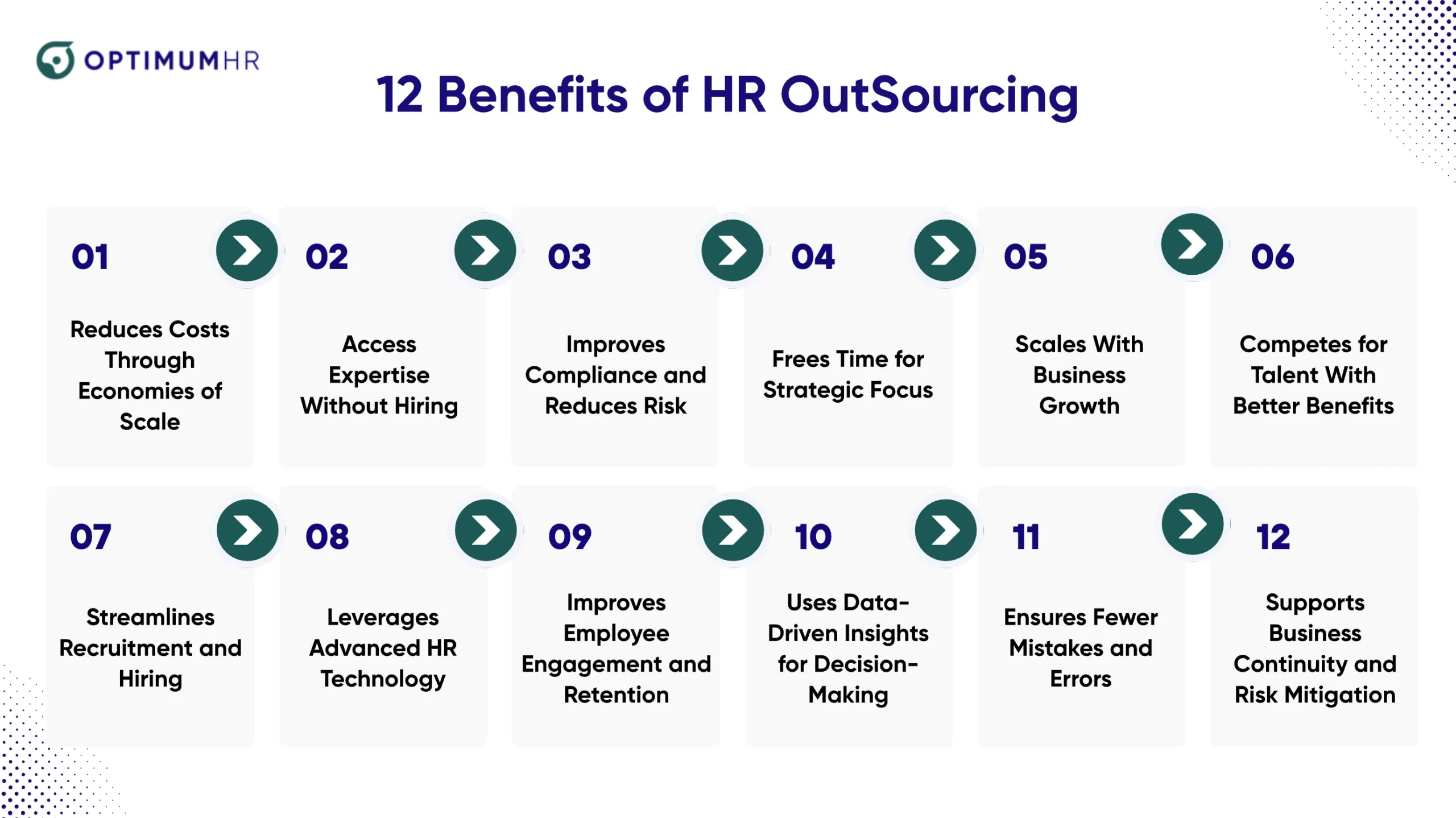
Top 12 benefits of HR outsourcing are:
- Reduces Costs Through Economies of Scale
- Access Expertise Without Hiring
- Improves Compliance and Reduces Risk
- Frees Time for Strategic Focus
- Scales With Business Growth
- Competes for Talent With Better Benefits
- Streamlines Recruitment and Hiring
- Leverages Advanced HR Technology
- Improves Employee Engagement and Retention
- Uses Data-Driven Insights for Decision-Making
- Ensures Fewer Mistakes and Errors
- Supports Business Continuity and Risk Mitigation
Reduces Costs Through Economies of Scale
Unlike traditional in-house HR departments that require ongoing investments in personnel, software, and compliance management, HR outsourcing reduces costs by converting fixed overhead into scalable operating expenses. Human resource service providers share infrastructure, technology, and specialized expertise across multiple clients, allowing businesses to access payroll, benefits administration, and compliance support at a lower per-employee cost than maintaining these functions internally. Reflecting these efficiencies, ZipDo reports that organizations outsourcing HR reduce administrative costs by 30% to 40%, demonstrating the financial advantages of economies of scale.
HR outsourcing also lowers indirect operating expenses by reducing recruitment costs, software investments, payroll errors, tax penalties, and compliance risks. Providers use their purchasing power to secure competitive employee benefits and workers’ compensation rates while automating routine HR processes through standardized workflows. This combination of shared resources and automation creates predictable HR costs and supports long-term operational efficiency as businesses grow.
Access Expertise Without Hiring
Outsourcing HR services provides immediate access to seasoned professionals, specialized skills, and advanced technology, enabling businesses to operate with the capabilities of a large-scale enterprise. Instead of relying on a single in-house generalist to manage diverse HR responsibilities, organizations gain on-demand access to experts in recruitment, benefits administration, employee relations, and labor law. This allows growing businesses to implement structured, enterprise-grade HR practices without the cost of hiring multiple specialists or investing in separate HR systems.
This expertise also strengthens compliance and long-term workforce management. By continuously monitoring changing labor laws and regulatory requirements at the federal, state, and local levels, HRO helps businesses reduce compliance risks and avoid costly legal issues. At the same time, providers deliver strategic HR guidance and data-driven workforce planning that improve employee management and organizational performance, allowing business leaders to focus on growth while maintaining a competitive advantage.
Improves Compliance and Reduces Risk
HR outsourcing improves compliance and reduces legal risks by providing specialized expertise to navigate complex labor laws, including OSHA, EEO, and wage-and-hour regulations. Human resource service providers continuously monitor changing employment requirements, helping businesses maintain compliance across payroll, employee classification, tax filings, and workplace policies. According to Insignia Resources, companies using outsourced compliance platforms experience an average 24% reduction in audit findings, demonstrating how proactive compliance management helps minimize regulatory violations and costly penalties.
To strengthen this protection, human resource service providers maintain accurate documentation, including personnel records, I-9 verifications, and safety reports, while conducting compliance audits and management training on workplace harassment and discrimination policies. Many HRO providers also offer indemnification and ongoing compliance support, reducing legal exposure and helping businesses maintain compliant payroll, benefits administration, and workforce management practices.
Frees Time for Strategic Focus
By offloading routine HR administrative tasks such as payroll, benefits, and compliance to specialists, HR outsourcing frees internal teams to focus entirely on core business growth. This shift reduces time spent on repetitive processes like recordkeeping, onboarding, and compliance tracking, which often consume significant administrative resources. Outsourcing providers streamline these functions through automation and standardized systems, minimizing manual effort and reducing errors.
As a result, management can redirect attention toward strategic priorities such as business development, customer engagement, and operational efficiency. According to the National Association of Professional Employer Organizations (NAPEO), companies that outsource HR spend about 21% more time on high-value activities. With fewer administrative distractions, employees can concentrate on their primary roles, improving productivity and overall performance. This reallocation of time and resources enables organizations to operate more efficiently while supporting long-term growth and innovation.
Scales With Business Growth
Unlike static in-house HR departments, which often require months of hiring and onboarding to expand their capabilities, partnering with an HRO provides immediate access to a modular HR infrastructure that scales dynamically with business needs. This eliminates operational bottlenecks, allowing organizations to grow their workforce without scrambling to increase internal administrative capacity. As a result, businesses can manage hiring surges seamlessly while maintaining consistent employee support and operational efficiency.
According to NAPEO, companies that partner with a PEO grow twice as fast, experience 12% lower employee turnover, and are 50% less likely to go out of business, delivering an average ROI of 27.2%. Beyond supporting workforce expansion, strategic HR outsourcing also simplifies entry into new markets by removing the complexity of local regulatory compliance. Providers offer scalable, location-specific compliance frameworks that manage multi-state tax withholding and jurisdiction-specific labor laws, enabling businesses to expand confidently while transforming fixed HR overhead into agile, variable operating expenses.
Competes for Talent With Better Benefits
Partnering with an HR outsourcing provider helps businesses, especially small to mid-sized businesses (SMBs), compete for skilled talent by providing access to comprehensive employee benefits that are often difficult to offer through an in-house HR function. Human resource service providers leverage their large client base to negotiate competitive rates for health insurance, retirement plans, wellness programs, and other employee benefits. By pooling employees across multiple organizations, HRO providers and Professional Employer Organizations (PEOs) secure Fortune 500-level health coverage, flexible spending accounts (FSAs), and other benefits that are often beyond the reach of individual businesses.
Beyond improving retention, these enhanced benefits strengthen the employee value proposition during recruitment while improving workforce retention. HRO providers also simplify benefits administration through streamlined enrollment processes and modern self-service platforms, reducing administrative complexity for employers. This allows businesses to attract qualified candidates, build a more stable workforce, and remain competitive without substantially increasing HR costs.
Streamlines Recruitment and Hiring
HR outsourcing helps businesses streamline recruitment and hiring by providing structured hiring processes, applicant tracking systems (ATS), hiring templates, and HR best practice guidance. Instead of building hiring workflows from scratch, organizations gain access to technology that centralizes job postings, applicant management, and onboarding, along with expert recommendations for compliant, effective hiring practices. This reduces administrative burden, improves consistency, and creates a more organized hiring experience. According to the Society for Human Resource Management (SHRM), organizations using outsourced recruitment models can reduce time-to-hire by up to 40%.
In addition to providing hiring technology, HR outsourcing partners help employers strengthen their recruiting processes through standardized templates, interview guides, job description support, and practical HR guidance. While the employer remains responsible for recruiting, interviewing, and selecting candidates, these tools and best practices help improve hiring consistency, reduce administrative errors, and support better workforce planning. Businesses can fill critical roles more efficiently while allowing internal teams to stay focused on core business operations.
Leverages Advanced HR Technology
A major advantage of outsourcing HR is the immediate access to advanced HR technology and systems without investing in expensive software infrastructure or upfront licensing fees. Access to sophisticated Human Resource Information Systems (HRIS) enables businesses to automate repetitive tasks such as time tracking, benefits administration, and document storage, ensuring data accuracy and enterprise-grade security. Through software-as-a-service (SaaS) models, businesses enjoy secure data encryption, audit trails, and employee self-service capabilities that scale seamlessly.
Modern HR platforms also provide a centralized system that serves as a single source of truth, supporting compliance and enabling employee self-service capabilities. In addition, built-in AI tools and predictive features help identify issues in payroll or onboarding before they escalate. By utilizing these enterprise-level tools through an external provider, businesses gain comprehensive reporting features and deep data visibility that would otherwise require separate, cost-prohibitive technical support teams.
Improves Employee Engagement and Retention
HR outsourcing improves employee engagement and retention by providing workers with seamless professional support, responsive communication channels, and premium workplace experiences that minimize administrative friction. When frustrating delays in payroll corrections or benefits updates are eliminated, overall workplace satisfaction rises. By handing these complex responsibilities to external specialists, businesses ensure that employee inquiries regarding health plans, leave requests, and tax documentation are resolved quickly and accurately, signaling a high level of organizational support.
Backed by this infrastructure, data from the National Association of Professional Employer Organizations (NAPEO) reveals that businesses utilizing an outsourced HR model experience an average 12% reduction in annual employee turnover compared to non-users. Beyond smoother administration, providers assist management in deploying structured performance management systems, transparent recognition programs, and employee wellness initiatives. This consistent, modern approach creates a more stable, supportive corporate culture, helping growing organizations retain high-performing talent over the long term.
Uses Data-Driven Insights for Decision-Making
Partnering with an external HR provider equips business leaders with advanced data analytics and strategic reporting capabilities unavailable in basic, manual in-house setups. By centralizing workforce tracking onto sophisticated HRIS platforms, HRO turns raw numbers into actionable business intelligence. Leaders gain deep, immediate visibility into key operational metrics, such as labor cost distributions, time-to-hire efficiencies, benefit utilization rates, and detailed departmental turnover patterns.
These data-driven insights allow management to shift from a reactive mindset to a highly proactive business strategy. Instead of guessing why certain departments experience high attrition or overspending on underutilized benefits, organizations use historical and predictive data to optimize workforce costs, forecast hiring needs, and structure competitive retention packages. This executive-level reporting provides businesses, including SMBs, with the precise analytical power needed to make confident, strategic growth decisions that protect their bottom line.
Ensures Fewer Mistakes and Errors
By using automated verification tools and real-time updates to local labor codes, HRO eliminates administrative mishaps such as missed tax deadlines, miscalculated overtime pay, or inaccurate paid time off (PTO) tracking. Entrusting workforce management to these certified professionals significantly reduces operational mistakes and processing errors that frequently plague overworked in-house teams. Because compliance and payroll calculations require meticulous precision, even a single oversight in manual tracking or an incorrect tax deduction can result in costly penalties.
Such error reduction is vital for maintaining smooth daily operations, lowering organizational risk, and safeguarding employee trust. Specialized HR teams apply standardized processing workflows, automated validation protocols, and dedicated quality assurance to ensure that routine tasks are performed accurately and consistently. Ultimately, minimizing these operational inaccuracies helps improve payroll accuracy, supports timely employee payments, and strengthens overall workforce management.
Supports Business Continuity and Risk Mitigation
Partnering with an external HR provider strengthens business continuity by protecting organizations from operational disruptions, data loss, and compliance risks. Relying on a single in-house HR professional creates vulnerabilities, as unexpected absences or employee turnover can interrupt critical functions such as payroll, benefits administration, and regulatory compliance. HR outsourcing eliminates these single points of failure by providing a dedicated team of specialists that ensures continuous service delivery and cross-functional support across essential HR operations.
Beyond maintaining continuity, HRO providers strengthen risk mitigation through secure cloud-based HR systems, automated data backups, disaster recovery protocols, and continuous compliance monitoring. Regular risk assessments, workplace safety training, and legal compliance tracking further reduce operational and regulatory exposure. This structured approach protects sensitive employee data, minimizes business interruptions, and helps organizations maintain stable HR operations through workforce changes, economic uncertainty, and organizational growth.
What Are the Benefits of HR Outsourcing for Different Business Sizes?
HR outsourcing delivers customized benefits by business size, such as startups gaining cost efficiency and scalability, small businesses receiving operational support, large enterprises benefiting from strategic workforce management, and local businesses gaining localized compliance and hiring advantages. While all organizations access expert HR, technology, and compliance support, priorities differ. Early-stage firms focus on savings and growth, while established companies emphasize efficiency and optimization, helping each choose the right outsourcing model.
What Are the Benefits of HR Outsourcing for Startups?
Benefits of HR outsourcing for startups include cost savings, scalability, access to better benefits, improved compliance, and reduced administrative burden. These advantages allow early-stage companies to build a strong HR foundation without the cost and complexity of developing an in-house HR department, giving founders access to specialized expertise, scalable infrastructure, and enterprise-grade tools while staying focused on growth.
5 major benefits of HR outsourcing for startups are:
- Avoid Hiring Your First HR Person and Save $60–90K
Hiring a dedicated, full-time HR manager early on is a massive financial commitment that drains critical seed or runway capital for startups. The average salary for a mid-level HR manager ranges between $60,000 and $90,000 annually, excluding taxes, equity, and benefits. Therefore, partnering with an HR outsourcing provider gives startups access to an entire team of fractional specialists (covering payroll, compliance, and recruitment) at a fraction of the cost of a single full-time internal hire, allowing founders to redirect capital toward product development and customer acquisition.
- Scale HR Infrastructure as Headcount Grows
For a rapidly evolving startup, partnering with an HRO ensures that operational systems scale flawlessly even when headcount fluctuates dramatically after a major funding round. Building an internal HR team that can handle that volatility without creating bottlenecks in onboarding or processing is incredibly difficult. HR outsourcing offers a modular, elastic infrastructure that scales seamlessly alongside hyper-growth, ensuring that automated payroll, contract templates, and employee directories adjust instantly to changing team sizes without disrupting company momentum.
- Access Fortune 500-Level Benefits to Compete for Talent
Utilizing HRO services allows early-stage startups to bridge the benefits gap and win elite engineering, product, or sales talent when competing directly against established corporate giants. By pooling thousands of workers across multiple client companies, HR outsourcing firms and PEOs unlock direct access to premium, Fortune 500-level health plans, retirement match programs, and wellness perks. This enables a 10-person startup to offer the same institutional-grade benefits as a massive corporation, significantly boosting candidate attraction.
- Stay Compliant Without Legal Expertise In-House
HRO frameworks protect vulnerable startups from regulatory pitfalls by monitoring rapidly changing labor laws without requiring an expensive, full-time legal team. Minor compliance missteps, such as misclassifying independent contractors, failing to set up multi-state tax withholding for remote workers, or violating local labor codes, can result in significant fines. HR outsourcing deploys location-aware regulatory systems and automated compliance audits, helping founders reduce legal risks and navigate compliance requirements across multiple jurisdictions more effectively.
- Focus Founding Team on Product, Not Payroll/Admin
By handing over administrative burdens to an HRO, startup founders can protect their finite time and keep their core team laser-focused on growth. Every hour a founder spends troubleshooting payroll processing, managing health insurance open enrollment, or tracking employee paid time off (PTO) is an hour lost on core business strategy. Transitioning these repetitive, non-revenue-generating operational tasks to external experts fully unburdens the founding team, allowing them to remain completely focused on building the product, scaling operations, and driving revenue.
What Are the Benefits of HR Outsourcing for Small Businesses?
The benefits of HR outsourcing for small businesses include replacing expensive HR staff with affordable per-employee pricing, reducing employee turnover through competitive benefits, accurately handling payroll, taxes, and compliance, freeing up owner and manager time, and gaining access to specialized HR expertise without expanding internal staff. Each of these advantages enables small business owners to improve operational efficiency, provide better employee support, and focus more resources on business growth.
Here are the key benefits of HR outsourcing for small businesses:
- Replace Expensive HR Manager With Affordable Per-Employee Pricing
HR outsourcing allows small businesses to replace the cost of hiring a full-time HR manager with a predictable per-employee-per-month (PEPM) pricing model, ranging from $50 to $150 per employee per month, depending on the service level. Instead of covering salaries, benefits, training, software, and other overhead that can exceed $75,000-$110,000 annually, small businesses pay only for the HR services they need while gaining access to a team of specialists. This flexible pricing model reduces costs, improves budget predictability, and delivers enterprise-level HR support at a fraction of the cost.
- Reduce Employee Turnover With Competitive Benefits Packages
HRO providers help small firms minimize turnover by granting access to premium, institutional-grade benefit plans that build long-term employee loyalty. Small businesses often lose top talent to corporate giants with richer compensation packages. By pooling thousands of workers, outsourcing firms secure cost-effective benefits, including comprehensive medical, dental, and vision coverage, 401(k) matching, disability coverage, and wellness perks. It enables small teams to match enterprise-level benefits, close the talent-attraction gap, and stabilize their workforce.
- Handle Payroll, Taxes, and Compliance Without In-House Errors
By leaning on an external provider, small businesses can execute complex payroll runs, tax filings, and local compliance checks with reduced administrative errors. Overworked owners or office managers attempting to handle local labor codes, state tax withholdings, and workers’ compensation formulas manually run a high risk of making costly mistakes. Specialized HROs utilize automated software validation and certified experts to ensure filings are accurate and on time.
- Free Owner/Manager Time for Revenue-Generating Activities
Transitioning repetitive back-office duties to an HRO frees up small business owners to spend their limited time on direct revenue-generating activities and customer retention. Every hour spent tracking down manual timesheets, processing paid time off (PTO) requests, or troubleshooting health insurance enrollment is an hour stolen from business development. Unburdening management from non-revenue administrative work allows them to focus entirely on closing sales and driving market growth.
- Access HR Expertise You Can’t Afford to Hire Full-Time
HRO frameworks grant small businesses on-demand access to specialized HR professionals, employee relations experts, and compliance attorneys they could not afford to hire full-time. Navigating sensitive workplace disputes, complex terminations, or shifting safety regulations requires deep professional experience. Outsourcing provides a direct lifeline to an entire multi-disciplinary team of certified experts, giving small business owners complete legal confidence and institutional support without the enterprise price tag.
What Are the Benefits of HR Outsourcing for Local Businesses?
The benefits of HR outsourcing for local businesses include managing location-specific labor laws, strengthening local recruitment, reducing compliance risks, minimizing administrative workload, and allowing business owners to focus on serving their communities. Together, these advantages help local employers maintain compliant HR operations while improving employee management and supporting sustainable business growth.
Key benefits of HR outsourcing for local businesses include:
- Manage Local Labor Laws and Regulations Without Guesswork
For small-town storefronts and regional service providers, partnering with an HRO allows local businesses to navigate a constantly shifting landscape of city ordinances, county tax structures, and regional labor mandates without dangerous guesswork. Transitioning these tracking responsibilities to an external partner eliminates the stress of manually interpreting complex regional rules. Specialized HRO provides real-time regulatory updates and automated payroll adjustments, ensuring the business stays fully compliant with local minimum-wage hikes, predictive scheduling laws, and localized payroll tax requirements.
- Compete Locally for Employees With Professional HR Support
Utilizing an HRO bridges the talent gap for independent local businesses, granting them access to premium, institutional-grade benefit packages that make them highly competitive against dominant national chains operating in the same market. Localized businesses frequently struggle to retain quality workers who are lured away by corporate giants with richer perks. Providing access to top-tier health options, clear digital onboarding, and HRO helps community-centered employers attract high-caliber local talent and position themselves as premier workplaces.
- Keep Recruitment Local While Outsourcing Admin Burden
By integrating an HRO strategy, local businesses can maintain a personal, community-first approach to interviewing and networking while offloading the heavy administrative paperwork that slows hiring down. Building a strong regional team requires face-to-face trust, but the backend logistics can be crushing. The external partner manages background checks, drug screenings, offer letter generation, and tax onboarding behind the scenes, allowing the local management team to focus purely on finding the right cultural fit for their neighborhood market.
- Reduce Compliance Risk Specific to Your State/Region
Deploying an HRO framework shields local businesses from severe financial liabilities by assigning highly localized compliance experts who understand the precise legal frameworks, workplace safety mandates, and workers’ compensation structures governing their specific geographic region. Different states and municipalities enforce vastly different employment laws, posing a major risk for independent operations. Outsourcing HRO proactively audits safety protocols and manages local workers’ comp claims to keep the business fully protected from costly regional penalties.
- Focus On Community Relationships and Business Growth
Handing repetitive administrative duties over to an HRO returns invaluable time to local businesses and their leadership teams, allowing them to step out of the back office and focus fully on the front lines where customer relationships drive revenue. Every hour a local owner spends managing workplace disputes, tracking sick leave, or troubleshooting payroll software is an hour stolen from business development. Unburdening management from non-revenue administrative work allows them to focus entirely on maintaining product quality, serving neighbors, and driving local market growth.
What Types of HR Functions Can Be Outsourced?
Types of HR functions that can be outsourced include payroll and tax processing, recruitment, employee benefits administration, performance management, training and development, and employee relations. These HRO services allow businesses to streamline operations, improve compliance, and focus internal resources on strategic priorities while leveraging external expertise and technology.
6 major types of HR functions that businesses can outsource include:
- Payroll and tax processing
By handing off payroll management, businesses ensure that gross-to-net calculations, direct deposits, wage garnishments, and year-end tax reporting are handled flawlessly. Managing payroll involves far more than just writing checks, it requires strict compliance with shifting tax jurisdictions and meticulous record-keeping. External providers assume the full responsibility for calculating and filing local, state, and federal payroll taxes, protecting organizations from costly IRS penalties and processing errors.
- Recruitment and hiring
HR outsourcing streamlines recruitment by providing applicant tracking systems (ATS), standardized hiring workflows, and HR best-practice guidance. Employers can manage job postings, track candidates, and onboard new hires through a centralized platform, reducing administrative burden and improving hiring efficiency. Providers also offer compliant job description recommendations, interview guides, templates, and practical HR support. While employers remain responsible for recruiting and selecting candidates, these tools enhance consistency, strengthen compliance, and enable hiring managers to focus on identifying the best talent.
- Employee benefits administration
Outsourcing firms handle the entire benefits management lifecycle, from negotiating competitive rates with major insurance carriers to managing daily enrollments, deductions, and COBRA administration. Navigating health insurance markets and managing open enrollment can quickly become an administrative maze for a growing company. Transitioning this function ensures that employees receive seamless support for their medical, dental, and retirement plans without burdening internal administrative staff.
- Performance management
External HR partners help design and implement standardized performance management frameworks, including digital appraisal workflows, goal-setting tracking, and 360-degree feedback mechanisms. Building a high-performing workforce requires structured evaluation systems, yet internal performance reviews are frequently delayed or inconsistently applied. Utilizing an outsourced solution instills a culture of reliability, accountability, and transparent growth across the entire organization.
- Training and development
Outsourcing providers grant companies immediate access to robust Learning Management Systems (LMS) packed with certified modules covering workplace safety, anti-harassment compliance, and leadership training. Keeping an entire workforce up to date on compliance mandates and professional skills requires continuous tracking of education. Handing this tracking over to specialists ensures your team remains fully certified and compliant without requiring you to build educational courses from scratch.
- Employee relations
An outsourced HR partner provides an unbiased, third-party framework for investigating employee issues, drafting enforceable handbooks, and executing structured offboarding procedures. Handling sensitive workplace conflicts, policy grievances, and disciplinary actions requires an objective, legally sound approach to prevent compliance risks. This professional intervention resolves workplace friction efficiently while shielding the business from potential wrongful termination or labor lawsuits.
When Should a Business Consider Outsourcing HR?
A business should consider HR outsourcing when managing HR responsibilities begins to consume excessive time, increase compliance risks, or slow business growth. As organizations expand, routine tasks such as payroll, recruitment, benefits administration, employee relations, and regulatory compliance become more complex and resource-intensive. Partnering with an HR outsourcing provider allows businesses to streamline these responsibilities while gaining access to specialized expertise, advanced technology, and scalable HR support.
Common signs that it is time to outsource HR include:
- HR Administration Consumes Too Much Time: Owners, managers, or internal teams spend too much time on payroll, employee records, and compliance, leaving less time to focus on business growth.
- Workforce Growth Is Outpacing Internal Resources: Hiring new employees, expanding into new locations, or managing multiple teams creates HR demands that existing staff can no longer support efficiently.
- Compliance Risks Are Increasing: Frequent regulatory changes, payroll tax requirements, employee classification issues, and labor law updates are becoming difficult to manage internally.
- Recruitment and Retention Are Becoming More Challenging: Businesses struggle to hire qualified candidates, provide competitive benefits, or maintain consistent employee engagement and retention.
- HR Costs Continue to Rise: Maintaining internal HR personnel, software, training, and compliance systems becomes more expensive than outsourcing routine HR functions through a specialized provider.
How Much Does HR Outsourcing Cost?
PEO costs are typically charged either as a flat per-employee-per-month (PEPM) fee or as a percentage of gross payroll. Pricing often ranges from $40 to $200 per employee per month, or 2% to 15% of payroll, depending on company size, industry, workforce risk, geographic footprint, and selected services. Smaller businesses generally pay higher rates, while larger organizations may benefit from economies of scale. Additional fees may apply for benefits administration, multi-state compliance, specialized HR support, or higher-risk workers’ compensation coverage.
In the case of Optimum HR, PEO pricing is based on a PEPM model, which offers greater cost predictability and helps prevent expenses from increasing solely due to payroll growth. While standard administrative PEO costs with Optimum HR range from $100 to $150 per employee per month, this reflects a broader, more comprehensive service offering than lower-cost PEO providers. Optimum HR includes services such as full-service HR management, compliance support, risk management, payroll administration, and workers’ compensation coverage, areas that are often limited or unavailable in more basic PEO packages.
How to Choose the Right HR Outsourcing Partner?
To choose the right HR outsourcing partner, focus on evaluating service scope, expertise, compliance strength, technology, and support quality to ensure alignment with your business goals. Following these steps ensures you choose the right HR outsourcing partner for your business that aligns with your needs and long-term business goals.
Here is a step-by-step process to choose the right HR outsourcing partner:
- Define Your HR Needs: Identify which HR functions you want to outsource, such as payroll, recruitment, compliance, or full-service HR management.
- Evaluate Service Offerings: Compare HRO service providers based on whether they offer comprehensive solutions (PEO) or limited administrative support (ASO).
- Assess Industry Experience: Choose an HRO provider with proven experience in your industry to ensure they understand relevant compliance requirements and workforce challenges.
- Review Compliance Capabilities: Confirm the HRO provider can manage labor laws, tax regulations, and risk management to reduce legal exposure.
- Analyze Technology and Tools: Ensure access to HRIS platforms, payroll systems, and reporting tools that improve efficiency and data visibility.
- Compare Pricing Models: Review pricing structures, such as per-employee-per-month or a percentage of payroll, to ensure cost predictability.
- Check Support and Responsiveness: Evaluate the quality of customer support, response times, and the availability of dedicated account managers.
- Verify Reputation and Performance: Review client testimonials, retention rates, and performance metrics, including service reliability and satisfaction scores.
- Request a Demo or Consultation: Test the HRO provider’s systems and approach to confirm compatibility with your business processes.
- Ensure Scalability and Flexibility: Select an HR outsourcing partner that can adapt as your business grows and HR needs evolve.