
A Professional Employer Organization (PEO) helps businesses manage human resources, reduce administrative burden, and improve workforce outcomes through a structured co-employment model. According to NAPEO, more than 230,000 businesses and 4.5 million employees rely on PEO services today, and the industry generates over $414 billion in annual revenue, underscoring its growing role in modern business operations.
Businesses that partner with a PEO gain clear advantages in payroll, compliance, and employee benefits. Small and mid-sized businesses use PEOs to access enterprise-level benefits, and as a result, PEO users see 12% lower employee turnover. Retirement plan access also improves, with 52% of PEO clients with 10-49 employees offering retirement plans, compared to 23% of similarly sized non-PEO businesses. The impact extends to growth and stability.
As per NAPEO, companies using a PEO grow twice as fast, have 12% lower turnover, and are 50% less likely to go out of business, with an average ROI of 27.2%. These results show that a PEO strengthens operations, improves employee satisfaction, and supports long-term business growth.
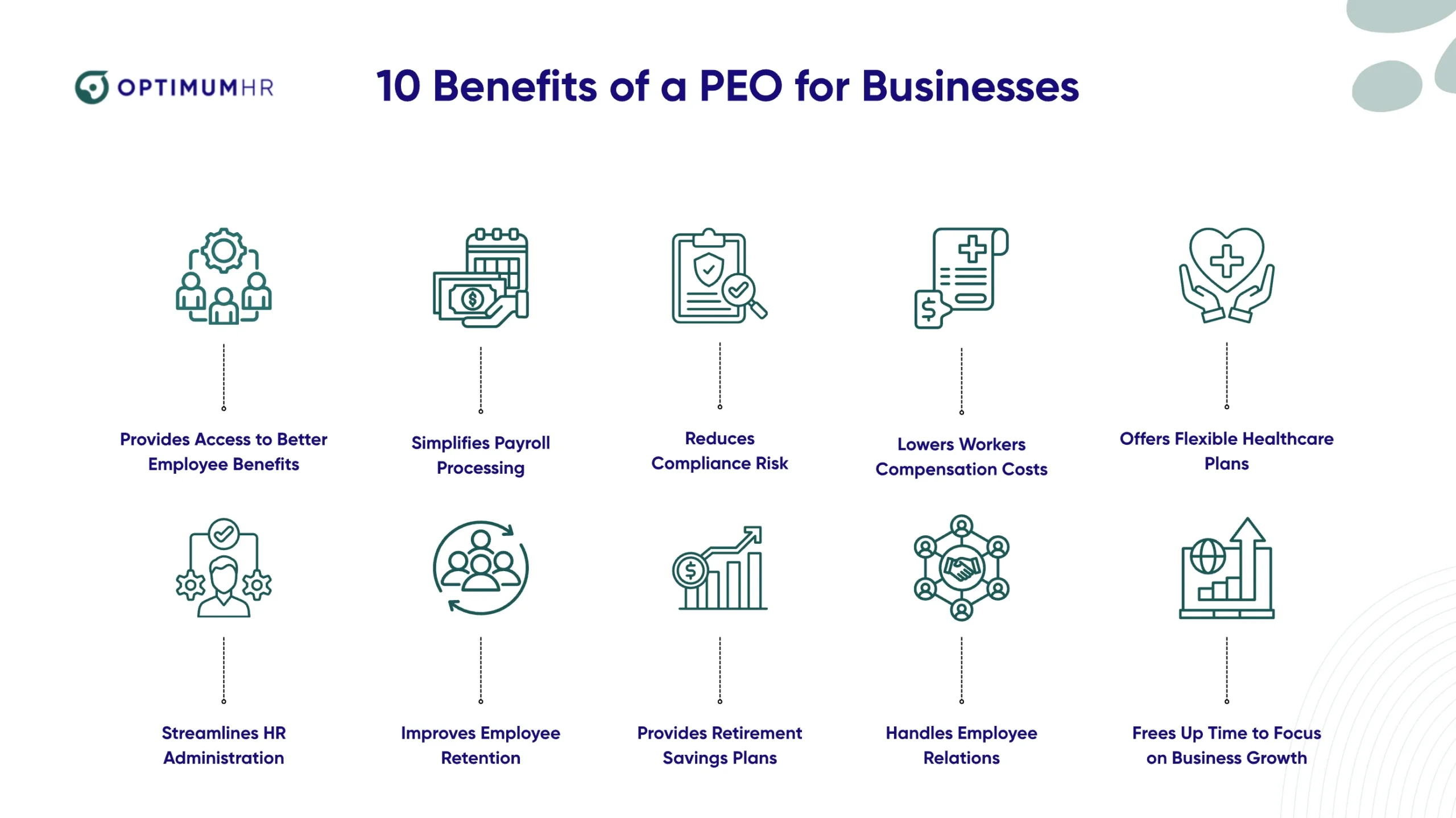
The top 10 benefits of a PEO for businesses include:
- Provides Access to Better Employee Benefits: Offers enterprise-level healthcare, retirement, and insurance plans that improve hiring and retention.
- Simplifies Payroll Processing: Manages payroll, tax reporting, and deductions with accuracy and compliance.
- Reduces Compliance Risk: Ensures alignment with labor laws, tax regulations, and workplace policies.
- Lowers Workers’ Compensation Costs: Controls premiums through risk management and centralized claims handling.
- Offers Flexible Healthcare Plans: Provides flexible group health insurance through pooled workforce access.
- Streamlines HR Administration: Centralizes onboarding, documentation, and policy management into one system.
- Improves Employee Retention: Reduces turnover by offering structured support and competitive benefits.
- Provides Retirement Savings Plans: Enables access to managed retirement programs with compliance support.
- Supports Employee Relations: Standardizes conflict resolution, communication, and policy enforcement.
- Frees Up Time to Focus on Business Growth: Reduces administrative workload, allowing leadership to focus on strategy and expansion.
1. Provides Access to Better Employee Benefits
Working with a Professional Employer Organization (PEO) provides small businesses access to high-quality, affordable employee benefits typically reserved for large corporations. By aggregating a vast workforce, PEOs secure superior health, dental, and retirement plans that independent companies would not otherwise qualify to access. These comprehensive packages help businesses attract top talent and boost employee retention by offering more competitive total compensation.
Under this shared management model, the PEO handles complex administrative tasks like plan negotiation, enrollment, and compliance paperwork, while the business retains daily operational control. This partnership directly benefits business owners by reducing administrative burdens and lowering turnover costs. Simultaneously, employees gain better coverage and financial security, leading to higher morale and engagement. Ultimately, PEOs streamline benefits management, allowing leadership to focus on growth while maintaining a stable, well-supported workforce.
2. Simplifies Payroll Processing
A PEO simplifies payroll by managing wages, tax reporting, and compliance requirements. This structured approach replaces manual spreadsheets with an integrated system, ensuring accurate payments and alignment with labor laws. By centralizing data, the PEO automatically calculates benefit deductions and handles all payroll tax filings, protecting the business from costly reporting errors or penalties.
This streamlined process directly benefits business owners by reducing administrative workloads, allowing them to focus on core operations and growth. Employees also benefit from receiving reliable, on-time payments and precise deductions, which strengthen trust and boost overall morale. Ultimately, this partnership provides a scalable, stable payroll framework that adapts as the company expands, ensuring consistent financial management and legal compliance across the entire workforce.
3. Reduces Compliance Risk
A Professional Employer Organization reduces compliance burdens by managing complex labor laws, tax regulations, and workplace safety standards. As businesses expand, the PEO fills regulatory gaps, ensuring policies and documentation align with current employment requirements. The PEO monitors legal changes and automatically updates handbooks and systems. They manage payroll tax reporting, workers’ compensation, and employee classifications to ensure everyday operations remain compliant.
Business owners benefit from protection against financial penalties and legal disputes, gaining expert HR support without hiring internal teams. This stability allows leadership to focus on growth and market expansion. In return, employees benefit from a professional environment with clear, legally sound procedures. This structured approach transforms compliance from a reactive task into a stable foundation for long-term business success.
4. Lowers Workers’ Compensation Costs
The PEO lowers workers’ compensation costs by managing claims, safety programs, and coverage within a structured system. This replaces independent insurance negotiations with efficient, centralized administration, helping small businesses control premium rates. By grouping multiple companies, the PEO secures competitive insurance rates and manages the entire claims process to prevent costly errors. They also implement proactive risk management, providing tailored safety training and protocols to reduce workplace incidents before they occur.
This setup directly benefits business owners by providing financial predictability, lower premiums, and a reduced administrative workload. Leadership can focus on growth while the PEO handles complex reporting and regulatory compliance. Employees also benefit from a safer work environment and efficient support in the event of an incident. Ultimately, it creates a secure, stable workplace through proactive risk control and professional claims oversight.
5. Offers Flexible Healthcare Plans
Accessing flexible healthcare options is a major challenge for small businesses, but a PEO addresses this by integrating them into a larger group network. This approach gives smaller companies access to a broader selection of health plans and benefits that are typically available only to larger organizations. The PEO leverages its larger workforce to negotiate with providers and streamlines benefits administration by linking plan selection and compliance paperwork directly to payroll processing for seamless deductions.
Business owners benefit from greater flexibility in offering benefits that align with their workforce’s needs while reducing administrative burdens, freeing them to focus on growth. Employees gain access to high-quality healthcare options that support their well-being, improve retention, reduce absenteeism, and boost overall engagement. By centralizing healthcare management, the PEO ensures regulatory compliance and helps businesses remain competitive in attracting and retaining talent.
6. Streamlines HR Administration
Tasks such as onboarding, record management, policy updates, and employee relations can be difficult to manage without a clear system. A PEO simplifies this by centralizing all HR administrative tasks within a single, structured framework. Instead of using multiple tools or manual processes, the business relies on a single system where the PEO manages core human resources functions with accuracy and consistency. The PEO standardizes functions such as benefits administration and policy updates, ensuring every employee follows a defined process aligned with employment laws.
Business owners benefit by reclaiming time for strategic growth and customer acquisition while maintaining operational scalability. Employees gain a better experience through clear communication, easy access to benefits, and consistent policy enforcement. Streamlining these complex responsibilities ensures high accuracy and strengthens overall engagement through a reliable, professional infrastructure that supports long-term stability.
7. Improves Employee Retention
Employee retention improves when businesses provide consistent support, clear policies, and strong employee benefits. A Professional Employer Organization (PEO) strengthens this foundation by providing a stable, well-managed workplace. This transition replaces inconsistent HR support and limited benefits with a reliable system for communication, compensation, and employee relations.
The PEO standardizes HR processes, improves employee relations management, and offers competitive benefits, including healthcare and retirement plans. This increases job satisfaction and reduces employee turnover. In fact, businesses that use a PEO experience 12% lower employee turnover than those that do not. For businesses, higher retention lowers hiring costs, protects internal knowledge, and supports stable operations, allowing teams to focus on growth rather than constant replacement. Employees gain long-term job satisfaction and a supportive environment where policies remain clear and consistent.
8. Provides Retirement Savings Plans
Small businesses struggle to offer retirement benefits due to high costs and administrative complexity, but a PEO makes these plans accessible by integrating them into a larger group structure. This approach allows companies to provide robust 401(k) programs with managed administration and compliance support. By handling plan setup, contribution tracking, and regulatory filings, the PEO removes the burden of managing complex financial processes internally, creating a more attractive total benefits package.
For businesses, this creates a stronger total benefits package that attracts and retains employees. Employees value long-term financial security, and access to retirement plans increases their commitment to the organization. From an operational perspective, the PEO reduces administrative workload and ensures accurate handling of contributions and reporting. This allows business owners to offer competitive retirement benefits while maintaining efficiency and compliance within a structured system.
9. Supports Employee Relations
A PEO supports and guides employee relations by establishing structured processes to address workplace issues, facilitate communication, and enforce policies. It standardizes how conflicts, complaints, and internal investigations are addressed, ensuring every case follows clear procedures aligned with employment laws. A PEO establishes clear procedures for handling workplace concerns, including internal employee investigations, conflict resolution, and policy enforcement. It ensures that all actions align with employment laws and company policies, reducing the risk of inconsistent decisions.
This professional oversight directly benefits business owners by providing expert guidance in sensitive situations, thereby improving decision-making and reducing management errors. Employees benefit from a transparent environment where communication is clear and treatment is consistent, fostering greater trust and engagement. Eventually, these managed processes protect the organizational culture and minimize internal friction, allowing leadership to focus on scaling the business in a stable, reliable workplace.
10. Frees Up Time to Focus on Business Growth
A professional employer organization frees up time by handling time-consuming administrative tasks such as payroll, benefits, and compliance management. Instead of dividing attention between operations and HR, business owners rely on a structured system to handle routine tax reporting, onboarding, and policy updates. As per NAPEO, businesses partnering with a PEO grow twice as fast, have 12% lower employee turnover, and are 50% less likely to go out of business. This transition replaces manual coordination and repetitive paperwork, allowing internal teams to stop tracking multiple systems. As a result, daily operations become more efficient and less dependent on manual coordination.
For businesses, it creates more capacity to focus on strategic priorities such as customer acquisition, product development, and market expansion. Leadership can allocate time toward revenue-generating activities rather than administrative work. The PEO’s scalable framework handles growing HR demands without requiring additional internal staff, ensuring efficiency remains high during expansion. In practical terms, the business gains operational efficiency, improved time management, and a clearer path toward sustained growth.
What Types of Businesses Benefit Most from a PEO?
Small and medium-sized businesses, healthcare practices, restaurants, nonprofit organizations, and startups are among the entities that benefit most from a PEO due to their distinct HR and compliance needs. SMBs use a PEO to manage limited HR resources, while healthcare, hospitality, nonprofits, and startups rely on it for compliance, workforce management, and scalability. This flexibility allows businesses across industries to gain structured HR support while maintaining operational focus.
Why Do Small and Medium-Sized Businesses Use a PEO?
Small and medium-sized businesses use a Professional Employer Organization (PEO) to manage HR functions without building expensive internal teams. For small businesses with fewer than 50 employees, PEOs offer a flexible alternative to full-time staff and lower insurance premiums through pooled purchasing power. Owners save time as the PEO handles payroll, tax filings, and workers’ compensation.
Mid-sized firms use PEOs to manage multi-state workforces and navigate complex regulations such as the ACA. This arrangement reduces operational pressure, allowing leadership to focus on growth. Key benefits include enhanced data analytics, professional training, and reduced per-employee benefit costs. By outsourcing administrative tasks and compliance risks, these enterprises operate with the capabilities of larger organizations. This structured support improves workforce management and enables businesses to compete for top talent by offering premium healthcare and retirement plans.
What Benefits Do Healthcare and Medical Practices Get from a PEO?
Healthcare and medical practices gain compliance support, structured workforce management, and access to competitive employee benefits through a professional employer organization. These practices operate under strict regulatory requirements and manage both clinical and administrative staff, which increases HR complexity.
A PEO ensures your practice aligns with critical standards, including HIPAA for data privacy and OSHA (Occupational Safety and Health Administration) for workplace safety. They also manage ERISA (Employee Retirement Income Security Act) and ACA requirements, keeping benefit plans legally compliant and tax-advantaged. This reduces administrative burdens and the risk of costly errors. Additionally, PEOs improve hiring and retention by providing access to competitive employee benefits typically reserved for larger organizations. Through structured workforce management and accurate documentation, a PEO helps medical practices maintain a stable, efficient, and fully compliant environment.
How Can Restaurants and Hospitality Businesses Benefit from a PEO?
Restaurant and hospitality businesses benefit from a PEO by improving payroll accuracy, managing high employee turnover, and ensuring compliance with labor laws. These businesses operate with shift-based schedules, tipped wages, and seasonal staffing, which increases HR complexity.
A PEO handles payroll for hourly employees, overtime calculations, and tip reporting while standardizing onboarding and benefits administration. This support reduces payroll errors and administrative workloads common in fast-paced environments. It also improves employee retention by offering access to better benefits, which restaurants often struggle to provide on their own. For hospitality businesses, the arrangement creates a stable HR structure. It allows managers to focus on service quality while the PEO efficiently manages workforce processes, compliance requirements, and administrative tasks.
Why Should Nonprofits and Charitable Organizations Consider a PEO?
Nonprofits and charitable organizations should consider PEO to manage strict compliance and control administrative costs. Since these organizations often operate on limited budgets and rely on grant-based funding, a PEO provides a structured HR system that ensures transparency and accountability.
- Cost and Resource Management: The PEO reduces administrative burden, allowing nonprofits to redirect limited resources toward mission-driven activities such as community programs and fundraising.
- Enhanced Employee Stability: By providing access to high-quality benefits and retirement plans, the PEO helps smaller charitable groups attract and retain talent they often struggle to support on their own.
- Audit and Regulatory Readiness: The PEO manages payroll, benefits, and employment law compliance while maintaining the precise documentation required for grant-based reporting and legal audits.
What Makes a PEO the Right Choice for Startups and Fast-Growing Companies?
A PEO is the right choice for startups and fast-growing companies because it provides immediate access to Fortune 500-level benefits, robust multi-state compliance, and scalable HR technology within a single structured system. This combination allows growing businesses to build strong operational foundations without slowing down expansion.
For startups and fast-growing companies, a PEO provides a stable, scalable HR framework that supports expansion, reduces compliance risk, and enables leadership to focus on innovation and market growth.
5 key reasons PEOs are ideal for fast-growing companies include:
- Scalable HR infrastructure: The PEO supports rapid hiring and workforce expansion without requiring internal HR teams to grow at the same pace.
- Access to competitive employee benefits: Startups can offer healthcare plans and retirement savings plans that attract skilled talent.
- Multi-state compliance support: The PEO manages employment laws and tax reporting across different regions as the business expands.
- Operational efficiency: Administrative HR tasks, such as onboarding, documentation, and payroll, are managed through a centralized system.
- Improved talent retention: Structured processes and strong benefits help reduce employee turnover during growth phases.
What Are the Benefits of a PEO for Employees?
The benefits of PEO for employees include healthcare plans, retirement savings plans, and workplace support services that may not be available in smaller organizations. These benefits help employees maintain financial security and well-being. Access to flexible health insurance plans allows employees to manage their medical needs, while retirement savings plans support long-term financial planning. In addition, structured HR support ensures clear communication, defined policies, and fair employee relations management.
Employees experience higher job satisfaction, greater engagement, and increased trust in the organization. Reliable payroll processing, consistent policy enforcement, and access to professional HR support create a stable work environment. In practical terms, a PEO improves the overall employee experience by combining strong benefits, clear processes, and ongoing support, which leads to higher satisfaction and long-term retention.
Where Do Businesses Get Burned Without a PEO?
Without PEO oversight, businesses frequently get burned by employee misclassification audits, IRS penalties, and overtime or wage law violations that stem from complex labor regulations. These financial drains are often compounded by payroll tax errors and late-deposit penalties, as well as higher health insurance premiums due to the business’s lack of access to large-group rates. Furthermore, organizations face spikes in workers’ compensation premiums and coverage lapses that create dangerous liabilities, while a lack of formal HR structure increases exposure to wrongful termination and harassment claims. Ultimately, these factors lead to higher employee turnover as the business struggles to provide the competitive benefits necessary to retain top talent in a crowded market.
Here is the grouped breakdown of where businesses get burned without a PEO:
- Employee misclassification audits and IRS penalties
- Overtime and wage law violations
- Payroll tax errors and late deposit penalties
- Higher health insurance premiums without group rates
- Workers’ compensation premium spikes and coverage lapses
- Wrongful termination and harassment claim exposure
- Higher employee turnover without competitive benefits
How to Choose the Right PEO for Your Business?
Choosing the right Professional Employer Organization (PEO) involves evaluating your HR needs, comparing service offerings, including payroll, benefits, and compliance support, and verifying financial stability and industry expertise. The right PEO services align with your operations, support your workforce, and scale as your business grows. When chosen correctly, the investment pays for itself. The average annual ROI for a PEO partnership, based on cost savings alone, is 27.2%.
Steps to choose the right PEO include:
- Assess your HR needs: Identify gaps in payroll processing, benefits administration, compliance, and employee relations.
- Compare service offerings: Review how the PEO handles payroll services, employee benefits, workers’ compensation coverage, and compliance requirements support.
- Verify compliance and expertise: Ensure the PEO complies with employment laws and has experience in your industry, such as healthcare, hospitality, or small-business operations.
- Evaluate technology and systems: Check whether the PEO provides a centralized platform for payroll, reporting, and benefits administration.
- Evaluate cost models: Understand how the PEO structures pricing, whether it charges per employee or as a percentage of payroll. Clear pricing helps control costs and avoids unexpected expenses.
- Review financial stability and reputation: Confirm the PEO’s financial strength and client track record to ensure long-term reliability.
The right PEO improves payroll accuracy, ensures compliance with labor laws, and creates a structured HR system. A poor choice can lead to errors, compliance risks, and inconsistent employee management. Selecting the right PEO services provider with factors such as an average response time under 2 hours, a dedicated team model, a 4.8 Glassdoor rating, 10x Best Place to Work awards, and fixed-fee pricing instead of a percentage of payroll reduces administrative tasks, improves the delivery of employee benefits, and supports business growth. It helps businesses operate efficiently, maintain compliance, and scale.