

A Certified Professional Employer Organization (CPEO) is an IRS-certified PEO that meets federal requirements for financial stability, tax compliance, and bonding. To obtain IRS certification, a PEO must verify eligibility and identities, submit attestations and controlled group details, and provide an application, financial statements, and a surety bond. Once certified, it must maintain compliance and appears on the IRS public listing, where businesses can verify its certification status, including suspension or revocation. CPEO certification offers benefits such as reduced federal employment tax exposure, defined payroll tax liability, financial oversight, tax credit protections, and reduced duplicate wage-base taxation when switching providers under qualifying circumstances.
Beyond these benefits, understanding the differences between certified and non-certified PEOs helps businesses make informed decisions. Although Certified PEOs may cost more, offer fewer provider options, have limited certification coverage, and vary in service quality, businesses can address these drawbacks by comparing costs, evaluating HR support, checking industry and state coverage, and reviewing client feedback. Ultimately, selecting a Certified PEO that aligns with business needs can provide federal payroll tax protection, financial accountability, and reliable workforce administration.
What Is a Certified Professional Employer Organization (CPEO)?
A Certified Professional Employer Organization (CPEO) is a Professional Employer Organization (PEO) that the Internal Revenue Service (IRS) voluntarily certifies after it meets federal requirements for tax compliance, financial reporting, bonding, and business operations. A CPEO works with businesses through a service agreement to manage payroll administration, employment tax reporting, human resources (HR) support, and employee benefits administration.
Under Internal Revenue Code Section 3511, a CPEO generally assumes sole federal employment tax liability for compensation it pays to qualifying worksite employees under an applicable CPEO contract. Unlike standard PEO arrangements, IRS certification establishes specific federal employment tax responsibilities rather than serving as a general service-quality designation or transferring all employer obligations.
How Does IRS CPEO Certification Work?
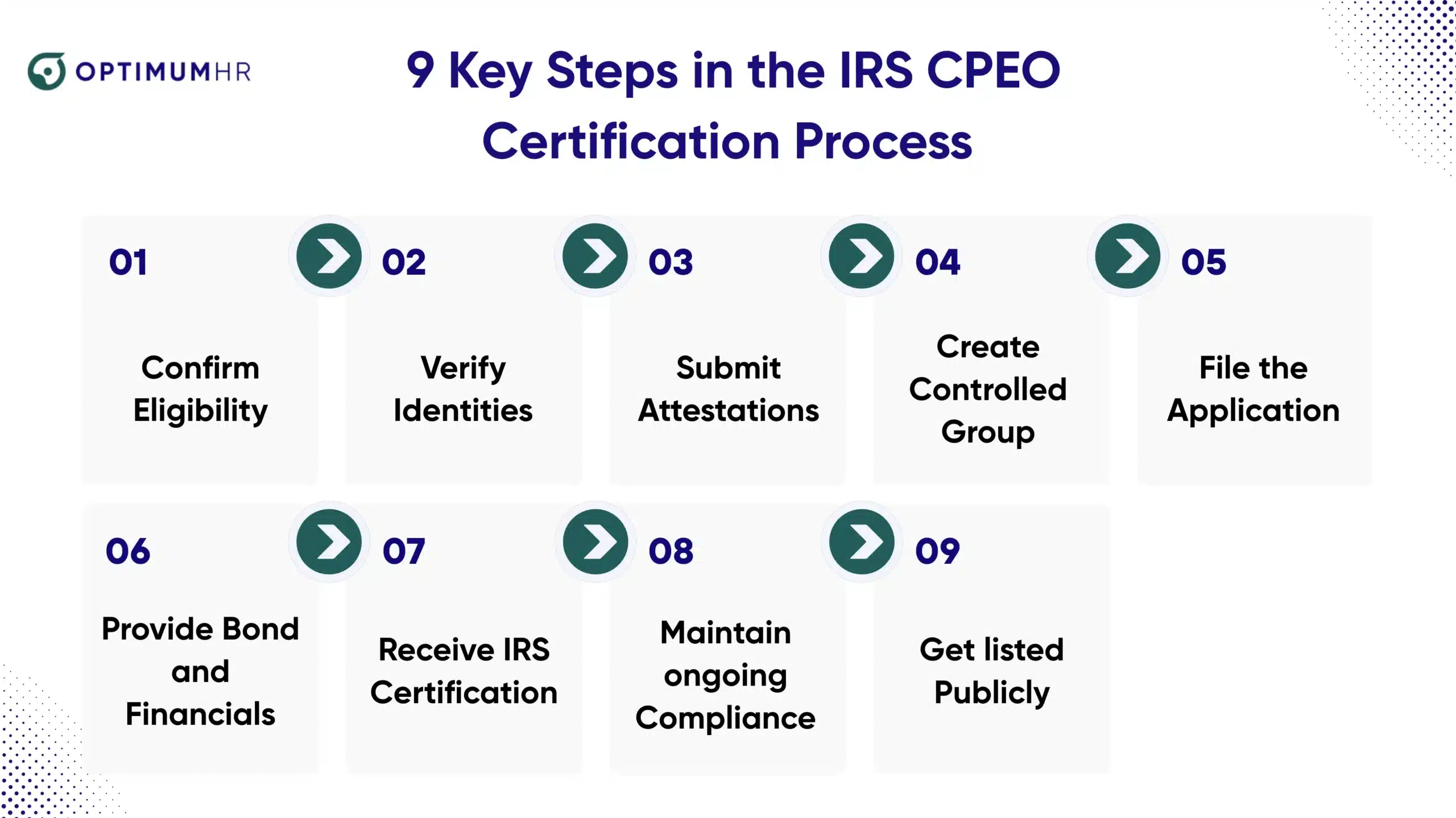
The IRS CPEO certification process involves verifying responsible individuals, reviewing audited financial statements, meeting surety bond requirements, maintaining ongoing compliance, and being listed in the IRS public CPEO directory. These requirements help the IRS evaluate a PEO’s financial responsibility, organizational integrity, and federal employment tax compliance.
The 5 key requirements of IRS CPEO certification are:
- Identity and background verification: The PEO must complete identity verification and background checks for responsible individuals, such as qualifying owners and corporate officers, to demonstrate organizational integrity.
- Audited financial statements: The PEO must submit audited financial statements and applicable Certified Public Accountant (CPA) attestations to demonstrate financial responsibility and federal employment tax compliance.
- Surety bond: The PEO must maintain an IRS-required surety bond to provide financial assurance for covered federal employment tax obligations.
- Ongoing compliance and reporting: The PEO must submit annual audited financial statements, quarterly employment tax compliance documentation, and required organizational updates to maintain its certification.
- Public certification listing: Once certification becomes effective, the IRS includes the CPEO’s legal business name and certification effective date in its public listing, allowing businesses to independently verify the provider’s certification status.
How Can You Verify Whether a PEO Is Actually IRS Certified?
You can verify whether a PEO is IRS certified by checking the official IRS CPEO Public Listings rather than relying solely on the provider’s website or marketing claims. The IRS publishes certified organizations, their certification effective dates, and separate lists of suspended or revoked CPEOs.
Follow these 5 steps to verify a PEO’s certification status:
- Visit the IRS website: Open the official CPEO Public Listings page to access the certification records.
- Find the provider’s legal name: Search the certified CPEO list for the organization’s exact registered business name.
- Compare entity details: Verify that the legal name matches the provider identified in your service agreement, including its Employer Identification Number (EIN).
- Check certification status: Review the certification effective date and check the IRS lists of suspended and revoked CPEOs.
- Confirm the contracting entity: Verify that the specific legal entity providing your services holds IRS certification, since related companies operating under the same brand may have different certification statuses.
What Happens If a CPEO’s Certification Is Suspended or Revoked?
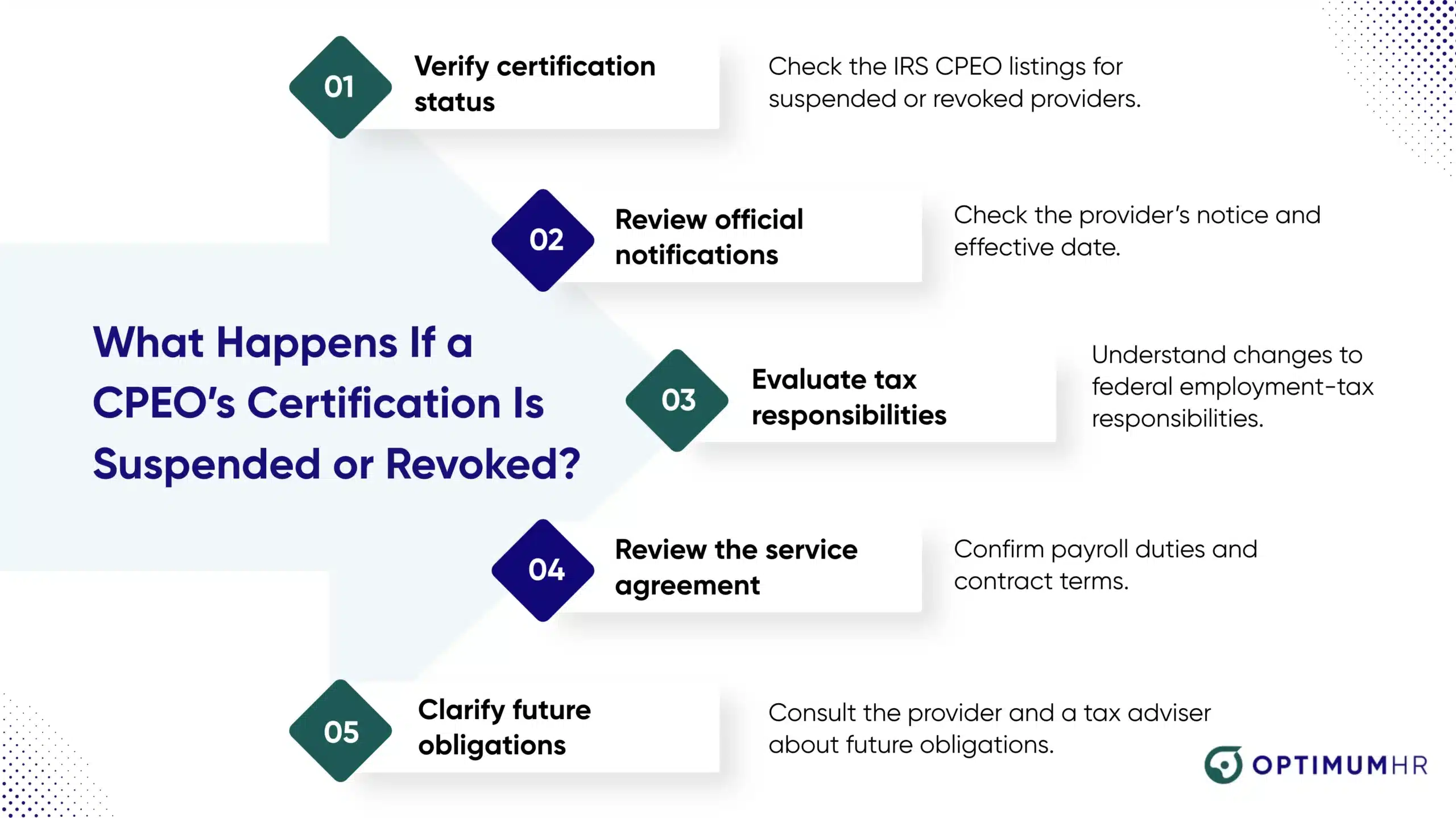
If a Certified Professional Employer Organization (CPEO) fails to maintain IRS certification requirements, the IRS may suspend or revoke its certification, potentially affecting employers’ federal employment-tax responsibilities. During suspension, special federal employment-tax treatment under Internal Revenue Code Section 3511 does not apply to new CPEO contracts, although existing qualifying contracts may remain covered. If certification is revoked or voluntarily terminated, that special tax treatment ends from the effective date, and client employers may become liable for applicable federal employment taxes.
Employers should take the following steps:
- Verify certification status: Check the IRS CPEO Public Listings for suspended or revoked organizations.
- Review official notifications: Examine the provider’s written notice and the effective date of any suspension, revocation, or termination.
- Evaluate tax responsibilities: Determine how the status change affects federal employment-tax liability under the existing service agreement.
- Review the service agreement: Confirm payroll reporting responsibilities, contract provisions, and any necessary changes to the arrangement.
- Clarify future obligations: Consult the provider and a qualified tax adviser to determine the appropriate employment-tax reporting and payment arrangements.
What Are the Benefits of Using a Certified PEO?
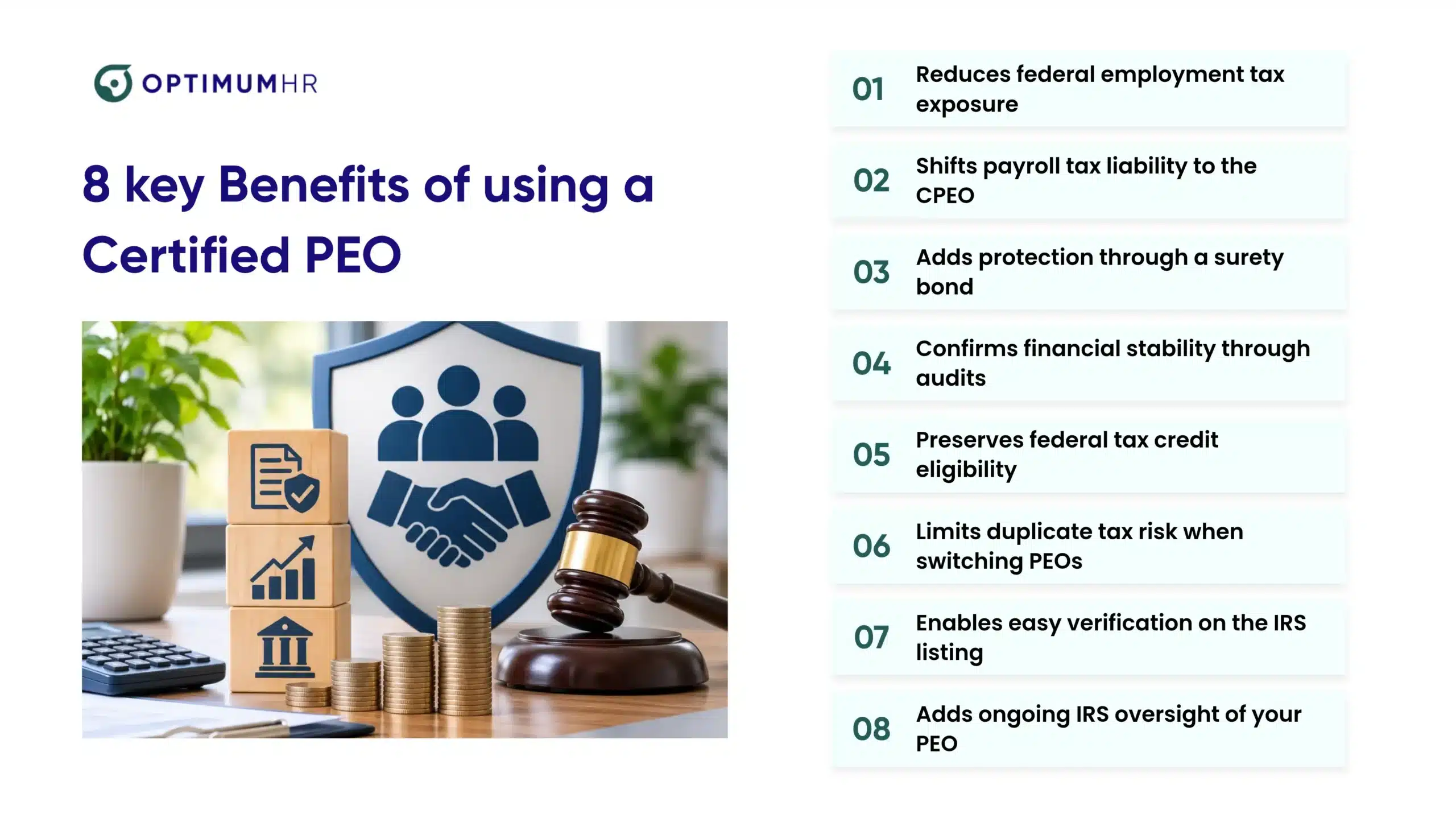
The benefits of using a Certified PEO include reduced federal employment tax risks, payroll tax liability protection, financial accountability, preserved tax credit eligibility, and ongoing IRS oversight. These advantages help businesses manage payroll tax obligations while maintaining compliance with federal tax regulations.
8 key benefits of using a certified PEO are:
- Reduces federal employment tax exposure
Working with a CPEO reduces federal employment tax exposure by establishing clear tax liability responsibilities under Internal Revenue Code Section 3511. According to the IRS Internal Revenue Manual, updated May 20, 2026, the IRS treats a CPEO as the sole employer for federal employment tax purposes for wages it pays to qualifying worksite employees. As a result, the CPEO assumes responsibility for applicable employment tax payments, deposits, and reporting, reducing the client’s direct exposure for those wages. However, both parties may remain liable for taxes involving non-worksite employees, depending on employee classification, covered compensation, and contractual terms. - Shifts payroll tax liability to the CPEO
When businesses struggle to manage payroll tax payments, reporting, and compliance, working with a CPEO can shift certain federal employment tax liabilities to the provider. According to IRS Publication 15 (2026), Employer’s Tax Guide, a CPEO is generally treated as the employer for federal employment tax purposes on wages it pays to qualifying worksite employees under an applicable CPEO contract. This arrangement places the responsibility for applicable federal income tax withholding, Social Security and Medicare taxes, and employment tax filings with the CPEO. However, employers may retain liability for non-worksite employees and compensation outside the qualifying arrangement. - Adds protection through a surety bond
CPEOs provide businesses with an additional layer of financial protection through a mandatory surety bond that covers specified federal employment tax obligations. According to IRS Revenue Procedure 2023-18, the required bond generally equals 5% of the CPEO’s federal employment tax liability from the preceding calendar year, subject to a minimum of $50,000 and a maximum of $1 million. This financial requirement benefits employers by adding accountability to the CPEO’s payroll tax responsibilities. If the CPEO fails to pay covered employment taxes, the IRS can seek payment from the surety company, although the bond does not eliminate every potential employer tax liability. - Confirms financial stability through audits
If a business wants greater financial transparency when outsourcing payroll and HR administration, working with a CPEO offers additional confidence through mandatory financial audits and ongoing financial oversight. CPEOs must submit annual audited financial statements reviewed by an independent Certified Public Accountant (CPA), along with quarterly working capital statements and federal employment tax compliance attestations. These reviews assess financial reporting accuracy, liquidity, and the organization’s ability to meet payroll and tax obligations. This provides employers with greater visibility into a provider’s financial accountability, although certification does not eliminate the possibility of future financial difficulties. - Preserves federal tax credit eligibility
As an SMB grows, working with a CPEO allows it to maintain eligibility for certain federal tax credits while outsourcing payroll and employment tax administration. Under Internal Revenue Code Section 3511(d), qualifying credits generally remain available to eligible client businesses rather than transferring to the CPEO. These may include the Research and Development (R&D) Tax Credit and certain employment-related credits. The CPEO must provide the wage and tax information needed to support applicable claims. However, eligibility depends on the employer meeting each credit’s specific requirements, including employee qualifications, eligible wages, and applicable tax rules. - Limits duplicate tax risk when switching PEOs
Working with a CPEO can help businesses avoid duplicate federal payroll taxes when entering or leaving a qualifying CPEO arrangement during the calendar year. Under Internal Revenue Code Section 3511(b), CPEOs and their clients receive predecessor-successor employer treatment for certain federal wage-base calculations. This allows previously paid wages to count toward applicable Social Security and Federal Unemployment Tax Act (FUTA) wage limits without automatically restarting those limits during the transition. However, this benefit applies to qualifying worksite employees and eligible contracts, and the treatment may differ when switching between separate PEO providers. - Enables easy verification on the IRS listing
CPEO helps businesses independently verify a provider’s IRS certification status before entering a payroll or HR service agreement. The IRS maintains public CPEO listings that identify certified organizations, their certification effective dates, and providers whose certification has been suspended or revoked. Since multiple legal entities may operate under the same business brand, employers should compare the provider’s exact legal name and Employer Identification Number (EIN) with their service agreement. Access to these official records adds greater transparency and makes it easier for businesses to evaluate a provider’s certification credentials during the selection process. - Adds ongoing IRS oversight of your PEO
When businesses work with a CPEO, they benefit from ongoing IRS oversight that promotes greater accountability in payroll administration and federal employment tax compliance. This oversight requires providers to continually meet financial, tax, bonding, and reporting requirements rather than relying solely on their initial certification. The IRS also monitors material organizational changes and can suspend or revoke certification when a provider fails to meet applicable standards. This gives employers additional confidence in their provider’s regulatory accountability and encourages consistent compliance throughout the business relationship.
What Is the Difference Between a Certified PEO and a Non-Certified PEO?
A Certified PEO is an IRS-certified professional employer organization that meets federal financial, tax compliance, and bonding requirements, whereas a non-certified PEO operates without IRS certification and does not receive the same federal employment tax liability protections. This distinction affects how businesses manage payroll tax responsibilities, assess financial reliability, and reduce employment tax risks.
| Comparison Factor | Certified PEO (CPEO) | Non-Certified PEO |
| IRS Certification Status | Voluntarily certified by the IRS | No IRS CPEO certification |
| Federal Employment Tax Liability | Generally assumes liability for qualifying worksite wages | Client may retain joint tax liability |
| Financial Requirements and Bonding | Mandatory audits and qualifying surety bond | No CPEO-specific federal requirements |
| Ongoing IRS Oversight | Continuing certification and compliance reviews | Standard applicable IRS oversight |
| Federal Tax Credit Eligibility | Specific statutory rules preserve eligible client credits | General tax credit eligibility rules apply |
| Mid-Year Switching and Wage Base Restarts | Special wage-base continuity rules may apply | General predecessor-successor rules may apply |
| Public Verification | Listed on the IRS CPEO public listings | No IRS CPEO listing |
| Provider Choice and Cost | Certification adds specific regulatory requirements. Service fees vary by provider, workforce size, benefits, and contract terms. | Offers an alternative for businesses that do not require CPEO-specific tax treatment. |
- IRS certification status
A CPEO has completed the voluntary IRS certification process, whereas a non-certified PEO has not obtained this federal designation. Under Internal Revenue Code Section 7705, certification requires meeting standards for financial responsibility, tax compliance, bonding, and organizational integrity. However, non-certified PEOs can still legally provide payroll administration, HR support, and employee benefits while following applicable regulations. The absence of certification does not necessarily indicate noncompliance or poor service quality.
- Federal employment tax liability
A CPEO generally assumes sole federal employment tax liability for wages paid to qualifying worksite employees under an applicable CPEO contract, whereas a non-certified PEO may share tax liability with its client. Under Internal Revenue Code Section 3511, CPEOs receive specific statutory treatment for covered wages. In contrast, non-certified PEO arrangements follow general employment tax rules, which may leave both parties liable. However, CPEO clients may still retain liability for non-worksite employees or uncovered compensation.
- Financial requirements and bonding
When considering financial responsibility, a CPEO must meet specific IRS requirements, including annual audited financial statements, independent CPA reviews, and a qualifying surety bond, whereas a non-certified PEO is not subject to these federal certification standards. These requirements provide additional financial accountability for CPEOs and support their federal employment tax obligations. In contrast, non-certified PEOs may follow state-specific licensing, bonding, financial reporting, or private accreditation requirements depending on their location and operations.
- Ongoing IRS oversight
A CPEO must continue meeting IRS certification requirements after approval, while a non-certified PEO operates outside the CPEO certification program. CPEOs undergo ongoing oversight through annual verification, financial reporting, employment tax compliance reviews, and surety bond requirements. In contrast, non-certified PEOs remain subject to applicable federal and state regulations but are not subject to these additional IRS certification obligations. Failure to maintain compliance can result in suspension or revocation of CPEO status.
- Federal tax credit eligibility
For small and medium-sized businesses (SMBs), a CPEO preserves eligibility for certain federal tax credits under Internal Revenue Code Section 3511(d), whereas a non-certified PEO follows general federal tax credit rules without these specific statutory provisions. CPEO clients can retain qualifying credits, including the Research and Development (R&D) Tax Credit, based on eligible employee wages. In comparison, non-certified PEO clients may also claim applicable credits, but eligibility and allocation depend on general tax laws and their employment arrangements.
- Mid-year switching and wage base restarts
A CPEO can help businesses avoid restarting certain federal payroll tax wage bases when entering or ending a qualifying CPEO contract mid-year, whereas a non-certified PEO does not receive the same statutory treatment. Under Internal Revenue Code Section 3511(b), qualifying CPEO transitions receive predecessor-successor employer treatment, allowing previously paid wages to count toward applicable Social Security and FUTA wage limits. In contrast, non-certified PEO arrangements follow general wage-base rules, which may restart depending on the circumstances.
- Public verification
A CPEO can be independently verified through the official IRS CPEO Public Listings, whereas a non-certified PEO will not appear as an active IRS-certified organization. The IRS publishes certified providers, their certification effective dates, and separate records of suspended or revoked certifications. Employers can compare the provider’s legal business name and Employer Identification Number (EIN) with their service agreement. Meanwhile, non-certified PEOs may provide other licensing or accreditation credentials, but these do not establish IRS CPEO certification.
- Provider choice and cost
A CPEO may have higher service costs and fewer provider options, while a non-certified PEO may offer greater flexibility. CPEOs must meet IRS requirements for financial audits, surety bonding, and ongoing compliance, which can increase operating expenses and influence service fees. However, neither option is necessarily more expensive. Actual pricing depends on the provider, service package, workforce size, employee benefits, and employer risk profile.
Optimum HR is an IRS Certified Professional Employer Organization (CPEO) for clients under its PEO arrangement. Our certified entity, Optimum Employer Solutions, LLC, has been on theIRS CPEO public listing since April 1, 2022.
What Should You Consider Before Choosing a Certified PEO?
Before choosing a Certified PEO, businesses should consider pricing, federal tax protection, industry and state coverage, employee benefits, HR support, service quality, client reviews, and IRS certification verification. Evaluating these factors helps businesses select a provider that meets their workforce needs, supports payroll compliance, and delivers reliable HR services.
5 key factors to consider when choosing a certified PEO are:
- Compare Pricing Against Added Tax Protection: Request detailed quotes and compare administrative fees, payroll costs, and the value of CPEO-specific federal employment tax treatment.
- Confirm Industry and State Coverage: Choose a CPEO familiar with your industry’s workforce requirements, state employment laws, payroll regulations, and workers’ compensation needs.
- Review Employee Benefits and HR Support: Evaluate health insurance, retirement plans, benefits administration, payroll services, and access to dedicated HR specialists.
- Evaluate Service Quality and Client Reviews: Check customer testimonials, client retention, response times, account management, and available HR support channels.
- Verify IRS Certification Before Signing: Check the IRS CPEO Public Listings and confirm that the certified legal entity matches the name and EIN in your service agreement.
When Does Working With a Certified PEO Make the Most Sense for Your Business?
Working with a CPEO makes the most sense for businesses with substantial payroll responsibilities that want clear federal employment tax treatment and that want greater financial accountability from their HR provider. It can be particularly valuable for growing small and medium-sized businesses that need dependable payroll administration, employee benefits, and ongoing HR support. IRS certification also lets employers verify a provider’s status through public records and confirms ongoing financial and compliance requirements. However, Businesses should compare service fees, industry experience, benefits packages, and provider availability to determine whether CPEO services meet their operational needs and budget.
Is a Certified PEO the Right Choice for Your Business?
Yes, a CPEO can be a right choice for businesses seeking defined federal employment tax responsibilities, additional financial safeguards, and independently verifiable IRS certification. However, certification alone should not determine your decision. Consider pricing, HR services, employee benefits, industry experience, payroll technology, customer support, and contract terms alongside the provider’s certification status. Evaluating these factors helps you select a certified PEO that aligns with your workforce requirements, operational priorities, and long-term business goals. To partner with an industry-leading Certified PEO, call Optimum HR at (888) 466-5521.