
PEO health insurance is group health coverage available through a Professional Employer Organization (PEO) that supports businesses with plan access, employee enrollment, benefits administration, and ongoing health insurance management. The process typically begins with selecting a PEO and defining shared responsibilities, then moves to employee pooling, plan selection, enrollment, and ongoing benefits support. Available benefits can include medical plans, PPOs, HMOs, high-deductible health plans, prescription coverage, dental, vision, life, and disability insurance.
Along with these benefits, employers should consider the costs and pricing factors associated with PEO health insurance. Overall, PEO costs can include health insurance premiums, administrative fees, PEO service fees, and initial setup costs. Employee demographics, claims history, location, plan design, and company risk can influence benefit rates. Depending on the plan structure and arrangement, relevant requirements can involve ERISA, the Affordable Care Act (ACA), COBRA, state insurance regulation, and rules that apply to plan sponsors and Multiple Employer Welfare Arrangements (MEWAs). As coverage continues, employers should review renewal notices, premium changes, current coverage, employee census data, available plans, and contract terms before deciding on a renewal strategy.
What Is PEO Health Insurance?
PEO health insurance is a way to access and administer employer-sponsored health benefits through a PEO relationship, where the PEO teams up with small and midsize businesses to coordinate plan access, benefits administration, and employee enrollment. By handling these functions, the PEO reduces the benefits-related administrative work managed internally. Eligible employees enroll in available plans, while the client employer manages its contribution toward coverage.
Some PEOs enroll worksite employees in PEO-sponsored large-group health plans, giving participating businesses access to a broader benefits structure. Coverage, provider networks, premiums, employer contributions, eligibility requirements, and plan availability vary by PEO, insurance carrier, workforce, and location.
How Does PEO Health Insurance Work?
PEO health insurance connects businesses and employees to group health plans through a PEO, which supports enrollment, benefits administration, and ongoing plan management. The PEO handles defined administrative responsibilities while the business continues to manage its employees and daily operations.
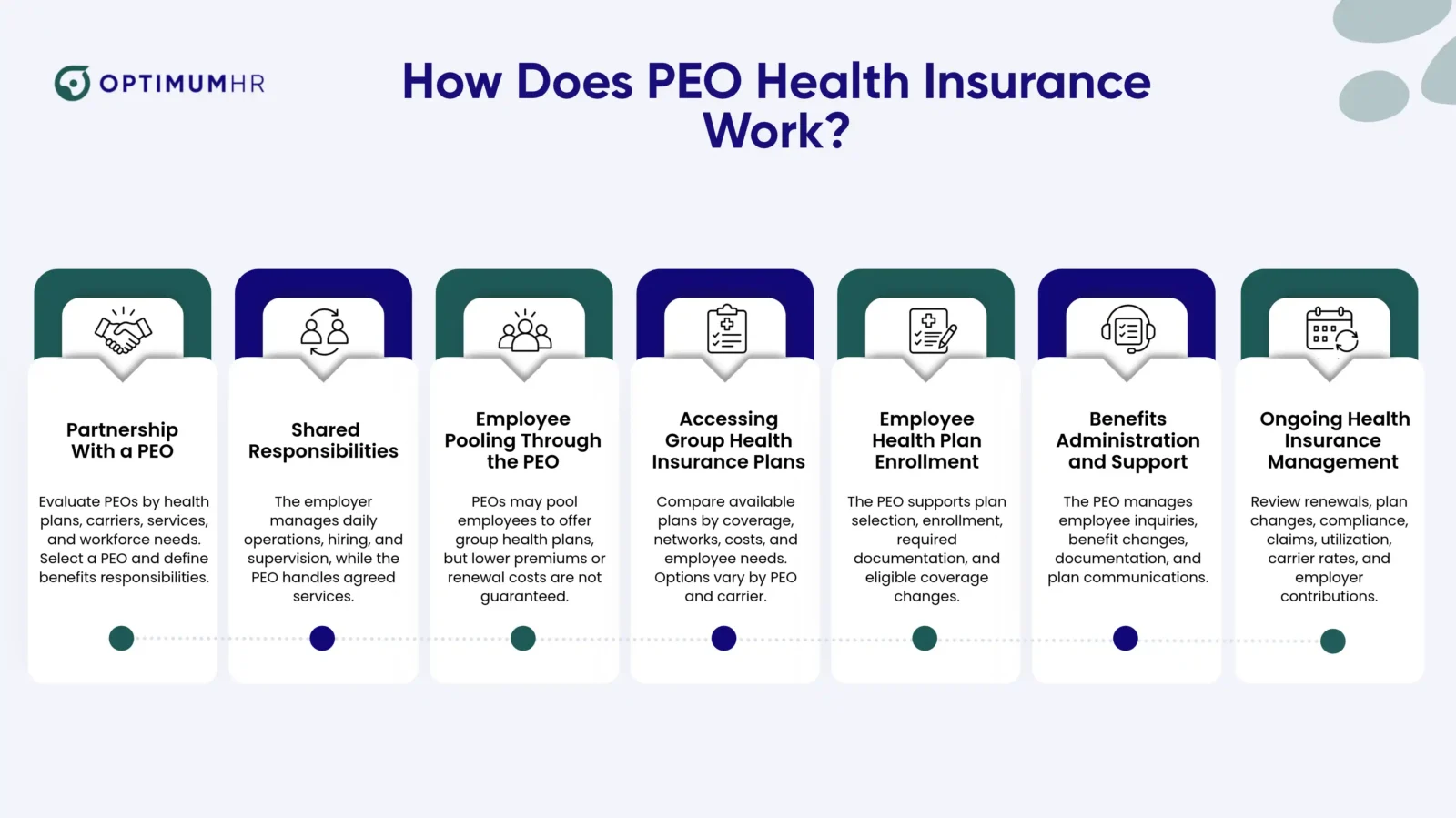
7 key steps in PEO health insurance work are as follows:
- Step 1: Partnership With a PEO
A business starts by evaluating PEOs based on available health plans, carrier relationships, benefits administration, service capabilities, and workforce needs. Employers should consider whether the PEO’s available benefits fit their employee population and whether its administrative support matches their internal resources. Once selected, the PEO works with the business to establish the appropriate service configuration and coordinate the benefits functions included within the PEO arrangement.
- Step 2: Shared Responsibilities
The business and PEO establish an arrangement that defines their shared responsibilities and the services the PEO will provide. The business generally maintains control over daily operations, employee supervision, hiring decisions, and workplace management.
- Step 3: Employee Pooling Through the PEO
A PEO may combine eligible employees from multiple client businesses within a broader benefits structure. This pooling model can provide smaller employers with access to group health plan options available through the PEO’s benefit programs. Employers can then evaluate those options based on their workforce and coverage needs. Participation in a larger employee pool does not automatically mean that health insurance premiums or future renewal costs will be lower.
- Step 4: Accessing Group Health Insurance Plans
Through its benefit programs and insurance carrier relationships, a PEO can provide participating businesses with access to available group health insurance plans. Employers review the available options based on factors such as plan design, coverage, provider networks, employee needs, and cost. The specific plans available depend on the PEO, carrier, workforce, and other applicable factors, so businesses should compare available coverage rather than assume every PEO offers the same options.
- Step 5: Employee Health Plan Enrollment
After the employer determines which health plans to offer, the PEO supports employees through the enrollment process. Employees can review available coverage, make benefit selections, provide required information, and complete enrollment through the PEO’s benefits process and technology. The PEO can also support eligible benefit changes when an employee experiences a qualifying event or needs to update coverage, helping the employer manage enrollment administration more efficiently.
- Step 6: Benefits Administration and Support
PEO support continues after employees complete enrollment. The PEO manages defined benefits administration functions, such as responding to employee questions, processing eligible enrollment changes, maintaining benefits documentation, and communicating plan information. This ongoing support can reduce the administrative workload placed on an employer’s internal team while giving employees a point of contact for benefits-related questions and assistance throughout their participation in the health plan.
- Step 7: Ongoing Health Insurance Management
Health insurance management continues through plan updates, renewals, employee benefit changes, and compliance support. During renewal, employers can review factors that may affect medical costs and coverage, including plan design, utilization, claims experience, carrier rates, employer contributions, and available plan options.
Optimum HR encourages businesses to look beyond the first-year medical rate when evaluating PEO health insurance. Rather than focusing only on the lowest initial price, Optimum works to establish realistic medical pricing expectations from the beginning and helps employers understand factors that may affect future renewals, such as utilization, claims experience, and plan design. The goal is to support a sustainable benefits strategy and long-term client relationship without promising a specific renewal rate or medical cost outcome.
What Health Insurance Plans Do PEOs Offer?
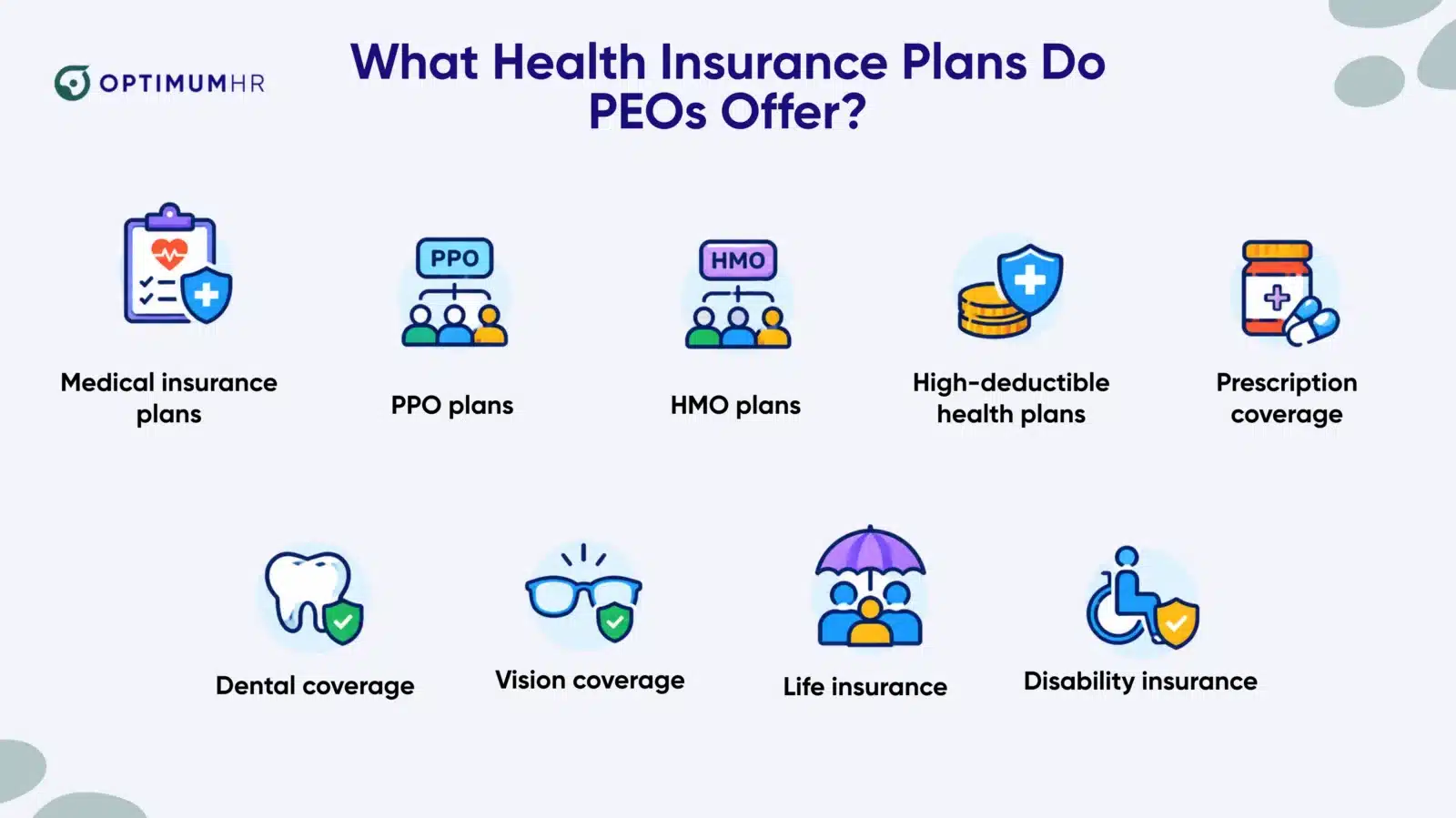
PEOs may offer employee benefits such as medical insurance, PPO and HMO plans, high-deductible health plans, prescription coverage, dental and vision coverage, life insurance, and disability insurance. Available plans and coverage options vary by PEO, insurance carrier, location, and the employer’s benefit program.
PEOs may offer the following 9 coverage options:
- Medical insurance plans
Medical insurance plans provide core healthcare coverage for services such as physician visits, hospital care, preventive care, emergency treatment, and other covered medical expenses. Through a PEO, businesses may access group medical plans while the PEO coordinates enrollment and ongoing benefits administration. Employers should also look beyond the initial premium and ask how medical rates are developed and what factors can affect future renewals. PEO medical underwriting may consider workforce demographics, plan design, health-risk indicators, medical and pharmacy data, and projected healthcare costs when developing pricing.
- PPO plans
Preferred Provider Organization (PPO) plans give employees access to a network of contracted doctors, hospitals, and other healthcare providers. Employees generally pay less when they receive care within the network but can usually visit out-of-network providers for an additional cost. PPOs also generally provide more flexibility when selecting providers than plans with stricter network requirements. When comparing PPO options offered through a PEO, employers should review network availability, deductibles, copays, coinsurance, out-of-pocket limits, and out-of-network costs to understand how each plan may affect both employee access to care and overall benefit costs.
- HMO plans
Health Maintenance Organization (HMO) plans generally require employees to obtain covered care from doctors and healthcare facilities within the plan’s network, except for qualifying emergency services. Some HMOs also use defined service areas and coordinated care structures. This can make a particular HMO’s availability depend on where employees live or work. Businesses considering an HMO through a PEO should compare provider networks, employee locations, plan costs, referral requirements, deductibles, and copays. Reviewing these factors helps determine whether the available network can reasonably serve the employer’s workforce.
- High-deductible health plans
High-deductible health plans (HDHPs) use higher deductibles before much of the plan’s cost-sharing begins and may allow eligible employees to contribute to a Health Savings Account (HSA). For 2027, an HSA-qualified high-deductible health plan (HDHP) must have a minimum deductible of $1,750 for self-only coverage or $3,500 for family coverage, with annual out-of-pocket expenses limited to $8,750 and $17,000, respectively. A PEO may support plan enrollment, payroll deductions, and related HSA administration where offered. When evaluating an HDHP, employers should compare premiums, deductibles, HSA contributions, and expected healthcare use.
- Prescription coverage
PEO medical plans may include prescription drug coverage that helps employees pay for medications covered under the plan. Rather than functioning as a completely separate PEO insurance plan in many cases, prescription benefits are typically connected to the employee’s medical coverage and governed by the carrier’s formulary, pharmacy network, and cost-sharing structure. The PEO can support enrollment and provide employees with benefits information and access to available plan resources. Employers should compare formularies, pharmacy networks, deductibles, copays, coinsurance, specialty-drug provisions, and prior authorization requirements when reviewing PEO medical options, especially when employees regularly use prescription medications.
- Dental coverage
Employers may use a PEO to offer group dental insurance alongside medical benefits, allowing them to provide dental coverage through the same broader PEO benefits program. Plans can provide different levels of coverage for preventive, basic, and major dental services depending on the carrier and policy terms. The PEO can handle eligibility, enrollment, payroll deductions, employee communications, and ongoing benefits administration. Employers should compare provider networks, deductibles, annual maximums, waiting periods, covered procedures, and contribution requirements.
- Vision coverage
PEOs provide access to vision benefits alongside medical and dental coverage as part of a broader employee benefits package. Depending on the carrier and plan, coverage may contribute toward routine eye examinations, prescription lenses, frames, or contact lenses according to specified allowances and usage limits. The PEO can coordinate employee eligibility, enrollment, payroll deductions, and benefits communication. Employers comparing PEO vision options should review participating providers, examination copays, frame and contact allowances, replacement frequencies, employee contributions, and coverage restrictions. NAPEO currently lists vision care among the benefits small-business employees may access through PEO arrangements.
- Life insurance
PEOs can offer group life insurance as part of broader employee benefits packages, although life insurance is separate from medical coverage. Depending on the PEO and carrier, businesses may offer basic employer-paid life insurance, voluntary employee-paid coverage, or supplemental options. The PEO can administer eligibility, enrollment, beneficiary information, payroll deductions, and employee communications.
- Disability insurance
Employers can include group disability insurance through a PEO as part of a broader benefits program, alongside medical coverage and other benefits. These plans can provide eligible employees with partial income replacement when a qualifying illness or injury prevents them from working, subject to policy terms. The PEO may coordinate eligibility, enrollment, payroll deductions, and benefits communication. Employers should compare benefit percentages, waiting periods, maximum benefit periods, coverage limits, and contribution structures. NAPEO’s December 2024 Annual Tracking Survey specifically included disability insurance among the health insurance benefits that respondents associated with PEO services.
What Are the Benefits of PEO Health Insurance?
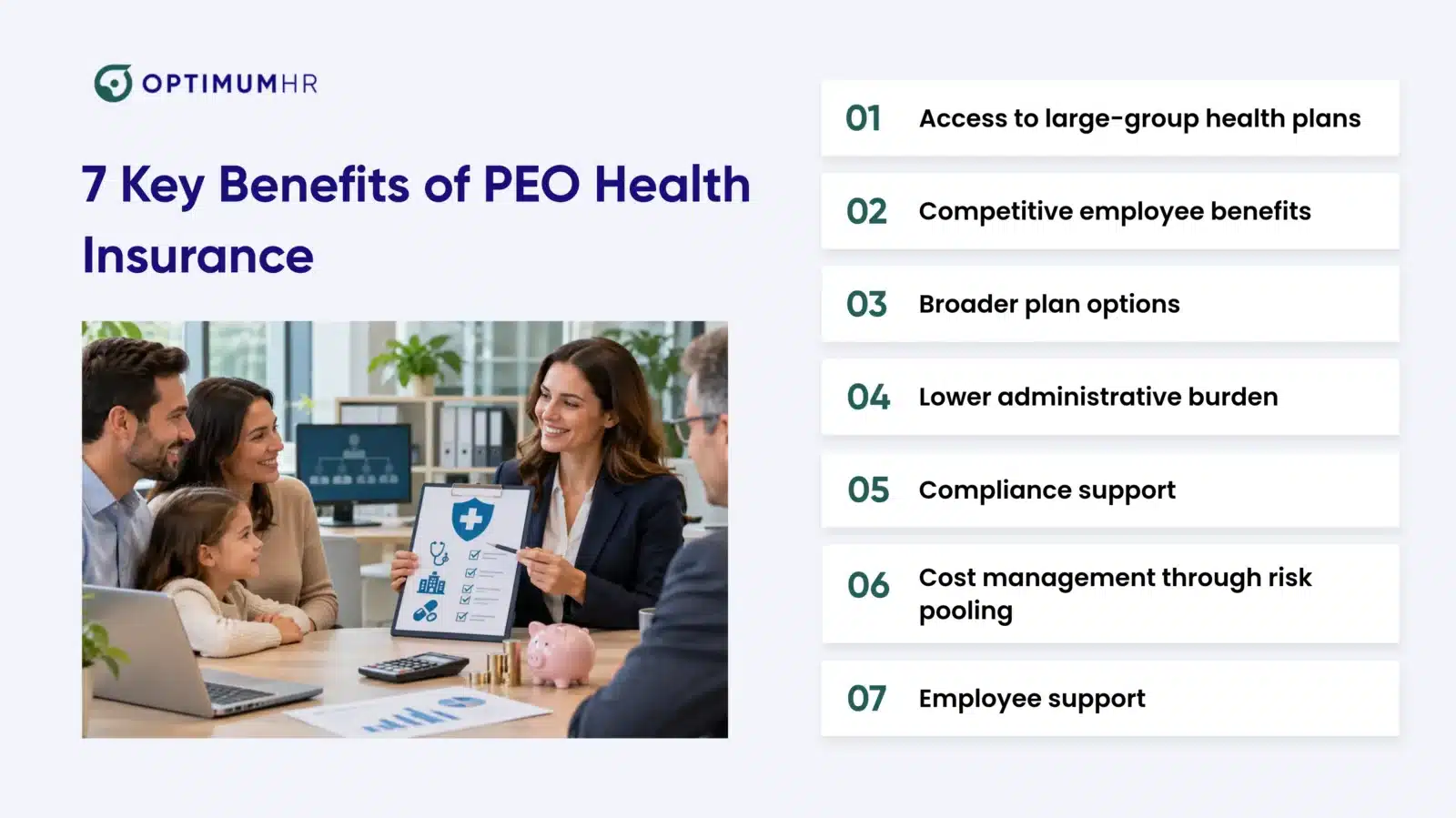
The key benefits of PEO health insurance include access to large-group health plans, competitive employee benefits, broader plan options, lower administrative burden, compliance support, cost management through risk pooling, and ongoing employee support. These advantages can help businesses manage health coverage more efficiently while giving employees structured access to benefits and support.
7 key benefits of PEO health insurance are:
- Access to large-group health plans
PEO health insurance gives participating businesses access to PEO-sponsored large-group health plans through a shared employment arrangement. The PEO can also coordinate enrollment, administration, and employee support. Plan availability depends on the carrier, employee location, workforce characteristics, and eligibility requirements. Access does not guarantee lower premiums, so employers should compare coverage, networks, costs, and renewal terms.
- Competitive employee benefits
When businesses work with a PEO, they can offer a structured benefits package that may include medical, dental, vision, life, and disability coverage. These benefits can support recruitment and retention by strengthening the overall employee compensation package. NAPEO’s 2024 research found that PEO clients had employee turnover rates 12% lower than comparable non-PEO businesses, although the study does not attribute that difference solely to benefits. Employers should still evaluate workforce needs, available plans, contribution levels, coverage, and long-term costs when building a benefits package.
- Broader plan options
For businesses seeking greater flexibility in health coverage, a PEO can provide access to multiple plan options through its benefits programs and carrier relationships. Through a PEO, available choices may include PPOs, HMOs, HDHPs, and other plans. Each plan type offers different approaches to provider access, cost sharing, and employee healthcare expenses. Employers should compare networks, deductibles, copays, contributions, and coverage structures because availability varies by carrier, employee location, eligibility, and PEO program.
- Lower administrative burden
During the plan year, PEO health insurance can reduce the administrative work involved in managing employee health benefits. A PEO can support health plan enrollment, eligibility updates, payroll deductions, benefits documentation, employee communications, and routine benefits questions. By handling agreed benefits administration functions, the PEO can reduce the day-to-day workload placed on an employer’s internal HR team. The specific responsibilities depend on the PEO arrangement, selected services, and health plans offered.
- Compliance support
PEO health insurance can provide administrative support for health benefits compliance, including ACA requirements, ERISA plan administration, COBRA continuation, HIPAA-related benefits administration, eligibility tracking, and required employee notices. Depending on the plan structure, support may also cover Summary Plan Description (SPD) distribution, plan documentation, and Form 5500 requirements where applicable. Responsibilities vary by PEO and arrangement, while employers remain responsible for obligations assigned under applicable laws and the PEO agreement.
- Cost management through risk pooling
For employers managing health insurance costs, a PEO’s risk pooling structure can provide access to a broader benefits pool that includes eligible employees from multiple client businesses. It does not guarantee lower premiums, since medical insurance costs and renewals depend on factors such as claims experience, workforce characteristics, location, carrier requirements, and plan design. Employers should consider these factors alongside the initial medical rate when evaluating the overall value of a PEO health plan.
- Employee support
PEO health insurance can provide employees with ongoing support to understand and manage their health benefits. Employees can receive assistance with plan information, enrollment, eligible coverage changes, benefits resources, and routine questions throughout the plan year. This support can make it easier for employees to access benefits information while reducing routine inquiries handled by an employer’s internal HR team. Optimum HR combines benefits technology with dedicated, high-touch benefits support, giving clients access to benefits professionals when health insurance questions require personal assistance. The level of support depends on the services included in the PEO arrangement.
A competitive first-year medical rate can be attractive, but employers should also understand what can affect future renewals. One employer who spoke with Optimum HR shared:
“My first year was fine.”
The employer reported a 25% to 35% increase the following year with a previous PEO. While this reflects one employer’s experience, it highlights why businesses should consider more than the initial price. Claims experience, utilization, plan design, and medical cost trends can influence renewal pricing.
Optimum HR focuses on setting realistic medical rate expectations from the start and helping clients understand factors that can affect future renewals, without promising a specific renewal outcome.
How Much Does PEO Health Insurance Cost?
Actual employer costs depend on the plan type, employee age, geographic location, carrier, provider network, coverage tier, employer contribution, workforce size, and PEO arrangement. Administrative or PEO service fees may also apply separately.
What Costs Are Included in PEO Health Insurance Pricing?
PEO health insurance pricing primarily includes health insurance premiums and any applicable carrier fees. These costs depend on the selected health plan, employee coverage needs, and carrier requirements. Employers should review these expenses separately from PEO administrative and setup fees to understand the cost of providing employee health coverage.
- Health insurance premiums
Health insurance premiums are the primary cost associated with providing employee medical coverage through a PEO. Premium amounts vary based on factors such as the selected health plan, workforce characteristics, geographic location, coverage tier, and applicable carrier requirements. Employers should evaluate premiums alongside plan design, employee contributions, and factors that can influence future renewals rather than focusing only on the initial medical rate.
- PEO service fees
PEO pricing is typically structured either as a percentage of payroll or as a per-employee-per-month (PEPM) fee. Optimum HR usually uses a PEPM model, which provides more predictable pricing and helps clients avoid costs increasing simply because payroll increases. General PEPM administrative costs typically range from $100 to $150 per employee per month. Final pricing depends on employee count, benefits needs, workers’ compensation exposure, and service scope.
What Factors Affect PEO Health Insurance Rates?
The key factors that affect PEO health insurance rates include employee demographics, claims history, geographic location, plan design, employer contribution strategy, and the characteristics of the PEO risk pool. These components can influence initial pricing and future renewals, so employers should consider the overall rate structure rather than focusing only on the first-year cost.
5 Key factors that affect PEO health insurance rates are:
- Employee demographics
Specific workforce characteristics can influence PEO health insurance rates, including employee age, geographic location, family or dependent enrollment, and selected coverage tiers such as employee-only or family coverage. Changes in the covered employee population can also affect costs over time. The factors an insurance carrier may use for rating or underwriting depend on the applicable insurance market, plan structure, location, and regulatory requirements.
- Claims history
Historical claims experience and healthcare utilization can affect health insurance pricing and renewal considerations by showing how a covered population has used healthcare services during previous periods. Depending on whether the plan is fully insured or self-funded, a PEO may consider an employer group’s claims experience when evaluating future costs. The role of claims data varies by PEO, carrier, plan structure, and underwriting approach, so employers should review how claims experience factors into their specific renewal process.
- Geographic location
Employee location can influence PEO health insurance rates through regional healthcare costs, provider pricing, carrier availability, and network differences. Average health insurance premiums in California were higher than those in some other states. Employers with workers across multiple states should therefore review available carrier networks, plan service areas, and regional pricing when evaluating PEO health insurance costs.
- Plan design
Plan design affects PEO health insurance costs through deductibles, copays, coinsurance, provider networks, and out-of-pocket limits. BLS reported that 94% of private-industry workers in medical plans had an annual deductible in 2024, showing how common cost-sharing is in employer coverage. Employers should compare plan structure with workforce needs because it can affect both premiums and employee healthcare costs.
- PEO risk pool
A PEO risk pool can influence health insurance pricing and benefit access by combining eligible employees from multiple client businesses within a broader benefits structure. This larger pool can affect how carriers evaluate risk and structure available health plans. However, participation in a PEO risk pool does not guarantee lower rates. Pricing can still depend on claims experience, workforce characteristics, geographic location, plan design, carrier requirements, and other applicable factors.
How Does PEO Health Insurance Renewal Work?
PEO health insurance renewal works by following a renewal timeline, reviewing the renewal notice and premium changes, evaluating current coverage and employee census data, comparing available plans, reviewing contract terms, and deciding on a renewal strategy. This process helps employers understand potential cost and coverage changes before selecting the health plan approach that fits their workforce and benefits needs.
Below are the 8 key steps in the PEO health insurance renewal process.
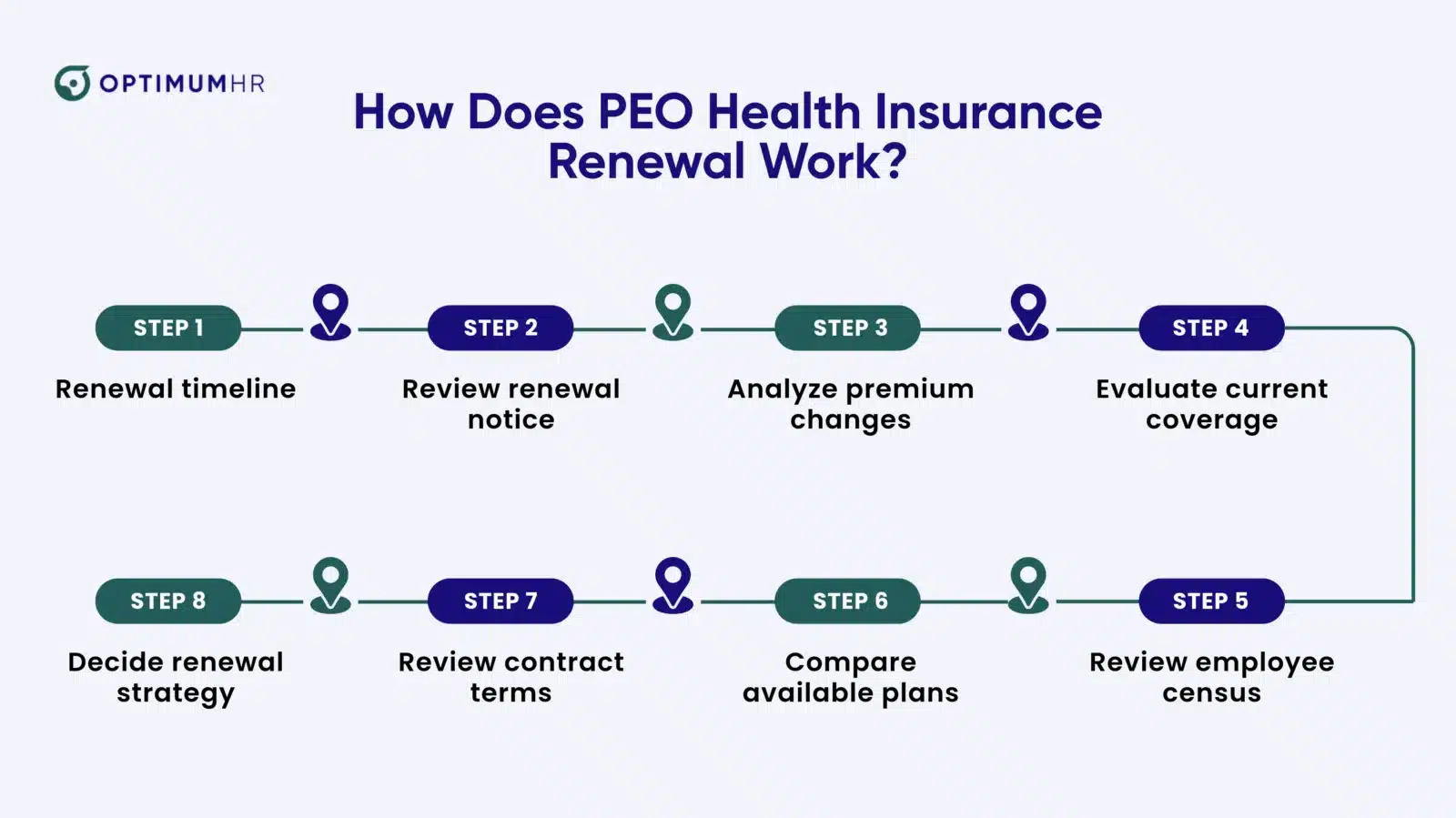
- Renewal timeline
Businesses should begin reviewing PEO health insurance renewal information early enough to understand potential pricing and coverage changes before the current plan ends. Starting the process early gives employers time to review renewal details, update workforce information, compare options, and prepare benefit decisions. The specific renewal timeline depends on the PEO, insurance carrier, and health plan.
- Review renewal notice
Once the renewal notice is available, employers should review the carrier’s renewal rate or rate action, plan design changes, premiums, coverage terms, provider networks, prescription drug formularies, and other applicable updates. Comparing these details with the current plan helps identify cost or coverage changes that require further discussion before deciding on renewal.
- Analyze premium changes
When renewal pricing changes, employers should look beyond the percentage increase and consider factors that may have influenced the new premium. Depending on the PEO arrangement and available reporting, this may include claims experience, loss ratio information, healthcare utilization, workforce changes, plan design, carrier pricing, and broader medical cost trends. Understanding these factors can help employers evaluate the renewal rate in context and identify areas to discuss with their PEO before selecting coverage.
- Evaluate current coverage
Employers should assess whether their current health coverage continues to meet employee needs and the business’s benefits goals. This review can include provider networks, deductibles, copays, coverage levels, employee participation, and plan usage. Evaluating current coverage can help businesses identify plan features that remain suitable and areas that may require adjustments during the upcoming plan year.
- Review employee census
Review and update the employee census before evaluating PEO health insurance renewal options. Confirm employee eligibility, age, location, coverage tier, and dependent enrollment information so the PEO can assess benefit costs and available plan options using current workforce data. Verify that census information is accurate before comparing renewal alternatives, as workforce changes can affect plan availability and pricing considerations.
- Compare available plans
Next, compare available health plans based on premiums, coverage levels, provider networks, deductibles, copays, out-of-pocket costs, and employee needs. Review these factors together to understand how each option differs in both cost and coverage. Consider the PEO benefits program, carrier availability, employee locations, eligibility requirements, and applicable plan criteria, as these factors can determine which health plan options are available for renewal.
- Review contract terms
Before renewing, employers should review applicable PEO agreements and benefit terms to understand service conditions, responsibilities, fees, renewal provisions, and other requirements. This review can clarify what the PEO manages and what remains the employer’s responsibility. Businesses should also identify terms that could affect benefit changes, plan selection, or service continuation during the next plan year.
- Decide renewal strategy
After reviewing pricing, coverage, workforce information, available plans, and applicable terms, employers can determine their renewal strategy. Depending on the available options, the business may continue its current coverage, adjust the plan design or contribution structure, or select a different available plan. The decision should consider both current employee benefit needs and factors that can affect health insurance costs over the next plan year.
Optimum HR supports businesses throughout the health insurance renewal process by helping them review plan options, understand pricing factors, and prepare for potential changes. Rather than focusing only on the first-year medical rate, Optimum HR emphasizes realistic rate expectations and the factors that can influence future renewals. Its high-touch service model also gives clients access to dedicated benefits support when renewal questions require personal assistance.
How Can Businesses Optimize PEO Health Insurance Costs?
Businesses can optimize PEO health insurance costs by adjusting plan design, evaluating employer contribution strategies, and comparing provider networks. Reviewing these areas can help employers identify cost-management opportunities while maintaining health coverage that supports their workforce needs.
Below are the 3 ways businesses support the health insurance renewal process.
- Adjust plan design
Consider whether changes to plan design could better balance health insurance costs with employee needs. Adjustments to deductibles, provider networks, copays, or coverage structures can influence both employer expenses and employee cost sharing. Employers offering high-deductible health plans can also review HSA employer contributions when assessing total plan costs and employee cost sharing.
- Evaluate contribution strategy
Review employer and employee contributions toward health insurance premiums across coverage tiers, such as employee-only, employee-plus-dependent, and family coverage. Employers can compare contribution levels, dependent coverage costs, and HSA employer contributions to understand how different strategies affect business expenses and employee affordability.
- Compare provider networks
Evaluate provider networks based on employee access, geographic coverage, and overall plan value. Assess whether employees can access appropriate physicians, hospitals, and other healthcare providers within each available network. Consider network differences alongside premiums and cost-sharing requirements to identify options that balance employee access with the business’s health insurance cost considerations.
How Does PEO Health Insurance Compare With Traditional Health Insurance?
PEO health insurance provides coverage through a PEO arrangement with shared benefits administration, whereas traditional employer health insurance is obtained and managed directly by the employer. This difference affects how employers select plans, enroll employees, administer benefits, and provide ongoing support.
| Comparison Factor | PEO Health Insurance | Traditional Employer Health Insurance |
| Group Health Plan Access | Access may be available through PEO-sponsored plans and carrier relationships. | Employer obtains carrier-direct group coverage, often through a broker. |
| Administrative Responsibility | PEO supports enrollment and ongoing benefits administration. | Employer manages administration internally or through a broker or provider. |
| Compliance Support | PEO provides defined benefits and compliance support within the arrangement. | Employer retains its responsibilities, often with outside support. |
| Plan Structure and Flexibility | Options depend on the PEO, carrier, eligibility, location, and funding structure. | Coverage may be fully insured or self-funded, depending on the employer and arrangement. |
How Can Businesses Choose a PEO for Health Insurance?
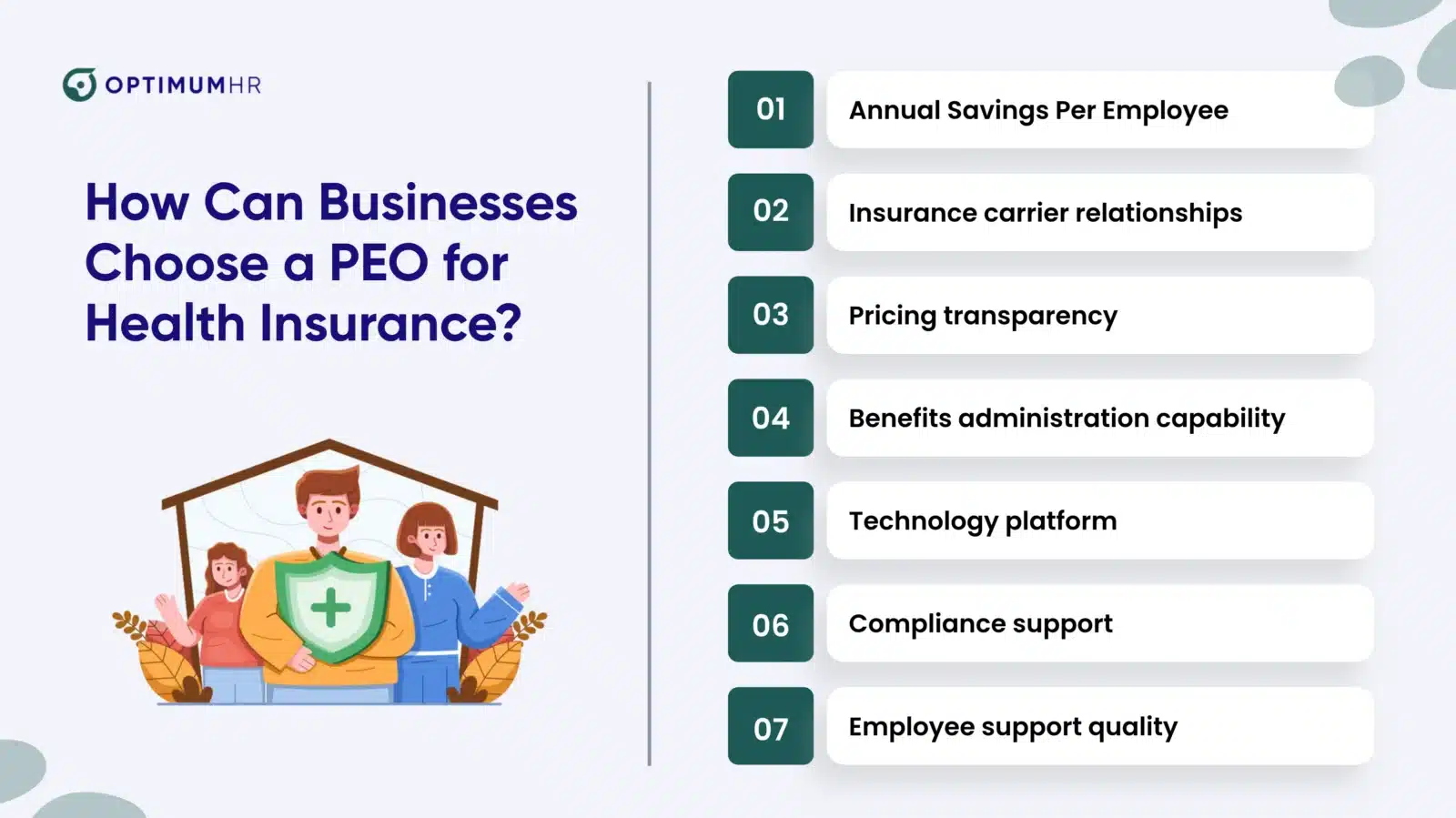
Businesses can choose a PEO for health insurance by evaluating health plan options, insurance carrier relationships, pricing transparency, benefits administration capabilities, technology platforms, compliance support, and employee support quality. Reviewing these factors can help employers select a PEO that aligns with their workforce needs, service expectations, and long-term benefits strategy.
7 key factors to consider when choosing a PEO for health insurance are:
- Health plan options: Review the medical plans and related benefits available through the PEO and determine whether they fit employee needs. Consider plan types, provider networks, coverage levels, cost-sharing structures, employee locations, and carrier availability.
- Insurance carrier relationships: Assess the PEO’s insurance carrier relationships because they can influence available health plans, provider networks, coverage options, and benefits administration. Confirm that available carrier options provide suitable access for the locations where employees live and work.
- Pricing transparency: Understand how premiums, PEO fees, administrative costs, and other applicable charges are structured before selecting a PEO. Ask how medical rates are developed, what factors can influence renewal pricing, and how the PEO communicates potential cost changes.
- Benefits administration capability: Evaluate how the PEO manages enrollment, eligibility changes, benefits documentation, employee communication, and ongoing plan administration. A clear benefits administration process can reduce internal workload and provide consistent support throughout the plan year.
- Technology platform: Review the PEO’s HR technology for employee access, benefits enrollment, reporting, payroll integration, and benefits management. Technology should make routine administration easier while providing employees and employers with access to the information they need.
- Compliance support: Assess how the PEO supports benefit-related administrative requirements, including applicable documentation, employee notices, eligibility processes, and compliance guidance. Confirm which responsibilities the PEO supports and which remain with the employer under the PEO arrangement.
- Employee support quality: Consider how employees receive help with enrollment, plan information, coverage changes, and ongoing benefits questions. Evaluate whether support is accessible and whether employees can reach knowledgeable benefits professionals when they need personal assistance.
Businesses can rely on Optimum HR for high-touch PEO health insurance support that combines HR technology with dedicated benefits professionals. Optimum HR helps clients evaluate plan options, understand benefits costs, manage ongoing administration, and address employee questions with long-term workforce needs in mind.