

HR outsourcing reduces operating costs through economies of scale, provides access to specialized HR expertise, improves compliance, reduces legal risks, and frees up time for strategic priorities. It also provides scalable HR support, competitive employee benefits, streamlined recruitment, advanced HR technology and workforce insights, improved employee engagement and retention, and fewer payroll and administrative errors. These advantages support startups, small businesses, mid-sized companies, and large enterprises, depending on their workforce needs.
Businesses can access these benefits by outsourcing payroll, recruitment, benefits administration, compliance, performance management, training, employee relations, and HR reporting. Depending on their needs, they can choose PEOs, ASOs, HR consulting, HRO providers, payroll and benefits services, RPO, fully outsourced HR departments, or hybrid models. Choosing the right HR outsourcing model allows businesses to address workforce challenges, improve operational efficiency, and align HR support with their size, budget, and long-term business goals.
10 Benefits of HR Outsourcing are:
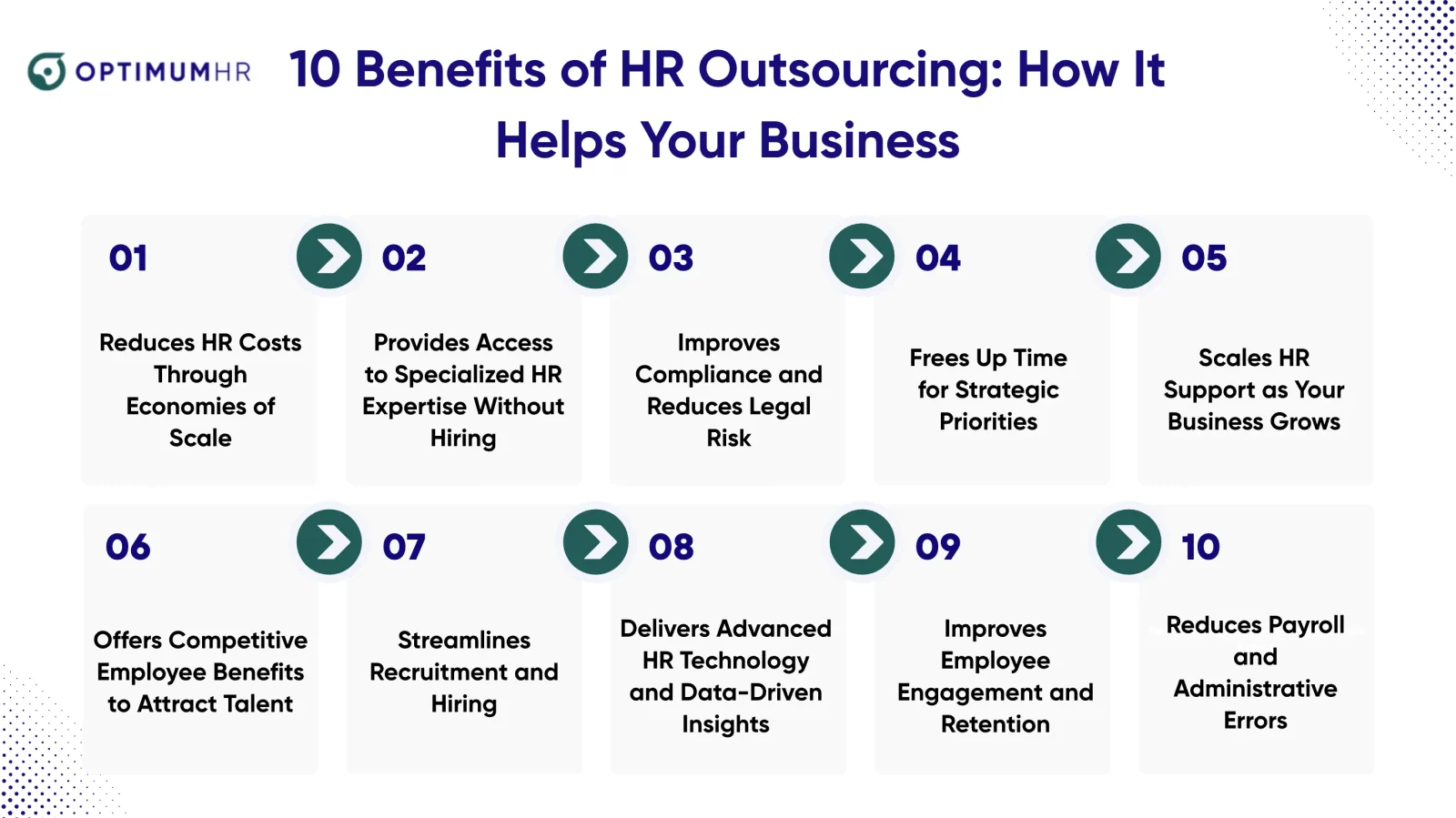
- Reduces HR Costs Through Economies of Scale
- Provides Access to Specialized HR Expertise Without Hiring
- Improves Compliance and Reduces Legal Risk
- Frees Up Time for Strategic Priorities
- Scales HR Support as Your Business Grows
- Offers Competitive Employee Benefits to Attract Talent
- Streamlines Recruitment and Hiring
- Delivers Advanced HR Technology and Data-Driven Insights
- Improves Employee Engagement and Retention
- Reduces Payroll and Administrative Errors
- Reduces HR Costs Through Economies of Scale
When businesses outsource HR functions to a service provider, they reduce HR costs through economies of scale by sharing resources, expertise, and infrastructure with other businesses. Instead of hiring separate specialists for payroll, benefits administration, recruitment, and HR compliance, businesses can access these services without maintaining a full in-house HR team. This reduces expenses associated with employee salaries, administrative staffing, and departmental overhead.
HR outsourcing also reduces technology expenses because service providers distribute the costs of HR software, payroll systems, employee databases, and system maintenance across multiple clients. Businesses can therefore reduce spending on software licences, system upgrades, and administrative infrastructure while accessing established HR technology and services without bearing the full cost of maintaining equivalent internal resources.
- Provides Access to Specialized HR Expertise Without Hiring
HR outsourcing gives businesses access to specialized HR professionals without hiring separate employees for every HR function. HR outsourcing providers offer expertise in payroll processing, employee benefits administration, employment law compliance, recruitment, employee relations, and performance management. This allows businesses to address HR knowledge and capability gaps that their internal teams may not be able to manage.
According to the CIPD’s People Profession 2023: International Survey Report, which surveyed 2,957 HR professionals across nine countries, important HR capabilities include talent management, employment law, data analytics, business transformation, and conflict resolution. In the United States, outsourced HR professionals can also help employers interpret requirements under the Fair Labor Standards Act (FLSA), Family and Medical Leave Act (FMLA), and Equal Employment Opportunity Commission (EEOC) regulations.
- Improves Compliance and Reduces Legal Risk
By outsourcing HR functions to a specialized service provider, businesses can improve employment law compliance and reduce legal risk through professional guidance, standardized HR processes, and regular compliance reviews. HR outsourcing providers help businesses maintain accurate employee records, manage payroll requirements, administer employee benefits, review employee classifications, and update workplace policies in accordance with applicable regulations. This support helps identify compliance gaps, reduce administrative errors, and maintain consistent HR practices. In the United States, HR outsourcing providers help businesses comply with federal laws such as the FLSA, FMLA, ADA, ACA, COBRA, and OSHA, as well as state wage-and-hour laws. They assist with minimum wage and overtime calculations, employee classification, leave administration, benefits compliance, workplace accommodations, and safety recordkeeping.
HR outsourcing providers also monitor changes in employment laws, assist with regulatory reporting, maintain required documentation, and recommend corrective actions when compliance issues arise. By addressing potential violations early, businesses can reduce their exposure to employment disputes, regulatory penalties, and legal claims. However, outsourcing HR responsibilities does not eliminate an employer’s legal obligations, and businesses remain accountable for complying with applicable employment laws.
- Frees Up Time for Strategic Priorities
HR outsourcing helps businesses save administrative hours by transferring recurring tasks, such as payroll processing, benefits administration, onboarding paperwork, employee recordkeeping, and HR reporting, to external providers. Automated HR workflows and employee self-service portals let employees access pay stubs, update personal information, and manage benefits without needing direct HR support. Businesses can measure these time savings by tracking monthly administrative hours, payroll processing time, onboarding completion time, and the number of routine employee requests handled through self-service systems.
Reducing HR administrative work also improves manager productivity by allowing supervisors to spend less time reviewing paperwork, responding to payroll inquiries, and coordinating employee records. For example, saving 10 administrative hours per week frees up 520 hours annually for customer service, business development, and workforce planning. Internal HR teams can redirect this time toward employee retention, talent development, and staffing strategies.
- Scales HR Support as Your Business Grows
If businesses outsource HR functions to a service provider, they can scale their HR operations as employee headcount, administrative workloads, and workforce requirements increase. HR outsourcing providers can adjust their service capacity to handle growing payroll volumes, additional employee onboarding, benefits administration, and more complex HR reporting. This flexibility allows businesses to expand their workforce and add HR functions without continuously hiring additional HR employees or investing in new internal HR infrastructure.
As businesses open new locations or expand into other states, their HR requirements may become more complex due to state-specific employment laws, multi-state payroll processing, and increased employee management needs. HR outsourcing providers can support geographic expansion by extending payroll administration, compliance assistance, employee recordkeeping, and HR technology services across multiple locations. Businesses can also adjust their outsourcing arrangements as workforce demands change, allowing HR capacity to grow alongside business operations
- Offers Competitive Employee Benefits to Attract Talent
During recruitment, businesses that outsource HR functions can better attract qualified candidates by offering competitive employee benefits with support from external HR providers. Depending on the outsourcing arrangement, providers can help businesses access and manage health insurance, dental and vision coverage, retirement plans, paid leave, and other employee benefits. Some providers, particularly Professional Employer Organizations (PEOs), may also offer access to group benefit plans, allowing smaller businesses to provide more comprehensive benefits packages when competing for talent.
According to the IFEBP 2023 report, titled Corporate Benefits Departments: Staffing, surveyed US employers outsourced an average of 40% of their employee benefits functions, including COBRA administration, retirement benefit payments, and health savings account administration. This shows that HR outsourcing plays a major role in employee benefits administration, allowing businesses to access external expertise and manage competitive benefits packages that help attract qualified candidates.
- Streamlines Recruitment and Hiring
HR outsourcing can streamline recruitment and hiring by reducing administrative workloads and supporting employee onboarding. While some HR outsourcing providers offer recruitment and candidate sourcing services, Optimum HR focuses on hiring support rather than directly recruiting candidates. Its services include applicant tracking software, background checks, electronic onboarding, and hiring best-practice guidance to help businesses manage hiring procedures.
For example, employers can use Optimum HR’s Applicant Tracking System (ATS) to organize applications and monitor candidate progress while retaining control over recruitment decisions. Background checks support pre-employment screening, while electronic onboarding simplifies new-hire documentation. Optimum HR also provides benefits administration and ongoing HR support to help businesses maintain consistent onboarding practices, improve hiring efficiency, and support long-term employee retention.
- Delivers Advanced HR Technology and Data-Driven Insights
When businesses adopt HR outsourcing, they gain access to advanced HR technology and digital tools without developing and maintaining every system internally. Depending on the service provider, businesses can use integrated Human Resource Information Systems (HRIS) to manage payroll processing, employee records, benefits administration, onboarding, and routine HR reporting. These centralized platforms reduce manual data entry, organize employee information, and simplify administrative workflows across multiple HR functions.
According to the International Foundation of Employee Benefit Plans’ 2023 report, Corporate Benefits Departments: Staffing, 51.6% of surveyed employers cited technology as a reason for outsourcing employee benefits functions. This suggests that access to technology is a key factor in HR outsourcing decisions, particularly for benefits administration. HR outsourcing providers may also offer workforce analytics, reporting dashboards, and automated reports that help businesses monitor employee headcount, payroll data, attendance, and turnover.
- Improves Employee Engagement and Retention
HR outsourcing helps businesses improve employee engagement and retention by supporting consistent HR practices, structured onboarding, and ongoing employee assistance. HR outsourcing providers can manage new hire orientation, benefits administration, employee inquiries, performance management processes, and workplace communication. These services help employees understand their responsibilities, access available benefits, receive timely HR support, and navigate workplace concerns. A more organized employee experience can strengthen employee satisfaction and encourage greater participation in company activities.
Businesses can improve employee relations and retention through outsourced HR support for performance reviews, employee feedback, workplace dispute resolution, and development initiatives. HR providers help establish consistent communication, fair workplace procedures, and positive employee experiences. These practices can improve employee satisfaction and encourage retention, although outcomes depend on compensation, leadership, and career opportunities.
- Reduces Payroll and Administrative Errors
As businesses grow, payroll and HR administration become more complex, HR outsourcing can reduce errors through standardized workflows, automated systems, and consistent data verification. HR outsourcing providers handle recurring tasks such as payroll calculations, employee deductions, tax withholding, benefits administration, employee recordkeeping, and HR reporting. These structured processes reduce manual data entry, duplicate records, calculation mistakes, and inconsistencies across HR operations.
To maintain payroll accuracy, HR outsourcing providers can verify employee information, review timesheets, calculate wages and deductions, reconcile payroll data, and check benefits enrollment records before processing. Automated validation tools can also identify missing information, incorrect entries, and discrepancies in employee records. This systematic approach allows businesses to minimize payroll corrections, maintain accurate HR documentation, and improve administrative consistency. However, businesses must still provide accurate employee information and review payroll reports to identify potential errors.
What Are the Benefits of HR Outsourcing for Different Business Sizes?
The benefits of HR outsourcing for different business sizes include structured HR processes and scalable support for startups, reduced administrative workloads and specialized expertise for small businesses, and improved HR capacity and workforce coordination for mid-sized businesses. Large enterprises benefit from standardized HR operations and efficient workforce management across multiple departments and locations.
What Are the Benefits of HR Outsourcing for Startups?
The benefits of HR outsourcing for startups include establishing structured HR processes, managing payroll, supporting recruitment, improving compliance, and building scalable HR infrastructure without hiring a large internal HR department. During the early stages of business growth, startups often operate with limited staff, budgets, and administrative resources. HR outsourcing providers can help establish employee documentation, workplace policies, payroll systems, benefits administration, and onboarding procedures while founders focus on business development and early hiring.
A 2025 study, Human Resource Management in Early-Stage Startups: A Qualitative Multiple-Case Study, examined eight startups and identified fractional HR management as a flexible solution for limited internal HR resources (Boldbaatar et al., 2025). Similarly, HR outsourcing allows startups to manage recruitment, onboarding, payroll, workplace policies, and employee documentation without building a large HR department. As startups grow, outsourced HR support can help establish structured HR processes and accommodate increasing workforce demands.
What Are the Benefits of HR Outsourcing for Small Businesses?
The benefits of HR outsourcing for small businesses include access to specialized HR support, reduced administrative workloads, improved payroll management, employee benefits administration, recruitment assistance, and employment law compliance support. For companies with 10–50 employees, owners and managers often handle recruitment, payroll processing, employee records, and workplace policies alongside daily business operations. HR outsourcing providers offer shared HR services, payroll support, and employee benefits administration, while Professional Employer Organizations (PEOs) may provide access to group benefit plans that could improve benefits affordability, depending on plan pricing and employer eligibility.
According to the National Association of Professional Employer Organizations (NAPEO) 2024 Annual Tracking Survey, 38% of surveyed US businesses outsourced HR services, and 45% of respondents who outsourced business functions cited saving time to focus on other business activities. This suggests that if small businesses outsource HR functions, they can reduce administrative workloads, dedicate more time to core business activities, manage payroll and employee benefits, and access specialized HR expertise without expanding their internal teams.
What Are the Benefits of HR Outsourcing for Mid-Sized Businesses?
The benefits of HR outsourcing for mid-sized businesses include standardized HR processes, increased HR capacity, streamlined payroll and benefits administration, and access to specialized support. As employee headcount grows across departments or locations, HR outsourcing helps businesses manage complex payroll requirements, employee relations, performance management, and workforce reporting while maintaining consistent workplace policies.
HR outsourcing also allows mid-sized businesses to expand existing HR capabilities without replacing their internal teams. External providers can manage benefits administration, compliance support, HR technology, and employee records, while internal staff focus on workforce planning, employee engagement, and organizational development. This approach helps mid-sized businesses coordinate HR operations across multiple locations and accommodate growing workforce demands.
What Are the Benefits of HR Outsourcing for Large Enterprises?
Large enterprises can benefit from HR outsourcing by expanding their HR capabilities, standardizing administrative processes, and improving operational efficiency across multiple departments and locations. Managing a large workforce involves complex HR requirements, including high-volume payroll processing, recruitment process outsourcing (RPO), benefits administration, compliance management, and workforce reporting. External HR service providers help enterprises coordinate these functions through established systems and consistent procedures, supporting workforce management across different business units.
For large organizations with existing HR departments, HR outsourcing extends internal HR capabilities rather than replacing them. Service providers can handle recurring administrative activities, provide specialized expertise, and maintain consistent HR processes across multiple locations. This arrangement lets internal HR teams focus on workforce planning, talent management, employee relations, and organizational development while maintaining centralized oversight of HR operations.
Which HR Functions Can You Outsource to Get the Most Benefits?
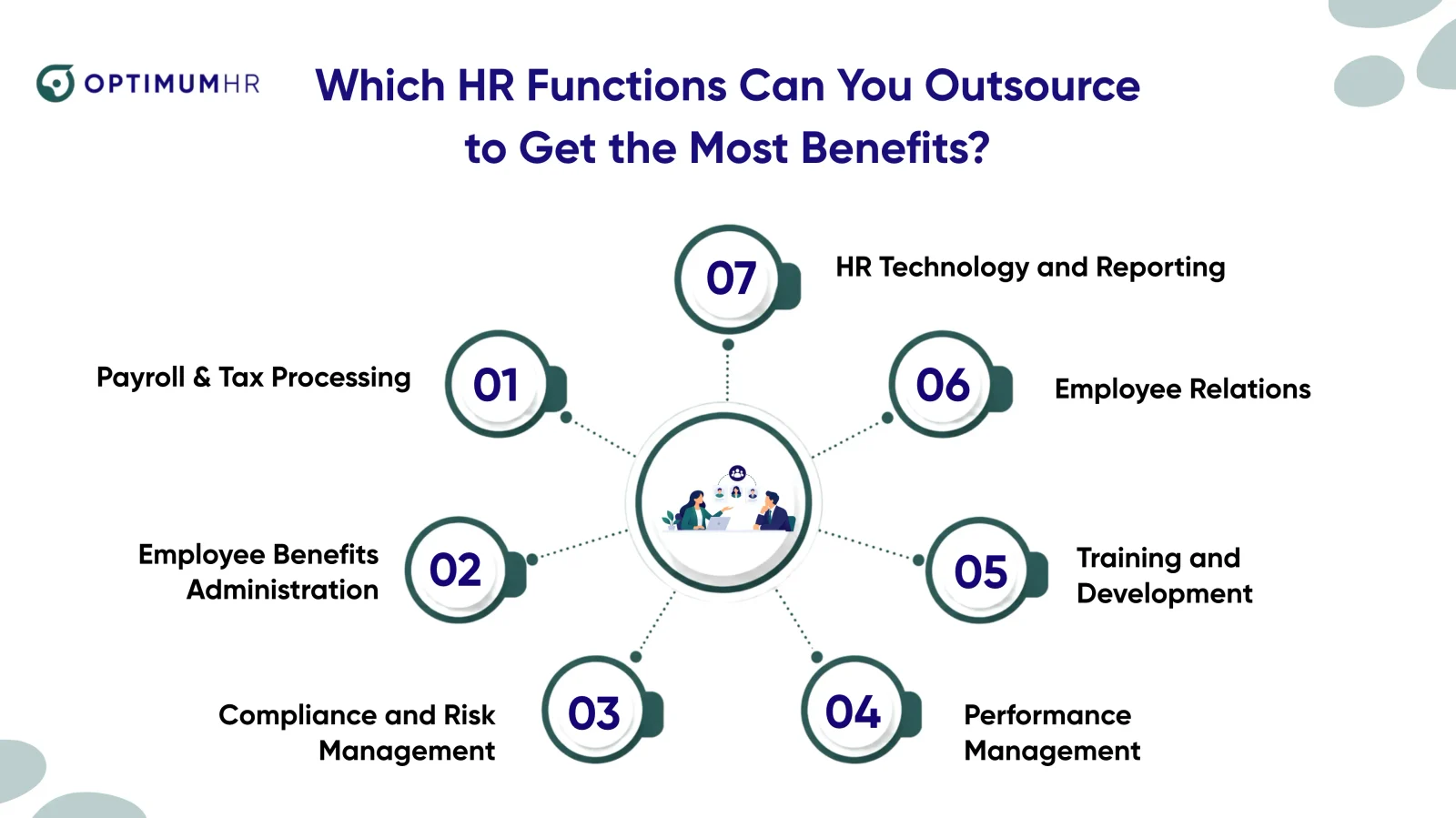
Businesses can outsource HR functions such as payroll, benefits administration, compliance, performance management, employee training, employee relations, and HR technology. Outsourcing these functions reduces administrative workloads, improves HR efficiency, and provides access to specialized expertise.
7 HR functions you can outsource to get the most benefits are:
- Payroll and Tax Processing
By outsourcing payroll and tax processing, SMBs can gain specialist support for wage calculations, employee payments, direct deposits, payroll tax administration, and recurring payroll records. HR outsourcing providers also manage payroll reporting and year-end documentation, such as W-2 forms, while supporting compliance with applicable payroll and tax regulations. Through standardized payroll procedures and automated systems, businesses can reduce manual payroll work, minimize calculation errors, and maintain consistent payroll operations without relying entirely on internal HR staff.
- Employee Benefits Administration
When businesses outsource employee benefits administration, they can manage health insurance, retirement plans such as 401(k), employee leave policies, and recurring benefits tasks through external HR providers. Depending on the arrangement, HR providers manage employee enrollment, eligibility, benefits records, plan administration, and communication with employees and insurers. This reduces administrative workloads, supports consistent benefits processes, and helps businesses meet applicable COBRA and Affordable Care Act requirements.
- Compliance and Risk Management
Outsourcing HR compliance and risk management provides businesses with specialist support for workplace policies, employment documentation, employee records, worker classification, payroll compliance, and leave administration. External HR providers monitor relevant employment requirements, review procedures, and identify compliance gaps. This support promotes consistent HR practices, reduces administrative errors, and helps businesses manage legal risks while retaining employer responsibility.
- Performance Management
If businesses outsource performance management, they can access structured processes for employee evaluations, goal setting, and continuous feedback. External HR providers support KPI tracking, 360-degree reviews, performance documentation, corrective action procedures, and performance improvement plans. They also guide managers through recurring evaluations, helping businesses maintain consistent performance standards, organized records, and fairer employee assessment processes.
- Training and Development
Training and development outsourcing allows SMBs to access professional learning programs, leadership development, and compliance training without building internal training resources. Through outsourced HR support, businesses can identify skill gaps, deliver technical and soft skills training, coordinate learning programs, and maintain employee training records. This approach reduces administrative workloads while supporting employee skill development and structured workforce training plans.
- Employee Relations
Outsourcing employee relations allows SMBs to manage workplace communication, employee complaints, grievance handling, and conflict resolution through structured HR procedures. With outsourced HR support, businesses can access manager guidance, maintain disciplinary documentation, address workplace concerns, and apply consistent policies. Such structured HR practices support fair handling of employee issues, reduce procedural inconsistencies, and promote a more stable work environment.
- HR Technology and Reporting
If SMBs outsource HR technology and reporting, they can access Human Resource Information Systems (HRIS), workforce reporting tools, and analytics without managing every system internally. Centralized HR platforms help businesses organize employee records, payroll data, benefits information, and reporting dashboards. These technologies reduce manual processes, improve workforce data visibility, and support organized HR administration and informed workforce planning.
What Types of HR Outsourcing Offer the Most Benefits?
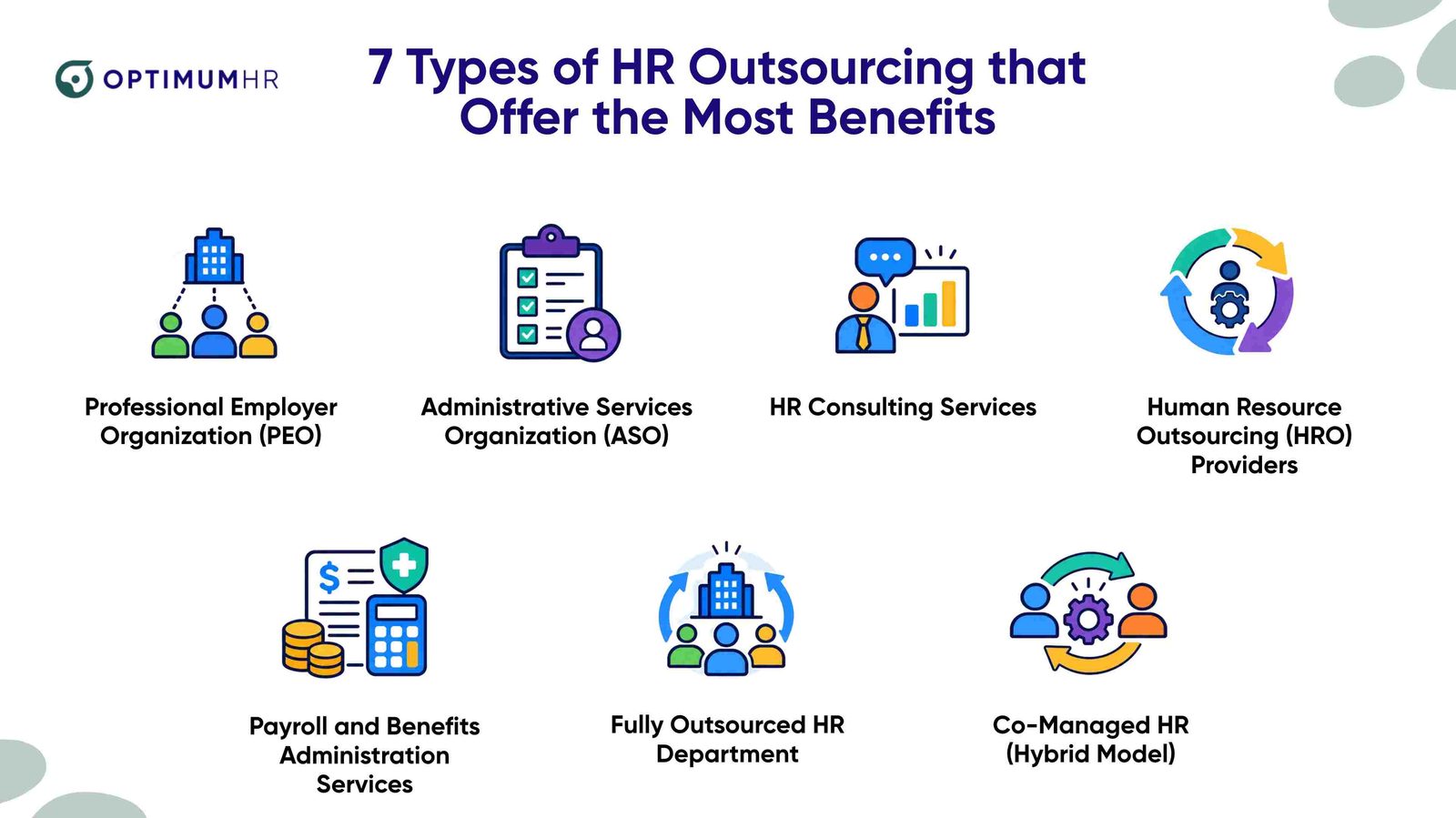
The main types of HR outsourcing include Professional Employer Organizations (PEOs), Administrative Services Organizations (ASOs), HR consulting services, Human Resource Outsourcing (HRO) providers, payroll and benefits administration services, fully outsourced HR departments, and co-managed HR (hybrid models). Each model offers different levels of support, helping businesses select HR services based on their workforce size, operational needs, and internal HR capabilities.
7 types of HR outsourcing that offer the most benefits are:
- Professional Employer Organization (PEO)
A Professional Employer Organization (PEO) is an HR outsourcing provider that manages payroll processing, employee benefits administration, HR operations, and compliance support through a shared employment responsibility arrangement. Under this model, the PEO handles agreed-upon HR responsibilities while businesses retain control over daily operations and employee management.
According to the National Association of Professional Employer Organizations (NAPEO) 2024 report, titled PEO Clients: Faster Growing, More Resilient Businesses with Lower Turnover Rates, businesses using PEO services experienced 12% lower employee turnover than comparable businesses. By combining multiple HR functions under one provider, PEOs help businesses streamline administration, maintain consistent HR processes, and access specialized HR support.
- Administrative Services Organization (ASO)
An Administrative Services Organization (ASO) provides outsourced HR administrative support while businesses retain their status as the sole legal employer and maintain responsibility for workforce management, employment taxes, and compliance. Unlike a PEO, an ASO allows businesses to select specific HR services based on their operational needs without sharing employer responsibilities.
Based on the services selected, an ASO can handle payroll processing, employee benefits administration, HR compliance support, risk management, personnel recordkeeping, and onboarding documentation. This flexible arrangement helps businesses reduce administrative workloads, access specialized HR support, and maintain direct control over employment decisions and HR operations.
- HR Consulting Services
HR consulting services provide businesses with specialized guidance on HR policies, employment law compliance, organizational challenges, employee relations, and workforce management strategies. Unlike full-service HR outsourcing, HR consulting focuses on advisory support or specific projects, such as developing employee handbooks, reviewing workplace policies, resolving employee disputes, improving performance management systems, and planning organizational changes.
Businesses can engage HR consultants for one-time projects, periodic consultations, or ongoing advisory support while retaining control over daily HR operations. This arrangement allows internal HR teams to address complex workforce issues, improve existing HR practices, and implement strategic HR initiatives without transferring routine administrative responsibilities to an external provider.
- Human Resource Outsourcing (HRO) Providers
Human Resource Outsourcing (HRO) providers help businesses reduce administrative workloads, improve HR efficiency, and access specialized support by managing one or multiple HR functions. Depending on business needs, HRO services can include payroll processing, benefits administration, recruitment, employee onboarding, compliance assistance, employee relations, and HR reporting.
Unlike HR consulting, which primarily offers advisory or project-based guidance, HRO providers manage agreed-upon HR operations on an ongoing basis. HRO also offers broader service coverage than payroll-only arrangements, allowing businesses to outsource individual HR processes or multiple functions while maintaining internal control over workforce management and strategic decisions.
- Payroll and Benefits Administration Services
Payroll and benefits administration services allow businesses to outsource recurring HR tasks, including wage calculations, tax withholding, payroll reporting, benefits enrollment, eligibility verification, employee deductions, and recordkeeping. Through standardized workflows and automated systems, service providers help reduce manual errors, maintain accurate records, and support timely payroll processing.
By outsourcing these administrative functions, businesses can reduce internal HR workloads without transferring their entire HR department. External providers handle agreed-upon payroll and benefits activities, while internal teams retain responsibility for employee management, workforce planning, and broader HR decisions.
- Fully Outsourced HR Department
A fully outsourced HR department allows businesses with limited or no internal HR infrastructure to delegate most recurring HR functions to an external service provider. These services typically include payroll processing, employee administration, benefits management, compliance support, recruitment, employee relations, and HR technology management.
Under this arrangement, businesses can access ongoing HR expertise without maintaining a complete internal department. Clear service agreements define provider responsibilities, decision-making authority, reporting procedures, and management oversight to maintain accountability and consistent HR operations.
- Co-Managed HR (Hybrid Model)
Co-managed HR helps businesses expand their existing HR capacity by combining internal HR teams with external outsourcing support. Under this hybrid model, internal HR teams manage strategy, company culture, leadership development, employee relations, and workforce decisions, while outsourcing providers handle payroll, benefits administration, compliance support, HR technology, and routine reporting.
This shared approach allows businesses to access specialized HR support and manage increasing workloads without replacing their internal HR departments. By dividing responsibilities based on operational needs, businesses can reduce administrative pressure, maintain consistent HR processes, and keep strategic workforce management under internal leadership.
What Potential Limitations Can Businesses Face When Outsourcing HR?
Businesses that outsource HR may face limitations, including reduced control over HR processes, employee data security and privacy risks, less personalized employee support, challenges aligning with company culture, difficulties transitioning providers, and limited flexibility in standardized HR services. These challenges can affect HR service quality, employee experience, and operational efficiency if businesses do not establish clear expectations and communication processes with their HR providers.
6 potential limitations businesses can face when outsourcing HR are:
- Shared Control Over HR Processes
HR outsourcing involves sharing responsibility for administrative tasks, workflows, and HR systems with an external provider. Businesses can maintain control over payroll adjustments, employee record updates, and benefits administration by establishing clear responsibilities and approval procedures. Defined communication channels and regular coordination help businesses maintain visibility into HR operations while benefiting from external expertise. The level of oversight depends on the outsourcing model, service agreement, and division of responsibilities.
- Employee Data Security and Privacy Considerations
HR outsourcing requires businesses to share sensitive employee information, including payroll records, tax details, benefits information, and personal data, with external providers. Businesses can protect this information by selecting providers with appropriate access controls, data protection policies, and secure information management practices. Reviewing security certifications, privacy procedures, and contractual safeguards helps businesses maintain confidentiality and support responsible employee data management.
- Maintaining Personalized Employee Support
Outsourced HR services can provide employees with access to dedicated HR representatives, support centers, and digital platforms. Businesses should ensure these services align with employee expectations and workplace requirements. Clear communication, accessible support channels, and coordination between internal managers and external HR representatives help maintain personalized assistance. Selecting a provider that understands workforce needs can support consistent employee experiences and satisfaction.
- Aligning Outsourced HR With Company Culture
Businesses can maintain cultural alignment by communicating their organizational values, workplace policies, and employee expectations to HR outsourcing providers. External providers often use standardized service procedures, making coordination important for maintaining consistent employee interactions and HR policy administration. Regular communication and clearly defined service expectations help outsourced HR teams support existing management practices, workplace relationships, and company culture.
- Planning a Smooth HR Provider Transition
Transitioning to an outsourced HR provider involves coordinating payroll migration, employee data transfers, benefits enrollment, technology integration, and workflow adjustments. Businesses can support a smooth transition by establishing implementation timelines, verifying employee records, and communicating procedural changes to their workforce. A structured transition plan and coordination with the provider help maintain payroll accuracy, benefits continuity, and consistent employee support throughout implementation.
- Flexibility of Standardized HR Services
HR outsourcing providers often use standardized technology platforms, reporting systems, workflows, and service packages to manage HR operations. Businesses should evaluate whether these services accommodate their workforce structure, payroll requirements, industry regulations, and reporting needs. Review customization options, system integrations, and service agreements before selecting a provider to identify suitable HR solutions. This approach supports operational compatibility while letting businesses plan for changing workforce needs.
How to Overcome the Challenges of HR Outsourcing?
Businesses can overcome HR outsourcing challenges through clear contracts, secure providers, regular performance reviews, strategic HR control, transparent pricing, cultural alignment, planned transitions, and customizable services. These measures help reduce operational risks, maintain service quality, and ensure outsourced HR functions meet business requirements.
Below are 8 key measures to overcome HR outsourcing challenges:
- Define Clear Service Expectations in the Contract
Specify HR responsibilities, service deliverables, response times, and performance standards in the outsourcing contract. Include service-level agreements (SLAs), accountability measures, and dispute resolution procedures to prevent misunderstandings.
- Choose a Provider With Proven Data Security Practices
Select an HR outsourcing provider with verified data security controls, access restrictions, and employee information protection procedures. Review security certifications, privacy policies, confidentiality agreements, and incident response protocols before sharing sensitive employee data.
- Set Up Regular Reporting and Performance Reviews
Establish regular reporting schedules to monitor payroll accuracy, employee support, compliance activities, and service delivery. Evaluate provider performance against agreed KPIs and address service gaps through scheduled review meetings.
- Keep Control Over Key Strategic HR Decisions
Retain internal authority over workforce planning, hiring strategies, employee relations policies, and organizational decisions. Clearly assign operational responsibilities to the HR provider while keeping strategic decisions under company management.
- Ask for Transparent Pricing Before Signing
Request a detailed pricing breakdown covering service fees, implementation costs, additional charges, and contract renewal terms. Compare pricing structures and clarify potential expenses before signing the HR outsourcing agreement.
- Select a Provider That Understands Your Company Culture
Choose an HR provider familiar with your organization’s values, communication practices, management approach, and employee expectations. Discuss workplace policies and employee support requirements to ensure outsourced HR services align with company culture.
- Plan the Transition With a Clear Implementation Timeline
Create an implementation timeline covering payroll migration, employee data transfers, benefits setup, system integrations, and staff communication. Assign responsibilities, establish deadlines, and verify transferred information to minimize operational disruptions.
- Choose Flexible Services That Can Be Customized
Select an HR outsourcing provider that offers customizable service packages, workflows, reporting options, and technology integrations. Confirm that the provider can accommodate specialized workforce requirements, complex HR processes, and changing business needs.
When Should a Business Consider Outsourcing HR?
A business should consider outsourcing HR when growing workloads, compliance challenges, payroll errors, hiring delays, employee turnover, administrative demands, multi-state expansion, or limited budgets strain its internal HR resources. Outsourcing HR allows businesses to access specialized HR expertise, reduce administrative burdens, improve compliance, and manage workforce operations without hiring additional in-house HR staff.
- Your HR Workload Has Outgrown Your Current Team: Consider outsourcing HR when your existing team struggles to manage employee records, payroll, recruitment, and daily HR responsibilities efficiently.
- You Are Struggling to Keep Up With Changing Labor Laws: Outsource HR support when your business lacks the expertise or resources to monitor labor law changes and maintain regulatory compliance.
- Payroll or Benefits Errors Are Becoming Frequent: Seek external HR support when recurring payroll mistakes, delayed payments, or benefits administration errors affect employees and business operations.
- Hiring Is Slow or Taking Too Long to Fill Roles: Consider HR outsourcing when recruitment delays leave positions vacant, increase employee workloads, or disrupt business operations.
- Employee Turnover Is Rising: Evaluate HR outsourcing when frequent employee departures indicate a need to improve onboarding, employee relations, and retention practices.
- Owners or Managers Spend Too Much Time on HR Tasks: Delegate HR responsibilities when payroll processing, employee documentation, and administrative tasks prevent managers from focusing on core business activities.
- You Are Expanding Into New Locations or States: Consider outsourcing HR when expanding into new states or locations requires managing different employment laws, payroll regulations, and workforce policies.
- You Cannot Afford a Full-Time In-House HR Team: Choose outsourced HR services when your business needs professional HR support but cannot justify the cost of hiring and maintaining a full-time HR department.
How Much Does HR Outsourcing Cost?
HR outsourcing costs range from $45 to $200 per employee per month (PEPM). Several factors affect pricing, including business size, employee count, service scope, HR support requirements, and workforce complexity. Additional charges may apply for payroll processing, benefits administration, regulatory compliance, and employee management services.
PEO pricing is typically structured as either a percentage of payroll or a per-employee-per-month (PEPM) fee. Optimum HR generally uses a PEPM pricing model, which provides predictable administrative costs without automatically increasing fees as payroll grows. The typical administrative fee ranges from $100 to $150 per employee per month, depending on workforce size, benefits requirements, workers’ compensation exposure, and the scope of HR services. Contact Optimum HR for a customized quote based on your business needs.
How to Choose the Right HR Outsourcing Partner?
To choose the right HR outsourcing partner, evaluate the provider’s industry experience, range of HR services, labor law compliance expertise, pricing structure, and customer support. Check whether the provider offers payroll processing, benefits administration, recruitment assistance, and employee management services that match your business needs. Review client feedback, service agreements, and technology capabilities before selecting a provider that supports your workforce requirements and business growth.