
HR outsourcing (HRO) provides small and mid-sized businesses (SMBs) with a strategic approach to managing human resources by reducing costs, improving compliance, increasing operational efficiency, and freeing internal teams. By transferring human resource functions such as payroll, recruitment, and benefits administration to specialized HR service providers, SMBs reduce administrative workload and convert fixed overhead into scalable costs. This shift also aligns with broader market trends, as a report by Grand View Research shows the global HR outsourcing market is growing at a CAGR of 12.8% through 2030, driven by SMB demand for AI-driven recruitment and predictive talent analytics.
Beyond operational gains, HR outsourcing strengthens workforce management and long-term scalability, offering SMBs specialized HR expertise, advanced technology, and data-driven insights that improve hiring, talent development, and employee engagement. Structured HR processes enhance recruitment efficiency, support employee experience, and align performance management with business goals. These benefits of outsourcing HR allow SMBs to scale operations, improve decision-making, and maintain a competitive position while building a more agile, compliant, and high-performing workforce.
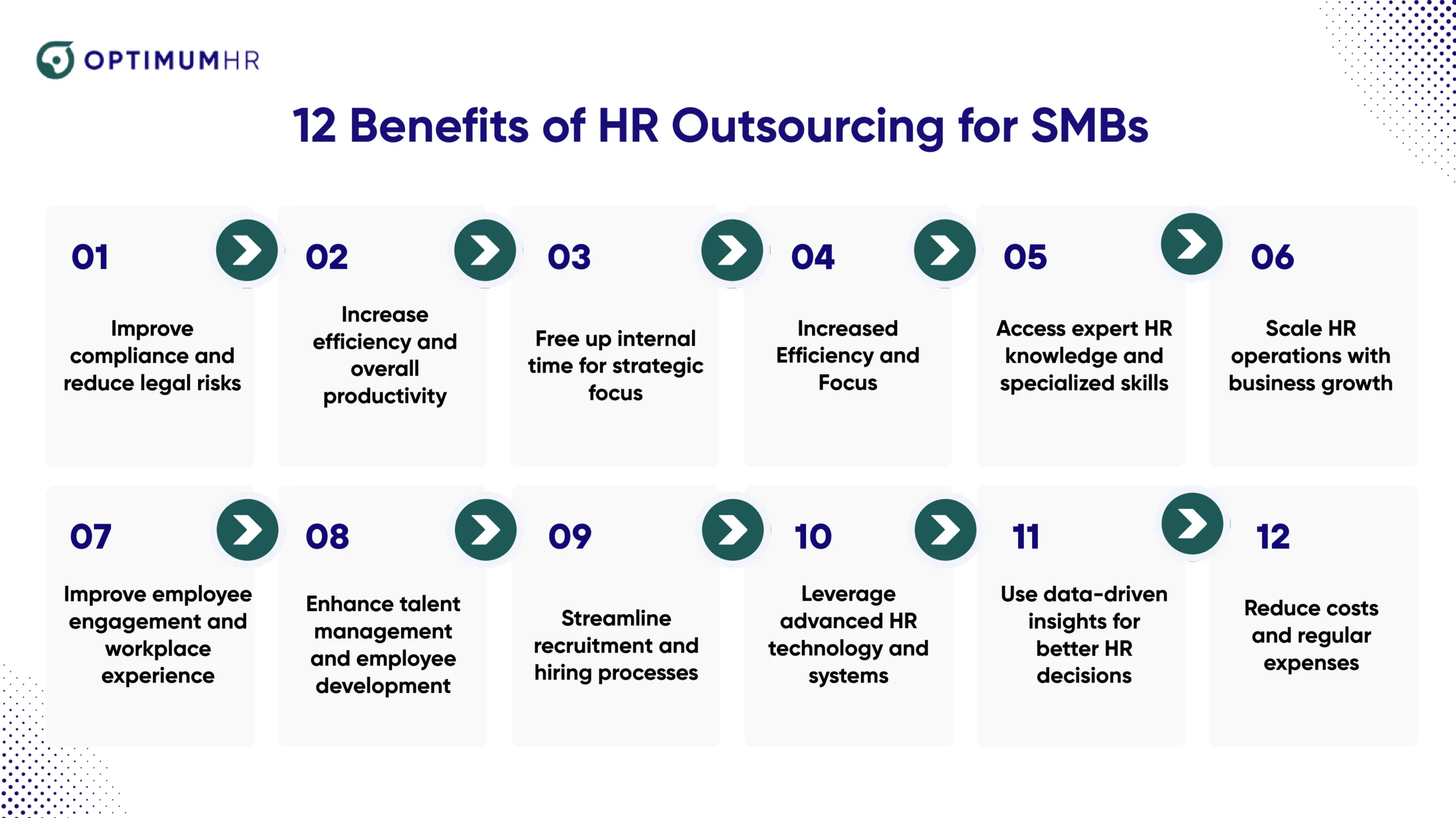
Top 12 benefits of outsourcing HR are:
- Improve compliance and reduce legal risks
- Increase efficiency and overall productivity
- Free up internal time for strategic focus
- Increased Efficiency and Focus
- Access expert HR knowledge and specialized skills
- Scale HR operations with business growth
- Improve employee engagement and workplace experience
- Enhance talent management and employee development
- Streamline recruitment and hiring processes
- Leverage advanced HR technology and systems
- Use data-driven insights for better HR decisions
- Reduce costs and regular expenses
Improve compliance and reduce legal risks
HR outsourcing enhances compliance and reduces legal risks for SMBs by providing specialized expertise to navigate complex, evolving labor laws, including OSHA, EEO, and wage-and-hour regulations. SMBs often face significant penalties for errors in employee classification or tax filings, but outsourcing HR establishes a structured compliance framework to ensure consistent regulatory adherence. These outsourcing benefits give smaller businesses access to the level of oversight that larger organizations maintain.
To achieve this risk reduction, human resources service providers proactively update their records to reflect regulatory requirements and maintain accurate documentation, including personnel records, I-9 verifications, and safety reports. They conduct compliance audits and provide management training on workplace policies, such as harassment and discrimination, to identify risks early. Many HROs also offer indemnification as part of their service scope, which shifts liability away from the business and ensures that payroll and benefits administration remain legally compliant.
Increase efficiency and overall productivity
By offloading SMBs’ administrative burdens, such as payroll, benefits, and compliance to specialists, HR outsourcing frees internal teams to focus on growth, which leads to higher efficiency and productivity. Tasks like payroll, which can consume up to 18% of administrative time, are automated and managed by providers, reducing paperwork and manual effort. This benefit of outsourcing HR allows employees to prioritize revenue-generating activities instead of time-consuming HR processes.
Reports from Deloitte indicate that SMBs outsourcing administrative functions can achieve around 32% improvement in operational efficiency by reducing back-office workload. Human resource service providers also use specialized HR technology to streamline employee management and reduce administrative errors by up to 51%, reinforcing the advantages of outsourcing HR. This structured approach improves hiring speed, enhances employee experience, and reduces operational delays. By transferring routine HR tasks to external experts, SMB leadership removes internal bottlenecks and maintains focus on strategic priorities.
Free up internal time for strategic focus
For SMBs, a human resources service provider frees up valuable internal time by outsourcing routine HR tasks, such as payroll, compliance management, and employee record-keeping, to a third party. These HR functions often consume significant administrative hours, limiting internal teams’ ability to focus on higher-value work. By removing these time-consuming responsibilities, SMBs can redirect resources toward strategic priorities such as business growth, workforce planning, and improving customer service operations.
HRO also creates a stronger strategic focus across the organization by allowing leadership to prioritize long-term initiatives while aligning HR functions with business goals through structured processes. Research from the National Association of Professional Employer Organizations shows that businesses that outsource HR spend about 21% more time on strategic activities, which supports faster market expansion. At the same time, HR outsourcing benefits also allow employees to experience higher engagement as teams focus on meaningful work rather than administrative tasks.
Increased Efficiency and Focus
Outsourcing HR services benefits SMBs by offloading time-consuming administrative tasks such as payroll and benefits administration to external experts. By delegating these routine functions, SMBs can shift their internal focus toward core competencies and revenue-generating activities like product development and customer service. This transition replaces fragmented, manual processes with automated workflows and advanced HRIS platforms, ensuring tasks are processed faster and with higher accuracy.
Access to specialized expertise and technology, further enhanced by HRO, provides better data visibility and stronger employee management. By reducing the administrative burden of onboarding and benefits, leadership can move away from daily burden to concentrate on high-impact business strategies and innovation. The benefits of HR outsourcing reduce overhead and eliminate operational bottlenecks, allowing SMBs to remain agile while accelerating overall productivity and long-term growth.
Access expert HR knowledge and specialized skills
Outsourcing HR services provides instant access to seasoned professionals, specialized skills, and advanced technology, enabling small and midsize businesses to operate like large enterprises. Instead of relying on a single generalist, outsourcing benefits ensures SMBs gain on-demand expertise in recruitment, benefits administration, and employee relations. This access allows SMBs to implement structured HR practices and use advanced HRIS platforms without the cost of hiring multiple specialists or purchasing separate systems.
HR outsourcing also strengthens compliance and strategic execution by ensuring continuous monitoring of labor laws and regulatory requirements at the federal, state, and local levels, thereby reducing the risk of litigation and penalties. Providers deliver tailored HR strategies that improve employee engagement and performance management. By shifting focus from administrative tasks to strategic support, outsourcing HR helps SMBs improve workforce outcomes and maintain a competitive position in the talent market.
Scale HR operations with business growth
Unlike static in-house HR departments that require months to expand, HR outsourcing provides the on-demand agility needed for rapid scaling. For SMBs, the transition from a small team to a large workforce often creates operational bottlenecks. HR outsourcing eliminates these constraints by offering a modular infrastructure that expands alongside your headcount. According to the Bureau of Labor Statistics, businesses that outsource HR functions can reduce their time spent on administrative tasks by over 40%, directly accelerating their ability to focus on market expansion.
Strategic HR outsourcing enables businesses to enter new markets without the friction of local regulatory hurdles. Providers offer scalable, location-aware solutions that automatically manage multi-state tax withholding and jurisdiction-specific labor laws. These benefits of outsourcing HR allow SMB owners to convert fixed personnel costs into variable operating expenses, ensuring the HR foundation supports long-term revenue objectives.
Improve employee engagement and workplace experience
HR outsourcing enhances employee engagement and the overall workplace experience in SMBs by delivering expert-level services, including structured onboarding, enhanced benefits, and modern HR technology. Since many SMBs struggle to maintain consistent employee support, outsourcing benefits improve communication and service delivery across the employee lifecycle through standardized systems. Research from the National Association of Professional Employer Organizations shows that businesses using outsourced HR models experience 10% to 14% lower employee turnover and higher employee satisfaction.
Outsourced HR service providers further strengthen workplace experience through tailored engagement strategies and efficient service management. They design onboarding programs that reduce early-stage attrition, provide comprehensive benefits, and implement performance management systems that support employee growth. Faster issue resolution and reduced administrative workload allow managers to focus on meaningful employee interactions, which strengthen workplace relationships and reinforce company culture.
Enhance talent management and employee development
For SMBs, HR outsourcing enhances talent management from a reactive administrative task into a proactive growth strategy. Internal HR teams often remain occupied with payroll and compliance, which limits their ability to build structured career paths or mentorship programs. By offloading routine HR functions, businesses can focus on leadership training, performance coaching, and workforce planning. A Gartner study indicates that organizations, including SMBs, outsourcing administrative HR functions can improve talent management effectiveness by up to 30% through more consistent development practices.
The benefits of outsourcing HR further strengthen this approach by introducing enterprise-grade training platforms and modern performance management systems. These tools create clear development roadmaps for employees, which support retention and long-term growth. With standardized onboarding and faster issue resolution, managers can prioritize mentorship over administrative tasks, helping SMBs build a skilled workforce aligned with innovation and business objectives.
Streamline recruitment and hiring processes
HR outsourcing streamlines recruitment and hiring processes by providing structured talent acquisition systems and access to experienced recruiters. Hiring internally often involves fragmented workflows, delayed candidate screening, and inconsistent evaluation methods. Outsourced HR providers manage end-to-end recruitment, including job postings, candidate sourcing, screening, and onboarding, using standardized processes. This approach reduces time-to-hire and ensures SMBs consistently attract qualified candidates aligned with role requirements.
The benefits of outsourcing human resources also include hiring efficiency through advanced recruitment tools and data-driven strategies. They use applicant tracking systems, talent pipelines, and market insights to identify suitable candidates faster and reduce hiring errors. According to the Society for Human Resource Management (SHRM), organizations that utilize outsourced recruitment models can reduce their overall time-to-hire by 40%. Faster onboarding and improved candidate experience help SMBs secure top talent while allowing internal teams to focus on core business operations.
Leverage advanced HR technology and systems
Another benefit of outsourcing HR services includes access to advanced HR technology and systems without investing in expensive infrastructure or software licenses. Access to sophisticated Human Resource Information Systems (HRIS) enables businesses, including SMBs, to automate repetitive tasks such as time tracking, benefits administration, and document storage, ensuring data accuracy and security. These platforms provide a centralized single source of truth, which is essential for maintaining compliance and enabling employees to use modern self-service capabilities.
Modern HR platforms also provide a centralized system that serves as a single source of truth, supporting compliance and enabling employee self-service capabilities. In addition, built-in AI tools and predictive features help identify issues in payroll or onboarding before they escalate. Through software-as-a-service models, SMBs access enterprise-level security, encryption, and audit trails, which ensure reliable and scalable HR operations.
Use data-driven insights for better HR decisions
One of the major advantages of human resource outsourcing is the shift toward data-driven HR, which moves decision-making from intuition to evidence-based strategy. By tracking key metrics such as turnover rates, time-to-hire, and training ROI, businesses can identify performance gaps and areas that require improvement. Research by Zalaris shows that companies using HR analytics report up to a 58% improvement in operational efficiency, demonstrating the measurable value of structured workforce data.
A data-centric approach improves decision quality across hiring, performance management, and workforce planning. Data-driven systems support objective evaluations, which help reduce bias in promotions and compensation decisions. Advanced dashboards convert workforce data into actionable insights, allowing leaders to align HR strategies with business goals. With real-time visibility, SMBs can respond to workforce challenges faster and plan future talent needs more effectively, supporting long-term growth and operational stability.
Reduce costs and regular expenses
Unlike traditional in-house HR models that require heavy investment in internal personnel, HRO treats human resources as a scalable, variable cost rather than a fixed overhead. For many SMBs, maintaining a full HR department is costly, while outsourcing allows businesses to pay only for the HR services they need. Studies from SHRM indicate that businesses, including SMBs, often experience 27% or more reduction in HR costs, while labor arbitrage can deliver 30-50% savings.
Strategic HRO for SMBs also reduces hidden expenses such as dedicated salaries, payroll taxes, and HR software licenses by leveraging economies of scale, in which providers use bulk purchasing power to secure competitive rates for employee benefits and workers’ compensation. In addition, HRO automates repetitive tasks such as tax filing and payroll processing, reducing administrative effort and improving cost efficiency while protecting SMBs from costly IRS penalties and legal risks.
What Types of HR Functions Can Be Outsourced?
Types of HR functions that can be outsourced include payroll and tax processing, recruitment and hiring, employee benefits administration, performance management, training and development, and employee relations. These outsourced HR functions collectively cover the full employee lifecycle, allowing SMBs to streamline HR operations, improve compliance, and access specialized expertise through a third-party provider.
6 types of HR functions that can be outsourced are:
- Payroll and tax processing
- Recruitment and hiring
- Employee benefits administration
- Performance management
- Training and development
- Employee relations
Payroll and tax processing
By outsourcing payroll and tax processing, SMBs gain end-to-end support for wage calculations, direct deposits, and tax filings. This outsourced HR function also covers year-end reporting, such as W-2s, and ensures compliance with changing tax regulations and payroll laws. As a result, SMBs reduce payroll errors, avoid penalties, and maintain accurate financial operations without requiring dedicated in-house payroll expertise.
Recruitment and hiring
For SMBs, outsourcing recruitment and hiring improves efficiency and candidate quality by leveraging specialized HR teams to manage job postings, sourcing, screening, interviewing, and onboarding. It also includes job description optimization, background checks, and salary benchmarking. One of the major benefits of outsourcing HR functions here is reduced time-to-hire and better hiring decisions, which helps SMBs avoid the financial and operational impact of a poor hire.
Employee benefits administration
Employee benefits administration outsourcing enables SMBs to efficiently manage health insurance, retirement plans such as 401(k), leave policies, and COBRA compliance. Within this outsourced HR function, HRO providers handle open enrollment and coordinate with insurance carriers to ensure compliance with regulations such as the Affordable Care Act. This structured approach allows SMBs to offer competitive, large-company benefits at reduced cost, making it one of the crucial benefits of outsourcing HR functions.
Performance management
Outsourcing performance management provides SMBs with structured systems for employee evaluations, goal setting, and continuous feedback aligned with business objectives. These services use modern tools to track KPIs, conduct 360-degree reviews, and manage performance improvement plans. This approach creates a more consistent and data-driven evaluation process, reducing bias in promotions and compensation decisions and lowering potential legal risks.
Training and development
Training and development outsourcing gives SMBs access to professional learning programs and leadership training without having to build internal resources. Providers assess skill gaps and deliver targeted content, including technical certifications and soft skills training, through digital platforms or expert-led sessions. As a result, employees gain relevant skills, retention improves, and SMBs build a more adaptable workforce capable of responding to evolving industry demands.
Employee relations
Outsourcing employee relations helps SMBs maintain consistent and compliant management of workplace communication, conflict resolution, grievance handling, and policy enforcement. HRO providers ensure that employee issues are addressed in a structured and legally compliant manner, reducing risk and improving workplace stability. This approach supports a more positive work environment and strengthens overall employee engagement across the organization.
How Much Does HR Outsourcing Cost?
HR outsourcing costs range from $45 to $1,500+ per employee per month (PEPM), with most SMBs paying around $70-$180 PEPM for partial HR services. Pricing models for HR outsourcing commonly include a flat fee per employee or a percentage of payroll (2-5%). Overall, HR outsourcing costs vary based on factors such as company size, industry requirements, and the scope of services, whether businesses choose comprehensive PEO solutions or more limited ASO support.
Optimum HR offers HR outsourcing services through a structured PEO model, providing dedicated HR support for hiring, onboarding, payroll, benefits, compliance, and employee management. The pricing structure follows a PEPM model, which improves cost predictability and prevents expenses from scaling directly with payroll growth. Standard administrative PEO services with Optimum HR range from $100 to $150 per employee per month and include full-service HR management, compliance support, risk management, payroll administration, and workers’ compensation coverage, offering a more comprehensive solution than basic PEO packages.
Why HR Outsourcing is Growing in 2026?
HR outsourcing is growing, driven by the need to integrate enterprise AI, manage complex regulatory compliance, and cut costs by up to 40% amid economic uncertainty. Businesses are increasingly relying on external HR partners to handle AI-powered talent acquisition, remote workforce management, and advanced analytics, which shifts HR from an administrative function to a strategic driver of growth. By delegating operational tasks, companies free internal resources for innovation, employee engagement, and long-term planning.
Growth for HR outsourcing is further accelerated by key trends shaping the modern workforce. AI-driven platforms automate entire HR processes, while outsourcing provides scalable cost structures that reduce fixed overhead. Rising regulatory complexity and global hiring demands encourage the use of Employer of Record models and compliance-focused providers. At the same time, demand for real-time insights and personalized employee experiences positions HR outsourcing as a critical component of modern business strategy.
How to Choose the Right HR Outsourcing Partner?
To choose the right HR outsourcing partner, focus on evaluating service scope, expertise, compliance strength, technology, and support quality to ensure alignment with your business goals. Following these steps ensures you choose the right HR outsourcing partner for your SMB that aligns with your needs and long-term business goals.
Here is a step-by-step process to choose the right HR outsourcing partner:
- Define Your HR Needs: Identify which HR functions you want to outsource, such as payroll, recruitment, compliance, or full-service HR management.
- Evaluate Service Offerings: Compare HRO service providers based on whether they offer comprehensive solutions (PEO) or limited administrative support (ASO).
- Assess Industry Experience: Choose an HRO provider with proven experience in your industry to ensure they understand relevant compliance requirements and workforce challenges.
- Review Compliance Capabilities: Confirm the HRO provider can manage labor laws, tax regulations, and risk management to reduce legal exposure.
- Analyze Technology and Tools: Ensure access to HRIS platforms, payroll systems, and reporting tools that improve efficiency and data visibility.
- Compare Pricing Models: Review pricing structures, such as per-employee-per-month or a percentage of payroll, to ensure cost predictability.
- Check Support and Responsiveness: Evaluate the quality of customer support, response times, and the availability of dedicated account managers.
- Verify Reputation and Performance: Review client testimonials, retention rates, and performance metrics, including service reliability and satisfaction scores.
- Request a Demo or Consultation: Test the HRO provider’s systems and approach to confirm compatibility with your business processes.
- Ensure Scalability and Flexibility: Select an HR outsourcing partner that can adapt as your business grows and HR needs evolve.

